To price vintage clothing, first confirm what the piece is and roughly when it was made. Then find recent sold listings for the same item in similar condition, adjust for flaws and venue, and set your price from that evidence. Asking prices and original retail prices are weak guides. Completed sales show what buyers actually paid.
This guide walks through that process: dating the garment, reading the factors that move value, finding comps, pricing when comps are thin, and knowing when to change a price.
TL;DR
- Identify and date the piece first. A wrong era or brand makes every comp you pull wrong too.
- Price from completed sales, not asking prices or retail. Match brand, era, size, condition and style.
- Scarcity, condition, label, era, colour, repairs and where you sell can all change the price materially.
- When comps are scarce, use the closest sold category, then watch how fast the piece sells and adjust.
- Save your comps with links so you can defend a price to a buyer or reuse it later.
Table of Contents
- What counts as vintage, and why it matters for price
- Date the garment before you price it
- What moves the price of a vintage piece
- How to find vintage comps from completed sales
- A worked example
- Pricing when comps are thin
- Venue changes the number
- Demand: what to watch
- Buying and collecting: the same method in reverse
- Price a batch faster with PriceXPoint
- Common mistakes to avoid
- FAQ
- Sources
What counts as vintage, and why it matters for price
The label "vintage" affects who looks at your listing and what they expect to pay. The common definition is an item at least 20 years old but under 100, which currently covers roughly the 1920s through the early 2000s. The same source notes that the term is elastic: each generation adds its own past to the list.
Two neighbors are worth separating:
- Archival pieces are specific items from a designer's or brand's past collections. They may not meet the age threshold yet but can still sell as collectible.
- Retro or "vintage-style" items are made recently to look old. They price as new or used contemporary clothing, not as vintage.
If you are unsure which bucket a piece falls into, that is the first thing to settle. A 1990s band tee and a 2022 reproduction of one can look nearly identical in a photo and sell for very different amounts.
Date the garment before you price it
Comps only work when you search for the right thing. Dating is the step most beginners skip, and it is where a lot of mispricing starts.
Clues that narrow the era
The Vintage Fashion Guild's quick tips for dating vintage point to several physical clues:
- Zipper type. Different zipper styles and makers belong to different periods.
- Union labels. The design of a union label changed over time, so it helps bracket a date.
- Fiber-content labeling. Whether and how fiber content is printed is a dating clue.
- Construction. Seam finishes, stitching and how the garment is put together all carry information.
- Brand label changes. Label redesigns, including the tabs on classic denim, help narrow the period.
Look at several clues together. One detail alone rarely settles it.
Read labels with care
Labels are useful, but they mislead in predictable ways. Museum guidance on dating garments cautions that a manufacturer or retailer may keep an outdated address on its labels after moving, and that historical fonts may be retained or revived. Treat a label as a lead, not a verdict.
In practice, a label tells you the earliest a piece could have been made. Factories often used up old label stock after a new design arrived, so a garment can be a little newer than its tag suggests. Cross-check with the zipper, the construction and the style of the cut.

If the label, designer or provenance is part of what makes the piece valuable, it is worth verifying with the same care a watch buyer applies to a dial and movement. This guide to checking a vintage watch shows the mindset: confirm what is original, what has been replaced and what the paperwork actually proves before you attach a price to it.
Identifying the item itself
If you cannot name the piece (brand, line, style), you cannot search for it. Start with whatever is printed or sewn in: brand, care tag, size tag, copyright line, country of manufacture. For graphic tees, the print copyright date and the hem stitching are the usual starting points. When the tag is gone, describe the item in plain words ("1980s satin bomber, embroidered back, snap closure") and search with those. A photo-based tool can also propose an identification that you then confirm or correct yourself.
What moves the price of a vintage piece
The Vintage Fashion Guild's overview of how vintage clothing is priced lists the factors that can materially change a garment's price. Here they are as a working checklist:
| Factor | What to ask | Effect on price |
|---|---|---|
| Scarcity | How often does this piece show up for sale? | Rarer pieces can command a premium |
| Condition | Stains, holes, odor, fading, missing buttons? | Flaws pull the price down, and mint pieces lift it |
| Quality | Fabric, stitching, weight, lining? | Well-made pieces hold value |
| Label or designer | Is the maker sought after? | Desirable labels carry more |
| Era | Is the decade in demand? | Some periods are more wanted than others |
| Colour | Is this a popular or unusual colorway? | Can swing demand either way |
| Repair work | What will it take to make it wearable? | Required work lowers what a buyer will pay |
| Venue | Where are you selling it? | The same piece can price differently by platform |
| Desirability | Is anyone actively looking for it? | Hype and trends move prices |
Provenance matters too. A documented history, such as an original receipt, a known first owner or a connection to an event, can justify a higher number, though only when a buyer can see the evidence.
The practical lesson: two garments that look alike can sit at very different prices. Your comps need to match on as many of these factors as you can manage, not just on brand and category.
How to find vintage comps from completed sales
"Comps" are comparable items that recently sold. They are the closest thing vintage has to a price list.
Why sold beats asking
An asking price is a hope. A sold price is a fact. Sellers list vintage at inflated numbers all the time, and those listings sit unsold for months. If you average them, you overprice. For a deeper look at the idea, see our guide to pricing antiques using sold prices, which applies the same logic to older goods.
A five-step comp process
- Name the item precisely. Brand, style, decade, size, material, and any print or pattern.
- Search completed or sold listings. Use the sold filter on each marketplace you can access. Ignore active listings except as a rough ceiling.
- Match on condition and size. A size small and a size XL of the same tee can sell at different prices. So can a faded piece and a crisp one.
- Collect five to ten sales. Throw out the clear outliers (a bidding war, a damaged piece, a bundle) and look at the cluster that remains.
- Record the range and the links. Save the low, middle and high sold prices and where each came from.
That middle cluster is your working price. Your piece's condition, size and rarity decide whether you sit at the bottom, middle or top of it.
Watch for bad data
Three things routinely distort comps:
- Misidentified items. A reproduction listed as the original makes the original look cheaper than it is.
- Bundles and lots. A lot of ten pieces tells you nothing about a single one.
- Best-offer listings. The listed price is often not the price paid.
This is where manual research gets slow. We built PriceXPoint to pull sold, asking and new listings from several marketplaces in one place, filter out misleading entries, and link each estimate to the sales behind it, so you can check the evidence yourself.
A worked example
Suppose you find a 1990s graphic tee with a single-stitched hem in good condition.
- You read the tag and the copyright line on the print, and check the hem and neck construction to confirm the era.
- You search sold listings with the brand, graphic, decade and size.
- You gather eight sales. Six land close together. One is far higher (a bidding war) and one is far lower (stained).
- You drop those two and note the range of the six.
- Your piece has no flaws and is a popular size, so you price in the upper half of that range and leave a little room for offers.
The numbers will differ for every item. What stays the same is the sequence: identify, date, pull sold comps, filter, adjust.
Pricing when comps are thin
Some pieces rarely sell. You may find two sales, or none. A few approaches help:
- Widen one factor at a time. Look for the same brand and era in a different style, or the same style in an adjacent decade. Note how much you moved.
- Prefer completed sales over retail. Guidance for resale shops says that when comparable sales are limited, completed sales are a better anchor than original retail price.
- Price in a range, then watch. Start at a defensible number, and track how many days it takes to sell.
- Use similar categories. For accessories, see how to price costume jewelry. For one-of-a-kind pieces, the approach in pricing collectibles with real sold prices transfers well.
When to change the price
The same consignment guidance suggests tracking sell-through and average days to sell. If your inventory keeps reaching the markdown stage, your starting prices are likely too high. If comparable categories sell at full price quickly, you may be leaving money on the table. Set a rule up front, such as reviewing any piece that has not sold after a fixed number of weeks, and apply it consistently.
To understand how sell-through works with sold data, read how to verify sold data before calculating sell-through rate.
Venue changes the number
The place you sell is one of the factors on the list above, and it deserves its own attention. Buyers on a fashion-focused app expect different prices than buyers browsing a general auction site or walking into a thrift aisle. A piece may sell faster at a lower price on one platform and slower at a higher price on another.
Platform-specific guides help here:
- For app-based fashion selling, see our Poshmark pricing strategy and how to find Poshmark sold listings.
- For handmade-adjacent or reworked vintage, see the Etsy pricing strategy playbook.
- For in-store pricing, see thrift store pricing.
Pull comps from the venue where you plan to list whenever you can. If you use sold data from a different platform, remember to account for fees and shipping on both.
Demand: what to watch
Demand moves prices, and it changes. Trends, media attention and generational nostalgia can lift a decade or a brand for a while and then fade. Since the definition of vintage keeps moving forward, as noted above, pieces from the late 1990s and early 2000s now sit inside it, and buyers are shopping for them.
You do not need a forecast. You need current sold data. If recent sales for a style are frequent and prices are rising, demand is healthy. If sales are rare and prices have drifted down, price more cautiously. Re-checking comps before each listing, rather than relying on last season's number, is the simplest way to keep up.

Buying and collecting: the same method in reverse
If you are a buyer or collector, the process works the same way. Before you pay a premium, check that the item is what the seller says, that the era fits the labels and construction, and that the price sits within the sold range for that condition. If a seller's asking price is far above the recent sold cluster, you have grounds to offer lower. If it sits near the low end for a clean piece, it may be a good buy.
Our perspective
Vintage pricing goes wrong when people trust the wrong number: a retail price from memory, an optimistic asking price, or a sold price for a different item. We built PriceXPoint around one idea: a price is only useful if you can see the sales behind it.
That is why our estimates link to actual sold listings from several marketplaces, name every data source, and refuse to show a figure without supporting evidence. We think that transparency matters most in vintage, where one misread label can shift an item by a wide margin. So we let you verify and correct the item identification before you rely on the result.
We also think speed matters. A reseller sorting a bag of finds or a collector checking a single piece should not have to open a dozen tabs. Snap a photo or type the name, and see sold, asking and new listings in one view, with unreliable listings filtered out.
PricexPoint
Price a batch faster with PriceXPoint
If you are sourcing in volume, PriceXPoint can identify items from a photo or a name, show sold, asking and new prices across multiple marketplaces, and link each estimate to its sources. You can price many items at once with a CSV or a multi-item photo, and save your scan history with export options.
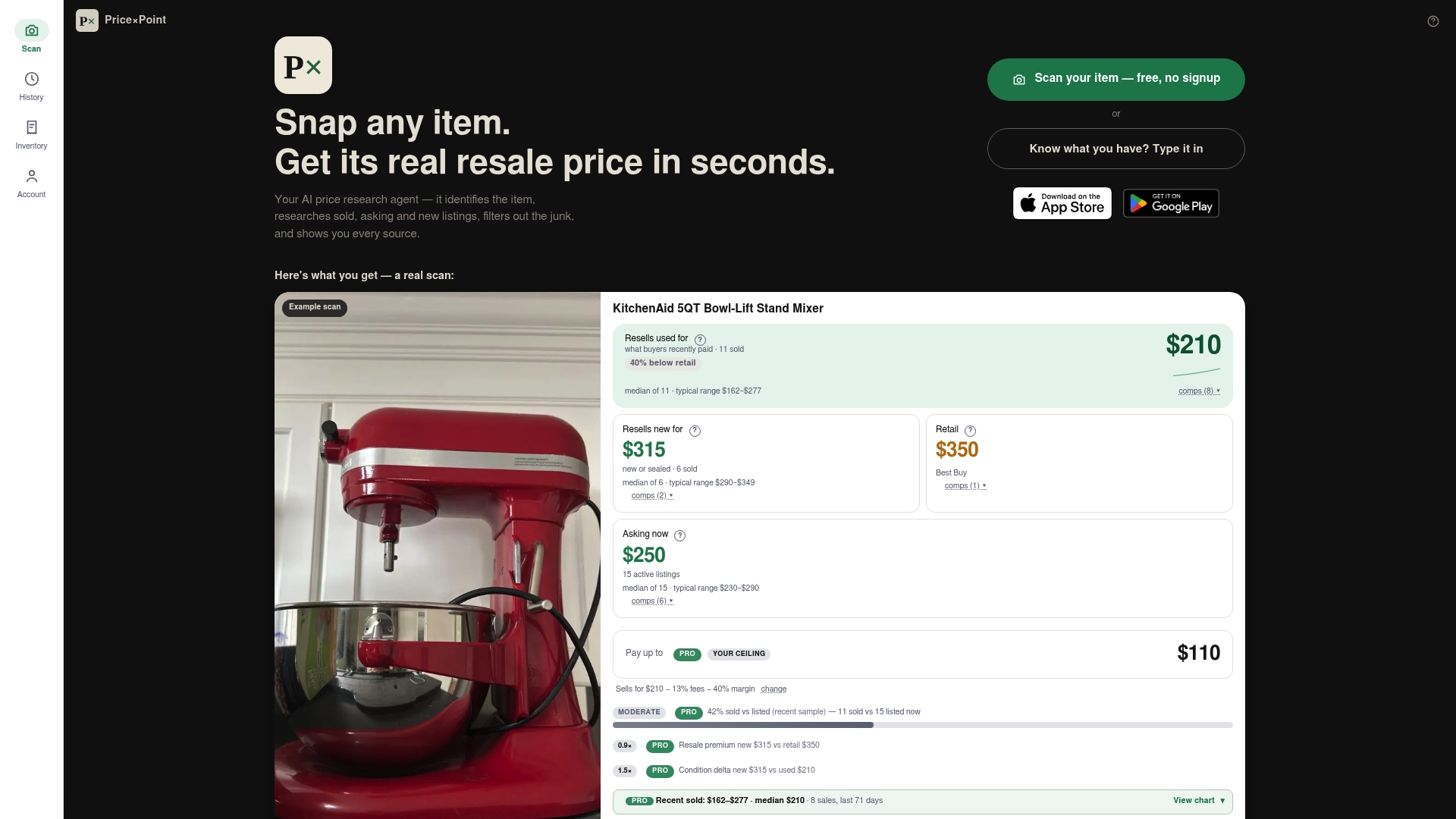
There is a free tier to start. Paid plans are Basic at $4.99 per month, Pro at $9.99 per month and Power at $24.99 per month. If you prefer to pay as you go, token packs are $5.99 for 100 tokens, $12.99 for 300 tokens and $34.99 for 1000 tokens, all one-off. You can also browse real sold prices for used items to see how the data looks. For a closer look at how sold data helps resellers, read our piece on AI for resellers that shows sold listings.
Common mistakes to avoid
- Pricing from retail. What something cost new says little about what it sells for now.
- Skipping the date. A modern reproduction priced as vintage will not sell. A true vintage piece priced as modern leaves money behind.
- Ignoring flaws in your comps. Compare like with like, including stains, repairs and missing parts.
- Trusting one sale. A single result can be a fluke. Look for a cluster.
- Never revisiting prices. Track how long pieces sit and adjust.
FAQ
How do I price vintage clothing if I cannot find an exact match?
Look for the closest sold items, changing one factor at a time, such as era, style or size, and note how far each change moves the price. Completed sales are a better anchor than original retail. Start at a defensible price and review it if the piece sits unsold.
How can I tell if clothing is truly vintage?
Combine several clues: zipper type, union label design, fiber-content labeling, construction and brand label changes. Labels show the earliest possible date, not the latest, and addresses or fonts can mislead, so no single clue is final. The general rule is that vintage means at least 20 years old.
Are asking prices ever useful for vintage pricing?
They show the ceiling of what sellers hope for and what competition looks like, but they are not evidence of value. Use sold listings for the number and active listings only to see what you are up against.
Does where I sell change the price?
Yes. Venue is one of the factors that can materially change a vintage garment's price. Check sold data from the platform you plan to list on, and account for fees and shipping.
Sources
- What Is Considered Vintage? A Guide to Understanding the Term
- Quick Tips for Dating Vintage, Vintage Fashion Guild
- Dating garments, Museum of Design in Plastics
- How Vintage Clothing is Priced, Vintage Fashion Guild
- How to Price Consignment Items for Resale, SimpleConsign