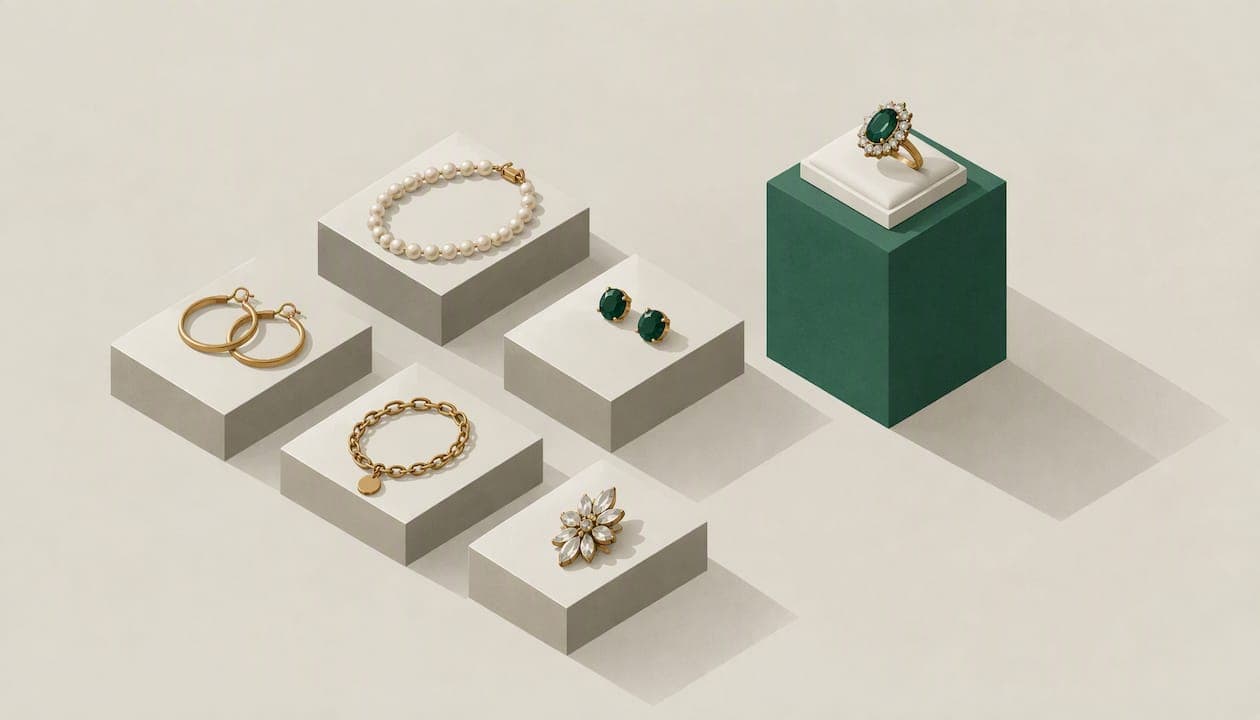
Price costume jewelry by finding several recently sold pieces that match yours on maker, design, materials, size and condition, then setting your price inside the cluster those sales form. Asking prices only show what other sellers hope for. Most costume pieces are worth between $5 and $50, but a signed piece in excellent shape can bring hundreds or more, so the real work is identifying what you hold.
TL;DR
- Identify the piece first: maker mark, era, materials, construction and any repairs. Comparing the wrong piece is the most common pricing mistake.
- Use sold prices, not asking prices. Look for three to five close matches and ignore extreme outliers.
- Most costume jewelry sells for $5 to $50, while signed, well-preserved designer pieces can reach far higher.
- Subtract fees, shipping and your time before you call a price "profit". Selling singly usually beats selling in a lot.
- A tool that shows sold comps with their sources can cut the research for each piece to a couple of minutes.
Table of Contents
- What costume jewelry is, and why pricing it is hard
- Step 1: Identify exactly what you have
- Step 2: Find sold comparables
- What makes costume jewelry worth more
- Vintage costume jewelry value: what to expect by type
- Sell singly or in a lot?
- Adjust for fees, shipping and time
- Where PricexPoint fits
- Our perspective on pricing costume jewelry
- Other items people price the same way
- FAQ
- Sources
What costume jewelry is, and why pricing it is hard
Costume jewelry is jewelry made from base metals, glass, plastic, rhinestones, faux pearls and similar materials rather than precious metals and gemstones. The term has been used since at least 1916, so a "vintage costume" piece can be a century old or only a few decades old.
Pricing it is harder than pricing a gold ring because there is no melt value to fall back on. The worth of a piece is entirely what a buyer will pay. That depends on a handful of variables: maker, design, rarity, age, materials, condition, completeness, size, color, wearability and collector demand. Two brooches that look alike to a casual eye can sit $200 apart.
That gap is why the search results for this topic mix $36 pendants from reproduction lines, $450 signed chokers, and auction lots estimated at $100 to $150. Those are different markets. Your job is to work out which one your piece belongs to.
Step 1: Identify exactly what you have
Before you look at a single price, write down what you can establish about the piece. A good identification covers the exact maker, the age, the materials, the construction, the size, any unusual stones or design features, the condition, and anything missing, replaced or repaired.
Look for a signature
Turn the piece over. Maker names and marks are often stamped on the back, on the clasp, or on a small tag near it. Names such as Trifari and Miriam Haskell can make a real difference: signed, high-design pieces with intricate craftsmanship, hand-set stones and excellent preservation are the ones that can be highly valuable. An unsigned piece is not worthless, but it usually sells on its look alone.
Judge the construction
Quality tends to show in the details. Antique dealers point to hand-set stones rather than glued ones, heavy weight, intricate filigree and sturdy clasps. Older styles such as box clasps can point to earlier production. Lightweight pieces with glued plastic stones are more likely to sit at the lower end of the range.
Note every flaw
Missing stones, replaced clasps, re-plated surfaces, green corrosion and broken pins all change the comp you should use. Be honest here. A buyer will find the flaw, and you want your comparables to share it. Verdigris, the green crust that forms on some base metals, can also spread to nearby pieces, so isolate the item and keep it dry rather than brushing residue across your other jewelry.

Step 2: Find sold comparables
The core method is simple: find what identical or near-identical pieces actually sold for. Search completed eBay listings, ended auctions, auction-house archives and dealer archives. Record the date, the venue, whether the price included a buyer's premium, and exactly how the piece matches yours.
A few rules keep the result honest:
- Use sales, not asks. Current asking prices show the competition you will face, but they are not proof of value.
- Match closely. Maker, design, condition, size, materials and rarity should all line up. Broad keyword averages are unreliable because eras, sizes and conditions vary so widely, which is why sold-price data is best treated as a starting point.
- Collect three to five comps. One sale is an anecdote. Several close sales form a cluster.
- Discard outliers. An unusually high or low result can come from bidder competition, weak photographs, poor titling or limited exposure.
- Account for charges. Auction premiums and other costs change what the seller actually received.
A worked example
Say you have a signed gold-tone leaf brooch with rhinestones, in good condition, no missing stones. You find five sold listings of the same design: $38, $42, $45, $48 and $140. The $140 sale is a bidding-war outlier, perhaps with strong photos and a dedicated collector in the mix. The cluster is $38 to $48, so a realistic list price is around $45 to $50, leaving room for a best offer. If your brooch had a replaced clasp, you would price toward the bottom of that range.

The same logic applies to everyday pieces. If your sold comps for unsigned bead necklaces cluster at $8 to $15, listing yours at $60 will not work, however much sentiment it carries.
What makes costume jewelry worth more
Several factors push a price up, and they stack.
| Factor | Raises value | Lowers value |
|---|---|---|
| Maker | Signed by a sought-after name | Unsigned, mass-produced |
| Construction | Hand-set stones, heavy, strong clasp | Glued stones, light, flimsy findings |
| Condition | Clean, original finish, nothing missing | Corrosion, replaced parts, loose stones |
| Completeness | Full parure (matching necklace, earrings, brooch) | Single leftover piece |
| Demand | Active collector following | Common design, little interest |
Rarity needs a caution. Scarcity alone does not set a price. It matters most when paired with collector demand, and a common piece by a sought-after maker can still sell strongly. A one-of-a-kind piece nobody wants is just a one-of-a-kind piece.
What is costume jewelry worth in practice?
As of August 2026, one dealer guide puts the majority of costume jewelry between $5 and $50, with select signed pieces in excellent condition bringing hundreds or thousands of dollars. That matches what auction houses show: a costume jewelry lot estimated at $100 to $150 can sell well above that when two bidders want it, but such results are the exception, not the baseline.
Vintage costume jewelry value: what to expect by type
Without inventing numbers for categories I have no evidence on, here is how to think about each group.
- Signed designer pieces. Treat each as its own research project. Search the maker plus the design name or a distinctive feature, and compare only against the same design.
- Unsigned but well-made pieces. These sell on design and condition. Expect the lower to middle part of the range unless the design is distinctive.
- Sets and parures. A complete, matching set can be worth more together than its parts, because collectors value completeness. If one piece is missing, price the remaining pieces individually.
- Everyday modern fashion jewelry. Mostly low value. It is often best sold in a bundle, but see the next section.
Sell singly or in a lot?
Pieces sold individually usually realize higher prices than they do in bulk lots, where the "lot price" is often set by the average pieces. The sensible approach is to split your box in two:
- Pull the signed, unusual or well-made pieces and research each one.
- Bundle the remaining common pieces into themed lots, such as "gold-tone brooches" or "faux pearl strands".
Mixed lots of unbranded fashion jewelry on marketplaces are typically listed at modest prices, around $35 for a 50-plus piece lot at the time of writing, so a lot is the right home for pieces that would each earn only a dollar or two after fees.
Adjust for fees, shipping and time
A comp tells you what a buyer paid, not what you will keep. Adjust for condition, collector demand, and the costs and risks of your selling method, including fees, shipping and the time spent researching and reselling. A $12 necklace that costs $5 to ship and 15% in marketplace fees leaves you very little.
The format matters as well. A rare, in-demand piece can do well at auction, while common pieces usually do better at a fixed price. Our guide on auction versus Buy It Now walks through when each format wins.
Where PricexPoint fits
Doing this by hand works, but for a box of 80 pieces it takes days. PricexPoint is built for this step: snap a photo or type the item name, and the app identifies the piece, then shows sold, asking and new listings across multiple marketplaces, with unreliable listings filtered out. Each estimate links back to the actual sales it is based on, so you can check the evidence yourself and correct the identification if the app got it wrong.
For larger collections you can price in bulk with a CSV or multi-item photos, and your scan history is saved with export options. Plans are Basic at $4.99 per month, Pro at $9.99 per month and Power at $24.99 per month, and you can also buy one-off token packs: 100 tokens for $5.99, 300 for $12.99 or 1000 for $34.99. There is also a free tier to try it. See the current plans and token packs.
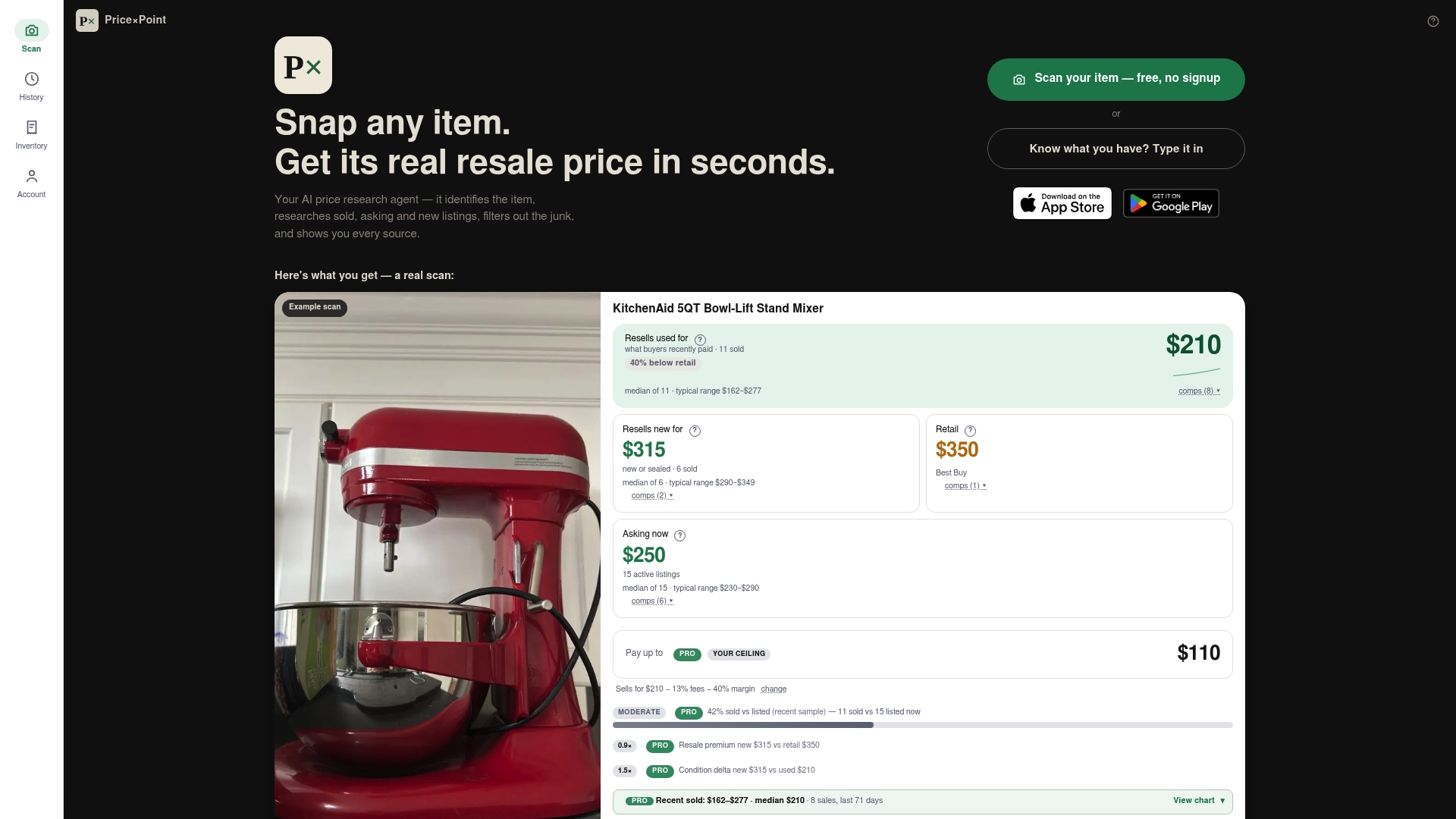
If you want to see what sold-price data looks like before you sign up, browse what used items sell for. For related categories, we also cover pricing jewelry with real sold prices and pricing sterling silver from sold comps, which helps when you need to separate costume from the real thing.
Our perspective on pricing costume jewelry
We built PricexPoint around one belief: a price without evidence is a guess. In costume jewelry that matters more than almost anywhere, because the same words in a listing title ("vintage gold tone brooch") cover items worth $4 and items worth $400.
So we do not give a figure we cannot back. Every estimate links to the sold listings behind it and names its data sources, and you can change the identification if the app picked the wrong maker or design. We think the best seller is not the one with the highest price, but the one who can say exactly why a piece is priced where it is.
Our advice for anyone with a jewelry box to clear: spend your time on the ten percent of pieces that might be signed or distinctive, and do not agonize over the rest. Research the few, bundle the many, and let sold data, not memory or hope, set the number.
— PricexPoint
Other items people price the same way
The same sold-comp method works for household vintage items. Vintage Tupperware is a good example: values depend on color, line, completeness and whether the lid matches, and everyday single pieces often sell for very little. One vintage Tupperware powdered sugar sifter at an online auction closed at a winning bid of $1.00. Complete sets in less common colors are where collectors tend to pay more, and the only way to know is to check sold listings for your exact set. For a wider view, see our guides to pricing collectibles and pricing antiques.
FAQ
What costume jewelry is worth something?
Signed pieces from sought-after makers, well-made items with hand-set stones, complete parures and pieces in excellent condition are the ones most likely to be worth real money. Most other costume jewelry sells for $5 to $50. Check the back for a maker mark first, then compare sold listings of the same design.
Will a pawn shop buy costume jewelry?
Sometimes, but do not count on it. Pawn shops focus on gold, silver and gemstones, and policies differ from shop to shop, so call before you go. If they do make an offer, expect it to be well below what you would get selling directly to a collector, because they must resell at a profit.
How do I tell if costume jewelry is valuable?
Look for a signature, heavy weight, hand-set stones and a solid clasp, then check what comparable pieces actually sold for. A high price on an active listing means little until you see matching sales. If the piece is signed, searching the maker plus the design is the fastest route.
Should I sell costume jewelry individually or as a lot?
Sell your best pieces individually, because they usually earn more that way. Put the common, unsigned items into themed lots so you do not spend more time and shipping on them than they are worth.
How do I price vintage Tupperware?
Use the same method: identify the line, color and completeness, then look at several sold listings rather than asking prices. Single everyday pieces often sell cheaply, so complete sets and less common colors are where to focus.
Sources
- How to Research the Value of Vintage Costume Jewelry
- What Is Costume Jewelry Worth? An Honest Guide
- Vintage Costume Jewelry: The Beginner's Master Guide
- Is Vintage Costume Jewelry Worth Anything?
- Source Costume Jewelry Without Overpaying
- Vintage Tupperware Jifi Sift Powdered Sugar Sifter Mill auction lot
- DOYLE costume jewelry auctions