
To price a collectible right now, pull recent sold listings for the exact variant and condition, then adjust for grade and fees. If you want the shortcut, a real-time valuation agent scans a photo, cross-checks sold, asking, and new listings across marketplaces, and hands you sold-sale evidence in seconds instead of minutes of manual digging.
TL;DR:
- Pricing collectibles requires recent sold listings from the past 30 to 90 days, matching exact variants to ensure accuracy.
- Grading is worthwhile only when the expected increase in value surpasses grading fees and turnaround time, especially for high-value items.
- Rarity and low edition size significantly boost value when coupled with strong demand, but verifiable population reports are essential for accurate assessment.
- Automated AI valuation tools are effective if they link to actual sold sales and draw from multiple marketplaces, but viral or unique items still need human judgment.
- Use sold prices, not asking prices, and consider regional and seasonal demand shifts to avoid pricing mistakes or falling for scams.
Table of Contents
- How Do You Price Collectibles Accurately?
- Should You Grade or Authenticate Before You Price It?
- What Drives Prices in Different Collectible Categories?
- Can You Trust Real-Time AI Price Estimates?
- How Do You Turn a Price Estimate Into a Sale?
- Do Prices Shift by Region or Season?
- What Pricing Mistakes and Scams Should You Watch For?
- How Much Do Rarity and Edition Size Affect Value?
- PricexPoint's Take: Evidence Beats Averages
- Get a Real Sold-Price Estimate Right Now
- Sources
- FAQ
How Do You Price Collectibles Accurately?
Static price guides tell you what something was worth on average, not what it will sell for this week. That gap is exactly why a repeatable, sold-listing-first method beats guesswork or trusting a single "buy it now" price you happened to see.
Here's the workflow, and it takes less than ten minutes once you've done it twice:
- Filter to sold listings only and set the date range to the last 30 to 90 days. Older sales skew results, especially in categories that move fast.
- Match the exact variant. Year, print run, SKU, edition, serial number. A near-match isn't a match. A 1st edition holographic card and its common reprint can differ by 10 times or more.
- Adjust for condition or grade. A raw (ungraded) item should be priced conservatively against graded comps. Applying a discount of 30% to 50% off a PSA 9 comp for an unverified raw copy is a reasonable starting point.
- Check sample size and spread. Three sales clustered tightly tell you more than one outlier sale.
- Subtract fees, shipping, and expected returns to get to net proceeds, not gross.
- Cross-reference a second source (another marketplace or a specialist forum) before committing to a number.
- Optional shortcut: snap a photo into an AI valuation tool and let it pull the sold comps for you.
Asking prices are the biggest trap in this process. Sellers routinely list 20% to 40% above what buyers actually pay, and sold-item filters on major marketplaces exist precisely because asking prices are unreliable signals of real market value.
Should You Grade or Authenticate Before You Price It?

Grading changes the math more than almost any other variable in collectibles pricing, but it isn't always worth the money.
The rule of thumb: grading pays off when the expected post-grade value increase clearly outweighs the grading fee plus turnaround time. PSA's grading standards note that professional certification standardizes condition assessment and can meaningfully increase resale value, which is why a raw card worth $40 rarely justifies a $25 grading fee, while a card that could jump from $150 raw to $1,200 at a PSA 10 almost always does.
- Grade multipliers are not linear. A PSA 10 might sell for 3 times a PSA 9, but a PSA 9 might only sell for 1.3 times a PSA 8. Check population reports, not just the last sale.
- Coins work differently. PCGS and NGC grading affects numismatic premium separately from bullion (metal) value, so a common-date coin near spot price won't see the same lift a rare date will.
- Authenticity flags matter more than condition in some categories. PCGS grading standards specifically call out alteration, trimming, and toning as factors that can zero out a coin's premium regardless of surface condition.
- Restoration kills comic and card value. A restored copy of a key issue can sell for a fraction of an unrestored one and the same apparent condition.
- Watch for single-sale outliers. One sale at double the going rate usually means a bidding war, a misidentified lot, or a mistake, not a new market price.
Pro Tip: If you find fewer than five sold comps in the past 12 months, treat any estimate as low confidence and check a specialist forum or auction house before pricing high.
What Drives Prices in Different Collectible Categories?
General pricing logic holds across categories, but the specific levers that move value differ enough that treating every collectible the same way will cost you money.
- Trading cards: Print run size, graded population count, and whether the card ties to current tournament or pop-culture relevance drive most of the swing. Serial-numbered parallels can be worth 10 to 50 times the base card.
- Coins: Bullion coins track spot price closely, while numismatic coins carry a premium tied to mint mark, mintage, and provenance that can dwarf the metal value entirely.
- Toys and action figures: Sealed-in-box condition often doubles or triples value over loose, complete examples. Retailer-exclusive variants and packaging damage (crushed corners, sun-faded graphics) swing price heavily even within "sealed" listings.
- Comics and books: Key first appearances and major story issues carry the premium, and a missing or damaged dust jacket can cut a first-edition book's value by half or more.
- Vinyl records: Original pressings, specific matrix numbers, and intact inserts or posters matter more than the artist's overall popularity. A misprint or promo-only pressing can outvalue the standard release many times over.
Market data on eBay's best-selling collectibles shows trading cards leading in unit volume while coins pull a disproportionate share of total revenue, which tells you something practical: high-volume categories reward speed and clear comps, while high-value categories like coins reward patience and specialist verification.
Can You Trust Real-Time AI Price Estimates?
Static price guides and live sold-price feeds solve different problems. A price guide like NGC's is a dealer retail average built from historical transactions, useful for long-term context but explicitly not designed to capture short-term swings. A live feed pulling actual sold listings from the past few weeks tells you what's happening in the market right now, which is the number you actually need before you list or buy.
Before trusting any automated estimate, run it through a short checklist:
- Does it show links to actual sold listings, or just a number?
- What date range does it pull from?
- Does it draw from multiple marketplaces, or just one?
- How large is the sample, and does it flag low confidence when sales are thin?
Roughly 5 sales or fewer in a 12-month window is the threshold where confidence starts to drop and a manual double-check becomes worth the time.
Some AI valuation tools build their process around that checklist directly. They snap a photo or use an item name, then pull sold, asking, and new listings across multiple marketplaces, filter out unreliable data, and link estimates back to actual sold-sale evidence. The real sold-price examples page shows this in practice, and the how-it-works breakdown walks through the photo-to-price flow step by step.
No tool handles every edge case, though. Viral, hype-driven items and one-of-a-kind provenance pieces can spike far beyond what recent sold comps predict, and category reports on collectibles point to real examples of items that resold for orders of magnitude above retail after a social-media moment. Automated tools model patterns, not viral events.
How Do You Turn a Price Estimate Into a Sale?
Once you have a number, the decision is where to sell and how to price for what you'll actually keep.
- Match channel to price band. Lower-value, high-volume items do well on general marketplaces; high-value pieces often net more through specialist auction houses or consignment despite higher fees.
- Do the fee-aware math. If sold comps average $100 and your platform charges 13% in seller fees plus $8 shipping, your realistic net is closer to $79, not $100.
- Time it deliberately. Convention season, holiday gift periods, and category-specific drops (new set releases, movie tie-ins) shift demand noticeably; selling a week before a relevant event often beats selling a week after.
- Photograph and describe for confidence, not just accuracy. Buyers pay a premium when condition claims are backed by clear, well-lit photos of exact flaws.
Do Prices Shift by Region or Season?
Collectible demand isn't flat across geography or the calendar. Categories with strong regional fan bases, certain sports cards in specific countries, or manga and anime collectibles in markets with dense fan communities, routinely sell for more locally than they do in a broad international listing pool.
Seasonality compounds this. Holiday shopping months push toy and game collectible prices up, sometimes by a noticeable margin, as gift buyers compete with long-term collectors. Convention season does the same for comics, trading cards, and pop-culture memorabilia tied to a specific franchise having a moment. Coin and bullion prices move with financial markets rather than calendar events, tracking spot price shifts more than seasonal collector demand.
The practical takeaway: a sold-listing average from three months ago might already be stale if you're pricing during a seasonal spike or lull. Pull the most recent comps you can find, and if you're selling into a known seasonal window, weight recent sales from that same window more heavily than older data. A record player accessory that sold steadily at $60 in March might clear $85 in the run-up to the holidays simply because buyer volume and urgency both increase.
Regional marketplace differences matter too. An item can sit unsold on one platform for weeks while moving quickly on another simply because that platform's user base skews toward that category. Checking sold data across more than one marketplace isn't optional diligence, it's how you catch a regional demand gap before you underprice.

What Pricing Mistakes and Scams Should You Watch For?
The single most common pricing mistake is anchoring to ask prices instead of sold prices. A listing sitting at $300 for six months with zero sales tells you almost nothing about market value except that the seller is either patient or wrong.
The second mistake is treating a single outlier sale as the new normal. If nine comps sold between $40 and $60 and one sold for $150, that $150 sale was likely a bidding mistake, a misidentified rare variant, or a promotional stunt, not a signal to reprice everything at $150.
Scams cluster around a few repeat patterns:
- Fake certificates of authenticity for items that were never professionally graded or authenticated.
- Re-slabbed or swapped cases, where a low-grade item is placed inside packaging for a higher grade.
- Doctored photos that hide cracks, restoration, or trimming on high-value pieces.
- Bait pricing, where a seller lists far below market to drive traffic, then claims the item sold or upsells a "similar" piece at a higher price.
Protect yourself by insisting on serial numbers or certification numbers you can independently verify against the grading company's own lookup tool, by comparing photos against known population report images for that grade, and by treating any deal that's dramatically below every sold comp as a reason to slow down, not speed up.
How Much Do Rarity and Edition Size Affect Value?
Rarity is the single biggest value multiplier in collectibles, but it only matters when it's paired with demand. A card printed in a run of 500 is worthless if nobody wants it, while a mass-produced item tied to a beloved franchise can still command a strong price simply because collector demand outpaces even a large supply.
That said, when demand is roughly equal, edition size does the heavy lifting. A serial-numbered card out of 99 will consistently outsell the same design printed in the tens of thousands, often by a factor of 10 or more. Coins follow a similar pattern: low-mintage years and mint marks carry a numismatic premium entirely separate from the metal's spot value, which is why two coins with identical bullion content can sell for wildly different prices.
Print runs aren't always disclosed clearly, which is where population reports from grading services become useful. A PSA or PCGS population report tells you exactly how many examples of a given item have been graded at each level, giving you a real supply signal instead of a vague "limited edition" marketing claim. If a population report shows only 40 copies graded at the top tier out of thousands submitted, that scarcity is verifiable and defensible in your pricing, not just a hunch.
The practical rule: never price purely on stated edition size. Cross-check it against actual graded population counts and recent sold volume. A "limited edition" of 10,000 pieces that nobody is buying will price far below a "regular edition" item with steady, active demand.
PricexPoint's Take: Evidence Beats Averages
Static averages hide more than they reveal. A number without the sold listing behind it is a guess wearing a price tag. That's the whole argument for evidence-backed data, and it's why we built PricexPoint around linking every estimate to the actual sale that produced it.
Automation still has limits. Authenticating a suspected restoration, negotiating a one-of-a-kind provenance piece, or reading a genuinely thin market with three ambiguous sales still calls for a human expert's judgment. Try scanning one item you own and compare the result against a manual sold-listing search. The gap, or the lack of one, tells you a lot about how far this technology has come.
— PricexPoint
Get a Real Sold-Price Estimate Right Now
Manually filtering sold listings across multiple marketplaces takes time most resellers don't have between listings. Some tools compress that workflow into a photo or a typed item name, then return sold, asking, and new listing data with direct links back to the actual sales, so you're never pricing off a guess.
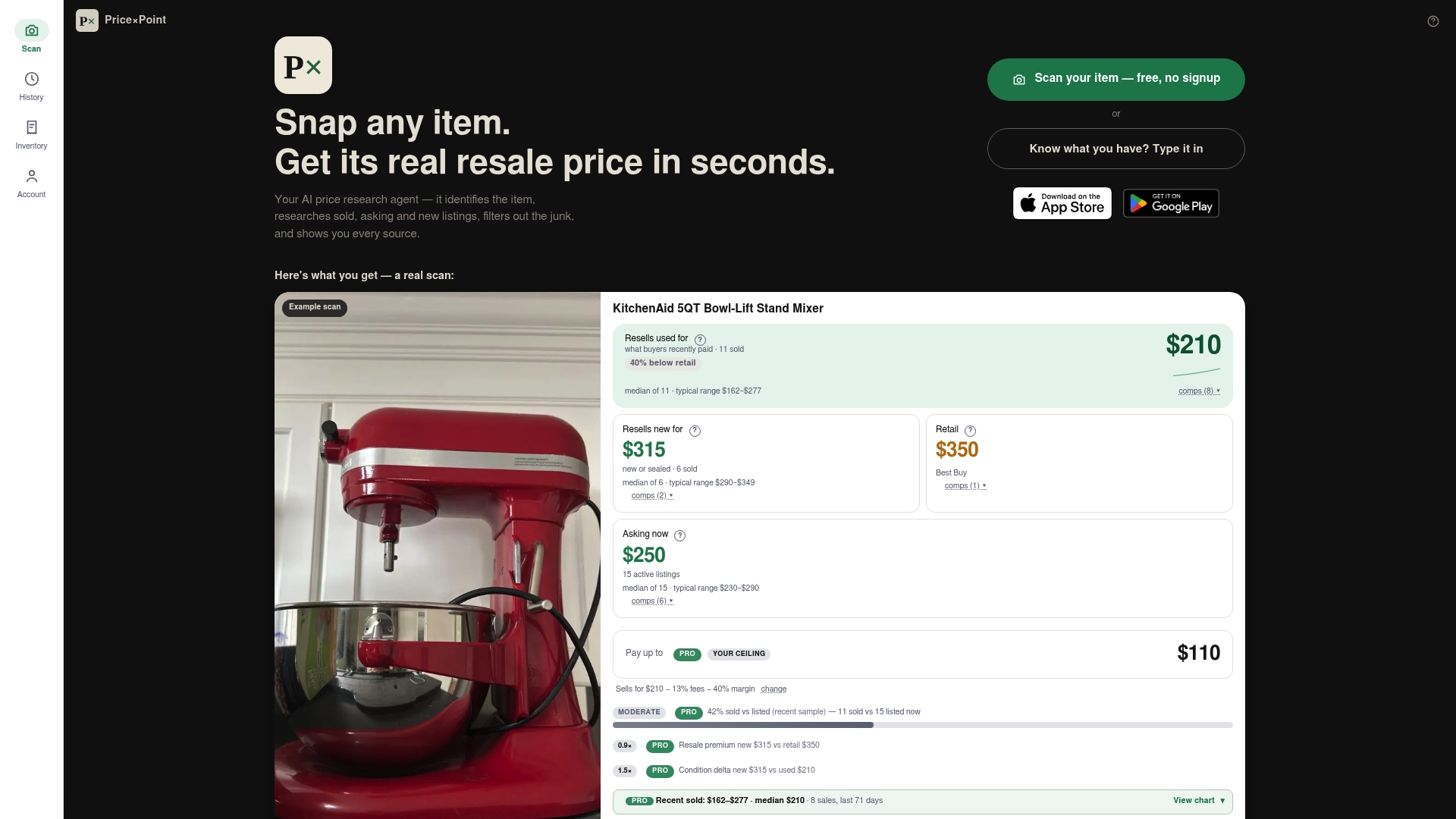
Snap a photo of one item sitting in your inventory right now and see what the real sold-price data shows versus what you assumed it was worth. If the free scan convinces you, the paid tiers unlock higher volume: Basic runs $4.99 a month, Pro is $9.99 a month, and Power sits at $24.99 a month, with token packs available starting at $5.99 for 100 tokens if you'd rather pay per lookup than subscribe. Check the full breakdown on the pricing page and start pricing your next item with sold-sale evidence instead of a hunch.
Sources
- NGC price guide
- PSA | Grading Standards
- Best selling collectibles on eBay (September 2026 Data) | Zika Analytics
FAQ
When Is Grading a Collectible Worth the Cost?
Grading typically pays off when the expected value increase after certification clearly exceeds the grading fee and turnaround wait. PSA's grading standards note that certification can significantly increase resale value, so a $50 fee makes sense on an item that could jump from $150 to over $1,000, but rarely on one worth $30 raw.
Should I Use Sold Prices or Asking Prices to Set My Price?
Always use sold prices. Asking prices are seller-set and frequently inflated, while sold-listing filters show what buyers actually paid, which is the only reliable signal of current market value.
How Accurate Are AI-Generated Collectible Price Estimates?
AI valuation tools are accurate when they're built on real sold-sale evidence with clear date ranges and multiple marketplace sources, rather than static averages. PricexPoint links every estimate to the actual sold listing behind it, letting you verify the number yourself instead of trusting a black-box figure.
What's the Difference Between a Price Guide and a Real-Time Valuation?
A price guide like NGC's reflects historical averages and explicitly does not capture short-term price swings. A real-time valuation pulls current sold listings, giving you a number that reflects what's happening in the market this week, not last year.
How Many Sold Comps Do I Need for a Confident Price?
Five or more sold comps within the past 12 months generally gives a reasonably confident estimate. Below that threshold, treat the number as low confidence and cross-check against a specialist forum, auction record, or a second marketplace before pricing.