To price a sterling silver item for resale, pull 3 to 5 recent sold listings that match the maker, pattern, and condition, then weight those sold prices far more heavily than any asking prices you find. Adjust the resulting figure for wear, hallmarks, and provenance, subtract marketplace fees, and set your listing price with a margin above that net number. Start by saving several matching sold listings before you write a single word of your description.
TL;DR:
- Matching recent sold listings and adjusting for wear, hallmarks, and provenance provides a reliable estimate 20 minutes or less per item.
- Prioritize sold comps from marketplaces and auction databases over asking prices, especially for rare or regional maker pieces.
- Condition grading and authentic maker marks significantly influence resale value, with professional appraisal recommended for high-value items.
- Deduct marketplace and processing fees from gross sale prices to determine the true net price you can expect to keep.
- Using tools like PriceXPoint can speed up research and improve pricing accuracy, but professional appraisals remain essential for items worth several thousand dollars or more.
Table of Contents
- How Do You Price Sterling Silver Fast?
- Where Do You Find Reliable Comparable Sold Listings?
- How Do You Grade Condition and Adjust for Maker Marks?
- How Do Fees Change Your Net Resale Price?
- What Pricing Template Should You Use to List Your Piece?
- Seeing Sold-Price Evidence in Practice
- What's Shaping Sterling Silver Prices Right Now?
- How Does the Spot Price of Silver Affect What Your Piece Sells For?
- Why Does Raw Silver Weight Price So Differently From a Finished Piece?
- Why Does the Same Piece Sell for Different Prices at Retail Versus Resale?
- Why Do Sterling Silver Prices Vary by Region?
- A Reseller's Take on Pricing Sterling Silver
- Speed Up Your Comp Research With PriceXPoint
- Sources
- FAQ
How Do You Price Sterling Silver Fast?
You can produce a defensible resale estimate for most sterling pieces in under 20 minutes if you work in order instead of jumping between tabs. The process below is the same one appraisers use informally, just compressed for someone listing a single item rather than a whole estate.
- Photograph the piece from four angles, then get a close, well-lit shot of every hallmark and maker's mark.
- Weigh the item and record its dimensions. Buyers searching sold listings filter on this.
- Search sold filters on your target marketplaces and log the source URL, sale date, sold price, shipping cost, and any buyer premium.
- Grade the condition against a simple scale and note what pulls the price up or down.
- Apply expected fees to your comps and calculate a net sale estimate, not a gross one.
- Pick a listing template: quick sale, standard, or premium, based on how fast you need to sell.
Do all six steps and you have a number you can defend if a buyer questions your price, which happens more often with silver than with most collectibles.
Where Do You Find Reliable Comparable Sold Listings?
Your comp set is only as good as its sources, and sterling silver is full of thin, noisy data. A candlestick that "sold" for $400 on one platform might have been a relisted item that never actually closed.
Four sources cover most of what you need:
- Sold and completed filters on general marketplaces, which show what buyers actually paid, not what a seller hoped for.
- Auction house results databases like LiveAuctioneers, which give you searchable, daily-updated hammer prices across millions of past lots.
- Marketplace sold filters specific to jewelry and estate categories, where sterling flatware and hollowware tend to concentrate.
- Documented case pages that already show sold-price evidence for a specific model or pattern, which save you the search entirely.
Match comps on maker, pattern or model name, dimensions, and finish before you match on anything else. A Gorham "Chantilly" teaspoon and a no-name teaspoon of the same weight are not the same item, even though scrap buyers would treat them identically. Use a date window, too. Silver flatware demand shifts with wedding-registry trends and estate-sale volume, so a comp from three years ago may not reflect today's market.
Give heavy preference to completed sales. When sold comps are thin for a rare or regional maker, expand your search window and geography before you resort to asking prices, and discount whatever asking prices you do use by a meaningful margin.
Pro Tip: Save a screenshot of every sold listing you use as a comp, not just the price. Sellers who lose that source when a listing expires have nothing to show a skeptical buyer later.
How Do You Grade Condition and Adjust for Maker Marks?
Condition and authenticity marks do more to move the price than almost any other factor besides the item itself. A five-point scale keeps your grading consistent across pieces:
- Mint or unused: original box or pouch, no polishing wear, marks crisp.
- Excellent: light use, no monogram removal, hallmarks fully legible.
- Good: visible polish wear or minor dents, no repairs.
- Fair: dents, worn plating on weighted pieces, or a removed monogram.
- Restored or repaired: replaced parts, re-soldered joints, or refinished surfaces.
Each band down typically reduces your comp median by a significant margin, and a professional restoration can cut even more if it's visible or affects function.
Hallmarks and maker marks matter more than most sellers realize. A piece stamped "STERLING" sits in a different value tier than one marked "800," which indicates a lower silver content standard used in parts of Europe, and unmarked pieces often sell for far less regardless of actual quality. Confirming what a mark actually says, and cross-checking it against a hallmark identification guide, should happen before you finalize any comp set.

If a single item's comp-based estimate clears a few thousand dollars, or the piece has murky or conflicting marks, a written appraisal is worth the cost. Professional appraisers following USPAP standards typically spend one to two hours per significant piece weighing market, cost, and provenance factors, which is more rigor than any online comp search can replicate.
How Do Fees Change Your Net Resale Price?
The sold price you see on a listing is never what the seller actually kept, and treating it as your target price is the single most common resale pricing mistake.
- Start with your weighted comp median. This is your gross estimate before any deductions.
- Subtract marketplace commission, which commonly runs in the 10 to 15 percent range depending on the platform and category.
- Subtract payment processing, typically 2 to 3 percent, if it's not already bundled into the commission.
- Subtract shipping costs you're covering, and add a buyer premium of 15 to 25 percent back in only if you're comparing to an auction house hammer price rather than a marketplace sale.
- What's left is your net sale estimate, the number that should actually drive your listing price.
Sold-weighted pricing models, the kind used by Loupe's watch valuation methodology, give completed sales five to ten times more weight than asking prices when calculating a market value. Applying that same logic to silver means a $300 asking-price listing barely nudges your estimate, while three $220 sold listings anchor it firmly. If any of your comps involved a lot sale (several pieces sold together), divide carefully. Lot sales routinely realize less per piece than a single, well-photographed item would, and that discount should not be carried into your individual-item estimate.
What Pricing Template Should You Use to List Your Piece?
Your weighted comp median is the anchor. Where you price relative to it depends entirely on how fast you need the sale.
- Quick sale: price at 70 to 85 percent of your weighted median. This moves inventory fast, useful if you're clearing estate lots or need cash flow.
- Standard listing: price at 90 to 105 percent of your weighted median. This is the default for most single items with decent comp coverage.
- Premium sale: price above your comps, but only with documented reasoning, such as rare pattern, exceptional condition, or verified provenance from a notable collection.
Format matters almost as much as price. A rare, high-demand maker (think Georg Jensen or early Tiffany) often does better in a timed auction format where competitive bidding can push past your estimate. A common pattern with steady but unspectacular demand usually sells faster with a buy-it-now-plus-best-offer setup.
Your photos, title, and description should work together to justify the number you chose. Lead your title with maker and pattern name, since that's what serious buyers search for. Photograph hallmarks clearly, not just the overall piece, and mention condition honestly in the first line of your description.
Pro Tip: List at your standard-tier price first, then revisit it after seven to ten days with no offers. Dropping to your quick-sale tier at that point beats letting a listing go stale for a month.
Watch your listing's view-to-watch ratio in the first week. A high watch count with no offers usually means your price is close but not quite there, while low views suggest a title or photo problem, not a pricing one.
Seeing Sold-Price Evidence in Practice
Manually compiling comps across multiple marketplaces is the most time-consuming part of this entire process, and it's exactly the gap PriceXPoint was built to close. The app identifies an item from a photo or name, then aggregates sold, asking, and new listings across markets and filters out unreliable or duplicate entries before showing you a result.
Some apps offer features like photo identification to pull maker and pattern details, aggregation of sold listings across multiple marketplaces, filtering out stale or duplicate listings, and exportable scan history so you can keep a record of every comp pulled, which can be useful if a buyer questions your price later.
PriceXPoint's worth pages show this in action across categories, and the Tiffany & Co. Return to Tiffany bracelet page is a useful reference for how sold-price evidence gets presented with linked sources. Even with a tool like this, high-value items with conflicting or unclear hallmarks still warrant a professional appraiser's opinion. No app, including this one, replaces physical authentication for a five-figure piece.
What's Shaping Sterling Silver Prices Right Now?
Estate sale volume has climbed as older collections change hands, and that's pushed supply of vintage flatware and hollowware higher in most secondary markets. More supply without matching demand tends to soften prices on common patterns, particularly large flatware sets that younger buyers rarely want in full.
At the same time, demand has bifurcated in a way that catches casual sellers off guard. Recognizable maker names, Georg Jensen, Tiffany, Gorham's more ornate patterns, continue to hold or gain value, while generic or unmarked pieces increasingly get priced closer to their material worth than their craftsmanship worth. This split matters when you're setting expectations: two candlesticks that look similar at a glance can sell four or five times apart in price purely because one carries a desirable mark and the other doesn't.
Jewelry-category sterling, especially mixed-metal and designer pieces, has held up better than flatware because it competes in fashion resale markets, not just antique ones. A sterling cuff with a recognizable design signature moves through general marketplaces at a pace estate silverware simply doesn't match.
The practical takeaway for a seller listing this year: don't assume a piece's category as a whole is trending up or down. Pull your comps specific to your exact maker and pattern, because broad "silver market" narratives mask enormous variation underneath.
How Does the Spot Price of Silver Affect What Your Piece Sells For?
Commodity silver prices set a floor, not a target, for sterling items with any design or maker value. A piece's melt weight matters mainly for unmarked, damaged, or low-craftsmanship items where buyers see nothing but raw material.
For anything with recognizable design, pattern, or maker attribution, spot price swings move the floor a little without moving the ceiling much at all. A rising commodity price might nudge up what scrap buyers offer for damaged pieces, but it does almost nothing to what a collector will pay for a mint-condition Jensen bowl, because that buyer is pricing craftsmanship and rarity, not metal content.
This is precisely why sold-comp pricing beats any melt-based shortcut for resale. A seller who prices a collectible piece off a commodity calculation is almost always leaving money on the table, sometimes a lot of it, because that method ignores everything that makes the item worth more than its weight. Reserve spot-based thinking for genuinely damaged, unmarked, or broken pieces where design value has already left the equation.
Why Does Raw Silver Weight Price So Differently From a Finished Piece?
A gram of raw sterling silver and a gram of silver shaped into a Tiffany bracelet occupy entirely different markets, even though they're chemically identical. Raw or scrap weight gets priced almost mechanically, largely a function of purity and mass. A finished piece gets priced on labor, design, brand, age, and desirability layered on top of that same material.

The gap between the two can be enormous. A plain, unmarked sterling bangle might be worth close to its material value. A design-forward, maker-marked bangle of the same weight can sell for many multiples of that, purely because of craftsmanship and brand recognition. Flatware splits the same way: a set from a mass-produced modern pattern often sells close to its weight-based value, while a set from a sought-after historic pattern in excellent condition sells well above it.
The practical rule: never anchor your resale estimate to weight alone unless the piece has lost its design value through damage or has no identifiable maker or pattern. If it still has a clear pattern, mark, and decent condition, price it as a finished object using sold comps, not as a chunk of metal.
Why Does the Same Piece Sell for Different Prices at Retail Versus Resale?
Retail and resale prices diverge for structural reasons that have nothing to do with an item's quality. Retail prices bake in brand markup, retail overhead, and often a story or presentation that resale buyers don't pay for twice. A sterling piece bought new from a boutique typically carries a markup reflecting the retailer's costs, not just the metal and craftsmanship.
Resale value strips almost all of that away and replaces it with what a comparable buyer is actually willing to pay today, based on completed sales rather than a price tag. This is why a piece purchased new for a few hundred dollars might resell for a fraction of that within a year, even in excellent condition. It's also why some vintage or discontinued pieces buck the trend entirely and appreciate, when scarcity and collector demand outpace the original retail markup that's long since evaporated.
For a reseller, the practical implication is simple: never use a retail price tag, whether from your own original receipt or a competitor's current listing, as a resale benchmark. Retail asking prices reflect a completely different set of costs and incentives than the secondary market you're actually selling into.
Why Do Sterling Silver Prices Vary by Region?
Sold prices for the same exact item can differ meaningfully depending on where the sale happens, and this catches out sellers who only check one marketplace or region before setting a price.
Regional collector demand plays a real role. A silver pattern associated with a particular country's design heritage, British hallmark silver, for instance, often commands stronger prices in markets with a deeper collector base for that style, while the same piece might move slower and cheaper elsewhere. Shipping costs and cross-border complications also depress prices in some regions relative to others, since buyers factor in what it will cost and how long it will take to receive a heavy or fragile item.
Local supply matters too. A region with a lot of estate turnover in a given period floods that local market with similar pieces, pushing sold prices down temporarily even while demand elsewhere holds steady. This is part of why expanding your comp search geographically, rather than relying only on local sold listings, gives you a more accurate baseline. If you're deciding between selling locally for speed or listing broader for price, a resource like BuyBackBear's marketplace comparison is worth a look for weighing instant-cash options against broader listing reach.
A Reseller's Take on Pricing Sterling Silver
Comp-driven pricing beats melt-based guessing every time, not because melt value is wrong, but because it answers the wrong question. Buyers of anything with design or maker value aren't paying for silver content, they're paying for what that specific piece, in that specific condition, has actually sold for elsewhere.
Document your sold sources. A listing with three linked comps builds more buyer trust than any amount of confident-sounding description. And when the marks are unclear or the piece could be worth real money, call a specialist before you call it done.
— PricexPoint
Speed Up Your Comp Research With PriceXPoint
Every step in this guide, matching maker marks, pulling sold listings across multiple marketplaces, filtering out stale or duplicate data, takes time when done by hand. PriceXPoint is built to compress that research from an evening of tab-switching into a single photo scan, giving resellers a faster path to the same sold-price evidence this article recommends you gather yourself.
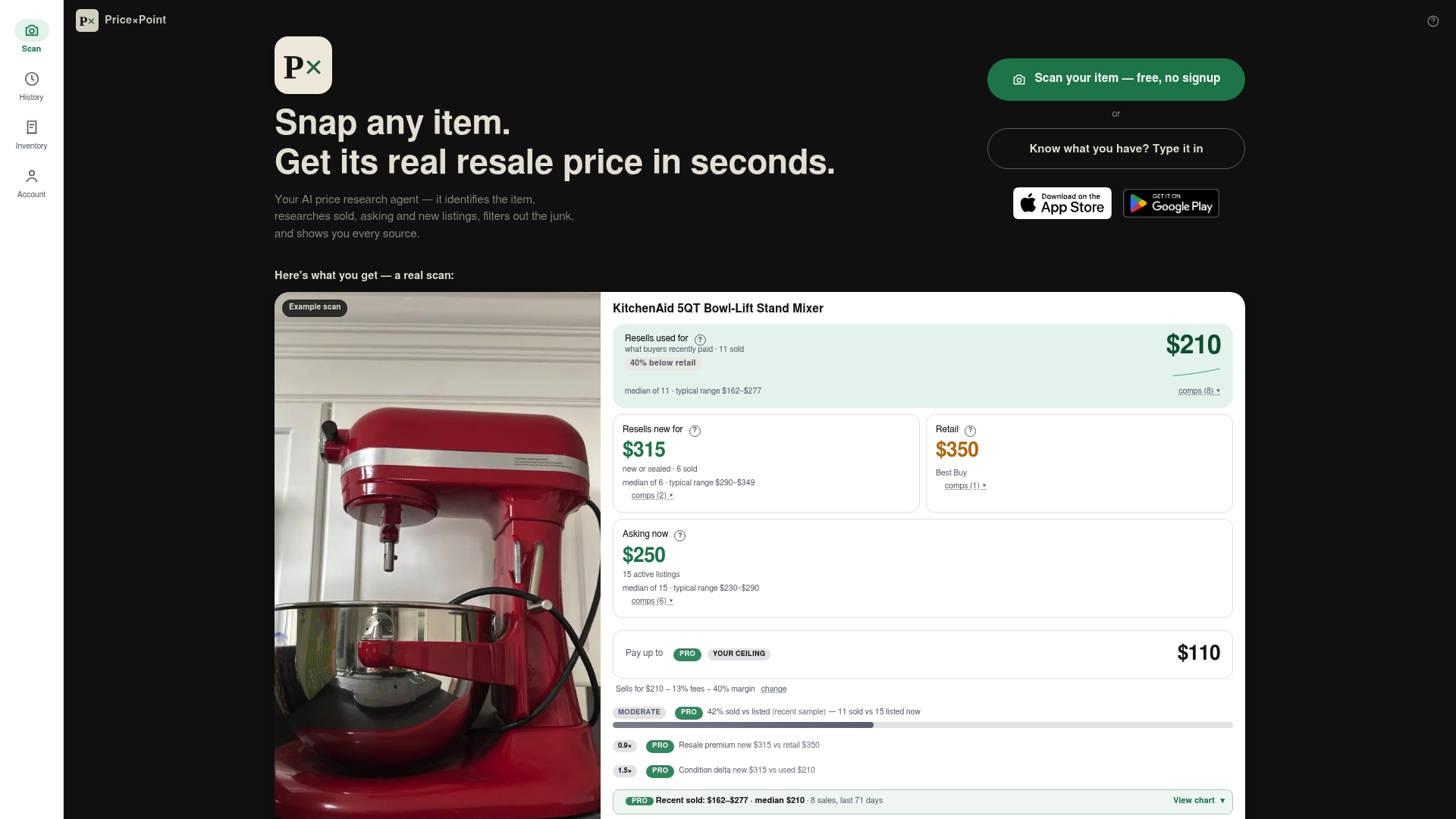
The app's core features line up directly with the workflow above: photo-based item identification, sold-listing aggregation across markets, filters that strip out unreliable or expired listings, and exportable scan history so you can keep a record for every piece you list. You can see the approach applied to real items on the worth pages, including examples like the Vitamix 5200 blender and Bose QuietComfort 35 II, which show the same sold-source evidence model this guide walks through for silver.
Plans start at $4.99 per month on the Basic tier, with Pro at $9.99 and Power at $24.99, or you can buy tokens individually starting at $5.99 for 100. Check the pricing page to compare tiers and find the option that matches how often you're pricing items.
Sources
Items you suspect are worth several thousand dollars or more deserve a professional, USPAP-compliant appraisal rather than a comp-only estimate.
FAQ
How Do I Price Sterling Silver Without an Appraiser?
Pull 3 to 5 recent sold listings matching the maker, pattern, and condition of your piece, then calculate a weighted median favoring completed sales over asking prices. Adjust that figure down for wear or up for rare marks and strong provenance, then subtract expected marketplace fees to get your net resale estimate.
Is Sterling Silver Priced by Weight or by Design?
It depends on whether the piece retains identifiable design and maker value. Damaged, unmarked, or generic pieces trend toward weight-based pricing, while marked pieces from recognized makers in good condition sell on craftsmanship and rarity, often for multiples of their weight-based value.
Why Do Sold Prices Matter More Than Asking Prices?
Asking prices reflect what a seller hopes to get, not what a buyer actually paid, and can sit unsold for months without adjustment. Sold-weighted methodologies, including Loupe's approach to watch valuation, give completed sales far more weight than asking listings precisely because they reflect real transactions.
How Much Do Marketplace Fees Cut Into My Silver Sale?
Commission fees commonly fall in the 10 to 15 percent range, with payment processing adding another 2 to 3 percent on most platforms. Always convert your gross comp estimate into a net figure before setting your listing price, or you'll undercharge without realizing it.
Does PriceXPoint Work for Pricing Sterling Silver Items?
Yes. PriceXPoint identifies items from a photo or name and aggregates sold, asking, and new listings across multiple marketplaces, filtering out unreliable data before showing you verified sold-price evidence, the same approach shown on its worth pages. Current plans and token pricing are listed on the pricing page.