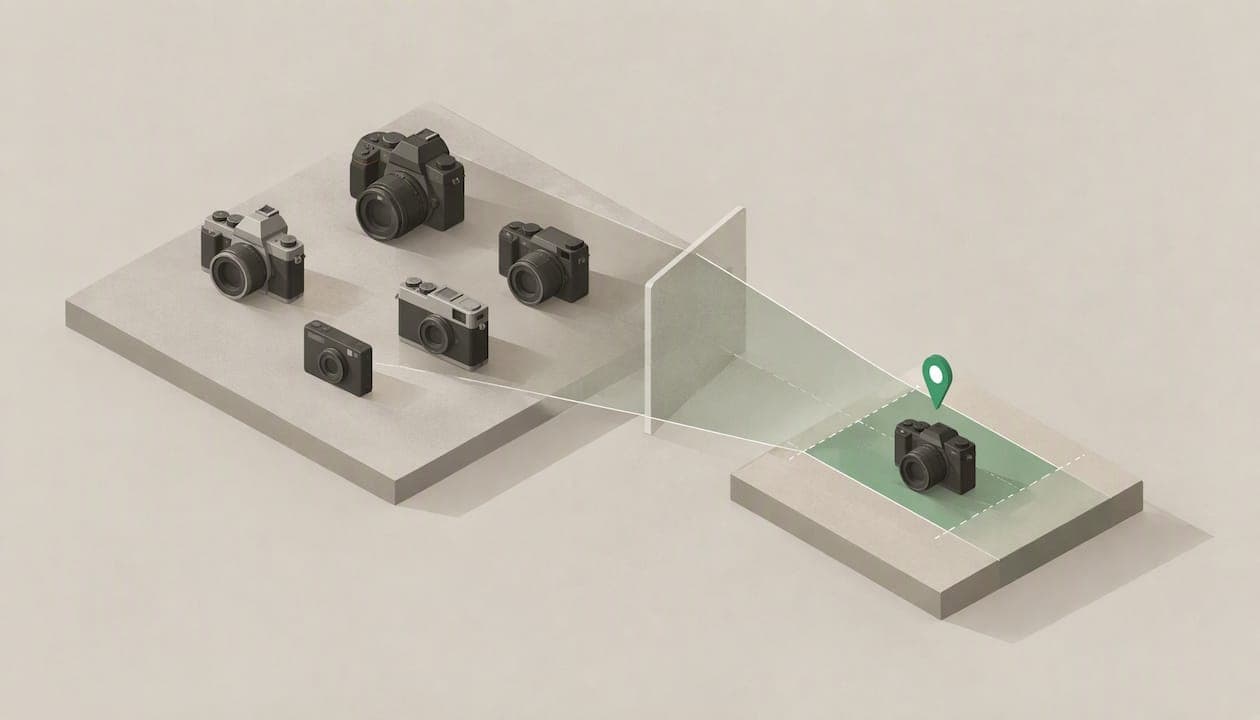
The right price for a used camera is what buyers have recently paid for the same model in the same condition, not what sellers are asking. Pull a handful of sold listings for the exact body, throw out the extremes, adjust for shutter count and accessories, and price inside the range that remains. The same method works for watches and phones, and this guide walks through it step by step.
TL;DR
- Use sold prices, not asking prices. Asking prices show what sellers hope for, and sold prices show what buyers actually paid.
- Collect five or more comps of the exact model, drop the unusually high and low results, and price inside the middle range.
- Shutter count, battery health, glass condition and key accessories move the price. Missing ordinary boxes and caps usually do not.
- Watches and iPhones follow the same logic, but the details that make a comp valid differ.
- Doing this by hand takes time. PricexPoint automates the comp search and shows the sales behind each estimate.
Table of Contents
- Why sold prices beat asking prices
- How to find comparable sales, step by step
- What moves the price: condition, shutter count and accessories
- A worked example
- Pricing used watches
- Pricing a used iPhone
- Our perspective: evidence first, always
- Do it faster with PricexPoint
- Common mistakes when pricing used cameras
- FAQ
- Sources
Why sold prices beat asking prices
Open any marketplace and search for a camera body: the listings will span a huge range. Some sellers want a premium because they have not checked the market. Others undercut to move quickly. Some listings have sat unsold for months because the price is fantasy.
Camera Traders, a camera retailer, advises researching current market prices with eBay's sold-items filter, because asking prices show what sellers want rather than what buyers actually paid. It admits the results may run somewhat high or low, but says the general trend tells you what to expect. That is the right mindset: a sold listing is evidence, not a verdict.
Three kinds of price data exist, and it helps to keep them apart:
| Price type | What it tells you | How much to trust it |
|---|---|---|
| Sold | What a buyer actually paid | High |
| Asking | The ceiling sellers are testing | Low on its own |
| New | The retail anchor, if the model is still sold | Context only |
Asking prices are still useful in one way: they show your competition. If you price at the middle of recent sold results while ten active listings sit far above, you will probably sell first. If active listings sit below the sold range, the market is softening and you should price toward the low end.
How to find comparable sales, step by step
1. Identify the exact model
Incorrectly identified models commonly lower offers, according to Amateur Photographer's guide to getting the best price for used cameras and lenses. Cameras come in near-identical generations (a Mark II and a Mark III, a kit body and a body-only version). Read the model name off the front plate or the menu, and note the lens if one is included. A lens kit is a different product from a bare body.

2. Search sold and completed listings
Jim Grey's guide to valuing an old camera recommends searching the exact camera on eBay and filtering to Sold and Completed items. Then compare sales that match yours in condition and included accessories. Skip the "best offer accepted" ambiguity where you can: if the final price is hidden, treat that sale as less reliable.
3. Gather at least five comps
One sale is an anecdote. Five or more is a pattern. For a rare or older camera you may only find two or three, and then you should widen the date window rather than the model range.
4. Remove the outliers
This is the step most sellers skip. Grey's worked example is a working Minolta Maxxum 7000i with a Minolta 35-70mm lens. The observed sales were $65, $54.05, $10.50, $35 and $49.50. The $10.50 sale looks like a broken unit, a mislabeled listing or a bad auction ending, so he set it aside. That leaves a practical range of $35 to $65.
A range is more honest than a single number. Price at the top of it if your item is clean and complete, and in the middle if it is average.
5. Check the dates
Camera prices drift. A model that has just been replaced usually softens, and a camera that becomes trendy can climb. Weight recent sales more heavily than ones from a year ago, and note any sharp jump or drop that suggests the market has moved.
What moves the price: condition, shutter count and accessories
Two cameras of the same model can sell for very different amounts. Here is what matters most, based on a dealer's view in the Amateur Photographer guide.
Things that cut value
- High shutter count. A shutter is rated for a limited number of actuations. The more a body has used, the nearer it is to a repair, and buyers discount accordingly.
- Dead or worn batteries. An original battery that no longer holds a charge makes a body feel old.
- Scratched lens glass. Optical damage is hard to fix and buyers pay less for it.
- Signs of impact. Dents, cracked housings or loose parts suggest drops.
Things that add value
Important accessories are reflected in pricing. For lenses that means items like a tripod collar, a case or a lens hood. For bodies, extra original batteries, a charger and a grip count for something.
Things that barely matter
Missing ordinary boxes and caps typically have little effect on price. The lesson from a dealer: functional risk matters more than cosmetic completeness. Spend your effort proving the camera works, not hunting for the original packaging.
A practical adjustment checklist
- Read the shutter count from the file metadata or a free reader for your brand, and put it in the listing.
- Test every button, dial, port, card slot and the flash.
- Inspect the sensor with a bright, evenly lit shot at a small aperture, looking for dust or marks.
- Shine a flashlight through each lens to check for fungus, haze and scratches.
- Photograph the camera as-is, including flaws. Buyers pay more when they trust the listing.
Then compare your findings with the comps. If your shutter count is far below the typical sold example, price at the top of the range. If your body is worn, price toward the bottom, or below it.
A worked example
Say you are selling an entry-level DSLR with its kit lens. You search for the model, filter to sold listings, and find six recent sales: $285, $300, $310, $295, $120 and $330. The $120 sale was marked "for parts or not working," so you exclude it. The remaining five run from $285 to $330.

Your camera has a low shutter count, a charger and a spare battery, and a clean lens. That puts you near the top of the range, so you list at $325 to $330 and leave a little room for an offer. If it had a worn grip and a dead battery, you would list nearer $290.
You can check real examples of how this looks for popular models: see what a Nikon D3500 or a Canon EOS Rebel T7 sells for, or look at a rugged compact such as the Nikon COOLPIX W300. For something at the premium end, the Leica M11 page shows how sold prices behave for a high-value body. Older film and camcorder models have pages too, such as the Canon T50, the Canon 200EG and the Samsung SC-D353.
Pricing used watches
People search for watch resale value and watch comps because watches are even more variable than cameras. The principle is the same, but the comp has to match on more points:
- Exact reference number, not just the model name. Two watches from one line can differ by thousands.
- Box and papers. On collector watches, the original box and warranty card are often part of the price, unlike on cameras, where boxes barely count.
- Service history and originality. Replaced dials, hands or bracelets reduce value for collectors.
- Condition of case. Heavy polishing can lower it.
- Sale channel. Auction results, dealer prices and private sales are different markets.
Auction results show the top of the market. For example, a single Christie's Geneva sale of collector's watches realised more than $43 million, with the auction house describing fierce competition among bidders. Those figures reflect rare, high-grade pieces, so do not use them to price an everyday watch. For ordinary watches, work from recent sold listings of the same reference in similar condition, and treat auction totals as context. Aggregators of auction outcomes such as Watch Collecting's sold watches page show how many pieces change hands at auction, which is useful for gauging demand for collectible references.
The same steps apply: gather five comps, drop the outliers, adjust for box and papers, and price inside the range.
Pricing a used iPhone
Phones are the easiest of the three to price because the models are standardized. Start with a trade-in figure as your floor. Apple's Trade In page gives estimated values that vary by condition, year and configuration, and the actual value depends on Apple receiving a device that matches your description. A trade-in estimate can change after physical assessment if the device does not match what you entered, as explained in Applesfera's coverage of Apple's trade-in fine print. The same article notes that accessories like boxes or cables are not required and do not raise the trade-in value.
A private sale will usually beat a trade-in, because you take the margin that a program keeps. Compare sold listings for the same model, storage size, carrier status and battery health. A phone in ordinary used condition should be priced at a realistic point in the range, not the ceiling, as The Mac Observer argued about trade-in credits. Prices also fall when a new model launches, so sell before the new release if you can.
For other electronics, the checklist is identical: exact model, storage or configuration, working condition, and a window of recent sold prices. If you want the general method for any category, our guide to calculating resale value of almost anything covers it, and the approach to pricing a used bike shows the same logic in a different market.
Our perspective: evidence first, always
We built PricexPoint because pricing by hand is slow and easy to get wrong. A single filtered search is only the start: you still have to sort out wrong models, broken-unit sales, bundles and listings that were never real transactions. Our view is simple. A price should come with the sales behind it, and if there is no evidence, there should be no number.
That is why our estimates link to actual sold listings from several marketplaces, name the data sources, and let you correct the item identification so the comparison is for the right model. Buyers can use the same evidence to check whether a seller's price is fair, and sellers can use it to defend theirs.
The biggest mistake we see is anchoring on a single high listing and waiting months for it to sell. The second biggest is pricing off a single low sale and giving away margin. A range built from several comps protects you from both.
— PricexPoint
Do it faster with PricexPoint
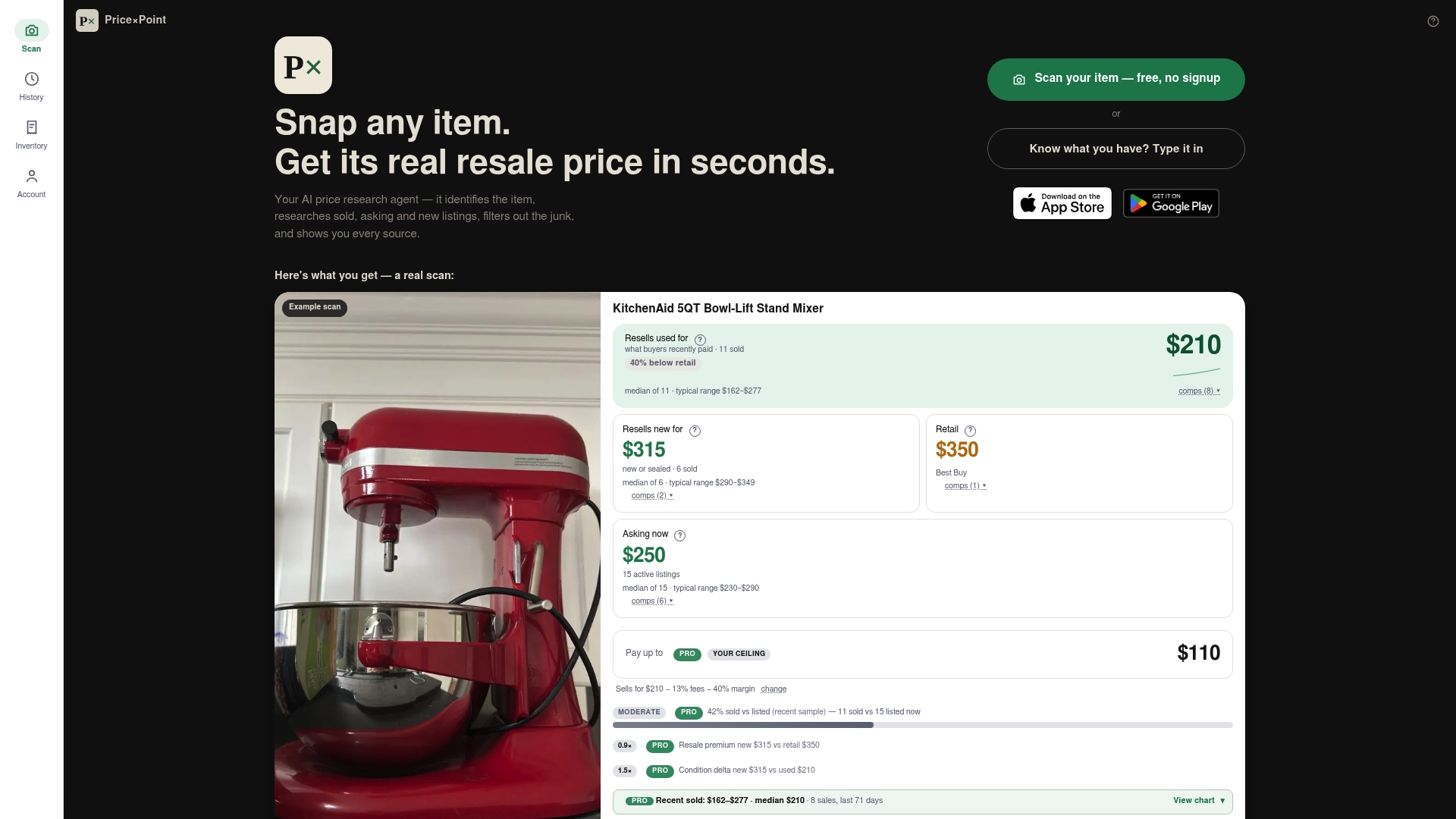
If you price more than a few items, the manual method adds up. With PricexPoint you snap a photo or type the name, and the app identifies the item and returns sold, asking and new listings across multiple markets, with unreliable listings filtered out and links to the sales. For a stock of items, it supports bulk pricing from a CSV or a photo of several items, and it saves your scan history with export options.
There is a free tier to try it. Paid plans are Basic at $4.99 per month, Pro at $9.99 per month and Power at $24.99 per month. If you would rather not subscribe, token packs are a one-off purchase: 100 tokens for $5.99, 300 tokens for $12.99 and 1000 tokens for $34.99. See the details on the pricing page, or browse real sold prices by item before you sign up.
Common mistakes when pricing used cameras
- Using asking prices as comps. They are a wish list, not a record.
- Comparing different kits. A body-only sale and a body-with-lens sale are separate products.
- Ignoring shutter count. Two identical bodies can be worth quite different amounts if one has been used heavily.
- Overvaluing the box. For most cameras, a missing box matters little compared with function.
- Keeping outliers. A parts-only sale or a mislabeled bundle will drag your average the wrong way.
- Never repricing. If a listing sits without interest for a couple of weeks, check the latest sold prices and adjust.
- Hiding flaws. Undisclosed damage leads to returns and disputes, which cost you more than an honest, lower price.
FAQ
How much does an old camera cost?
It depends entirely on the model, condition and what is included. A common entry-level body can sell for a few hundred dollars, while a clean vintage film camera or a premium mirrorless body can go far higher. Check sold listings for your exact model rather than relying on a general figure.
How do I find a camera's resale value?
Search the exact model, filter to sold and completed listings, and collect at least five comparable sales. Remove unusually high and low results and adjust for shutter count, condition and accessories. The remaining range is your realistic resale value.
Does shutter count affect what a used camera is worth?
Yes. A high shutter count is one of the things that commonly reduces offers, along with dead batteries, scratched lens glass and a wrongly identified model. A low count is a selling point worth stating in your listing.
Does it matter if I lost the original box?
For most cameras, very little. Dealers say missing ordinary boxes and caps have little effect, while accessories such as a tripod collar, case or lens hood can be reflected in the price.
Is trade-in or private sale better for a used iPhone?
Trade-in is easier and gives a firm estimate, but the value can change after inspection if the phone does not match your description. A private sale usually brings more money if you are willing to handle listing and shipping.
Sources
- What to look for when you're buying a used camera, Camera Traders
- How to find out what your old camera is worth, Down the Road
- Getting the best price for used cameras and lenses, Amateur Photographer
- Important Watches, Christie's
- Sold Watches, Watch Collecting
- iPhone Trade In, Apple
- Cuánto te paga Apple por tu viejo iPhone, Applesfera
- The Trade-In Mistake on iPhone 18 Pro Pre-Order Morning, The Mac Observer