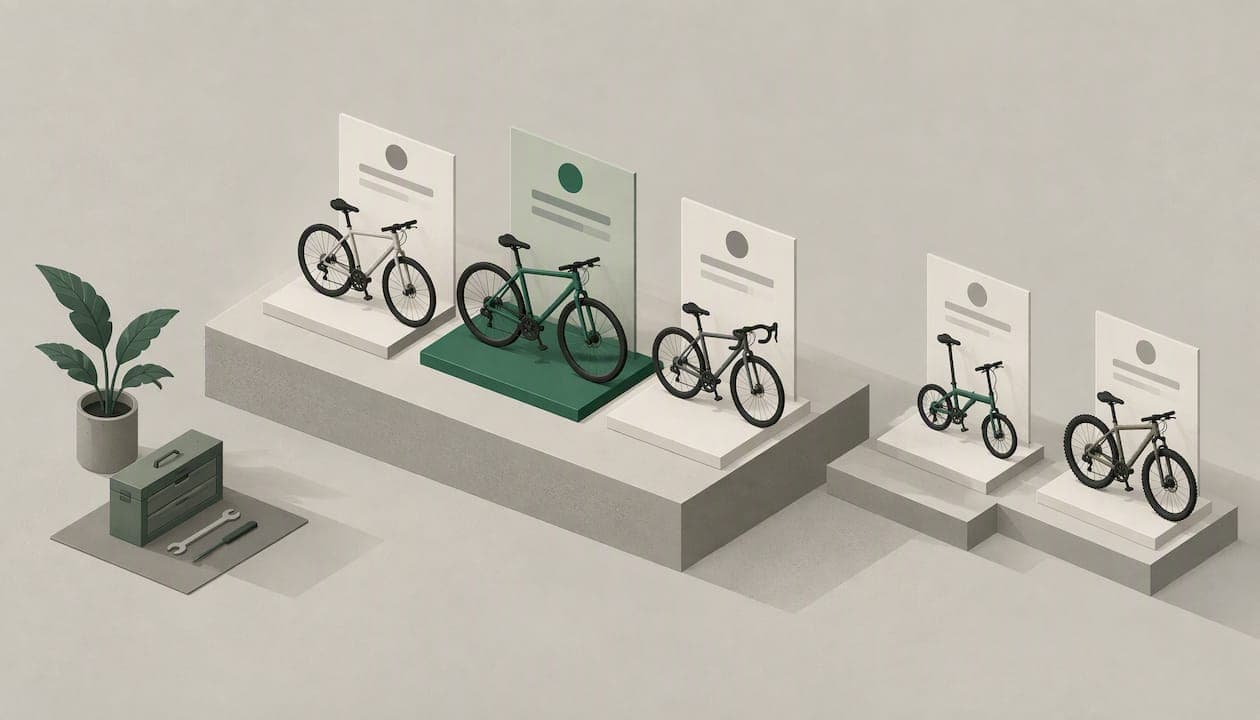
A used bike is worth what a comparable bike recently sold for, not what you paid and not what other sellers are asking. To price one, find five to ten sold listings for the same model, year, size and condition, take the middle of that range, then adjust for your bike's wear, extras and the time of year. The rest of this guide shows how, with real depreciation benchmarks and a worked example.
TL;DR
- Bikes lose the most value in year one, then fall more slowly. Treat depreciation as a sanity check, not a price.
- Price from sold listings, not asking prices. Asking prices show seller hope, sold prices show buyer behavior.
- Use the median of 5 to 10 true comparables, or the 25th to 75th percentile band, and ignore extremes.
- E-bikes are priced on battery health first. Spring listings beat winter ones.
- Buyers should check the serial number and ask for proof of ownership before paying.
Table of Contents
- Why bike resale values are hard to pin down
- Start with depreciation benchmarks
- Asking prices lie, sold prices do not
- A step-by-step method to price a used bike
- Adjustments that move the price
- Pricing e-bikes: battery first
- Where to sell, and what it does to the price
- Our perspective on bike pricing
- Let the app do the comp-hunting
- Buying used: price it fairly and check it is not stolen
- Common pricing mistakes
- FAQ
- Sources
Why bike resale values are hard to pin down
Cars have value guides. Bikes mostly do not. The same frame can be worth very different amounts depending on size, groupset, tire wear, local demand and even the month. A 56 cm road bike in a flat city with a big commuter crowd sells differently than the same bike in a mountain town where everyone wants a 29er.
That is why a single number from a generic calculator often misleads. Generic formulas apply a flat depreciation percentage and cannot see scarcity or oversupply. If three similar gravel bikes were just listed in your area, your bike is worth less this week than last month. Real market data catches that. A formula does not.
The good news is that the data exists. Every major marketplace shows what bikes actually sold for, and with a little discipline you can turn those sales into a defensible price in about ten minutes.
Start with depreciation benchmarks
Before you look at listings, get a rough range from the bike's age. One bike retailer's analysis of used-bike transactions puts the first-year loss at roughly 20 to 35% of the original retail price, because the new-bike premium disappears the moment the bike leaves the shop. The same source says values then drop about 10 to 15% a year in years two and three, and flatten after about five years, when a bike tends to hold 20 to 30% of its original price.
Here is what that looks like for a bike that cost $2,000 new. These are illustrative ranges built from those percentages, not quotes:
| Age | Rough share of original price | Example on a $2,000 bike |
|---|---|---|
| Under 1 year | 65 to 80% | $1,300 to $1,600 |
| 2 to 3 years | roughly 50 to 65% | $1,000 to $1,300 |
| 5+ years | 20 to 30% | $400 to $600 |
Treat these as a fence, not a price. If your bike is three years old and your comps say 25% of retail, either your bike is a poor seller or your comps are the wrong bikes. If your estimate lands far above the fence, check it again before you list.
Two things break the curve. Rare or in-demand models can hold value far better, and bikes sold during a shortage can even sell near retail for a while. Oversupplied, heavily discounted models fall faster. Neither shows up in a depreciation table, which is why sold data matters.

Asking prices lie, sold prices do not
Most sellers open a marketplace, search their model and anchor on the first few listings. Those are asking prices. Many sit unsold for weeks because they are too high. Experienced resellers know that asking prices represent the most optimistic end of the market, and they use the 25th to 75th percentile of actual transactions as a fair-value band. That filters out both the dreamers and the panic sellers.
A cleaner version of the same idea: calculate the median from 5 to 10 comparable sold or delisted listings instead of averaging asking prices. The median ignores the one oddball sale that would drag an average up or down. We wrote more about the trap of leaning on a single result in why one high sale can mislead.
What counts as a true comparable
A comp must match on the things buyers actually filter by:
- Model and model year. A 2021 and a 2024 version of the same bike can have different groupsets and geometry.
- Frame size. Extreme sizes (XS and XL) are slower sellers and often sell for less.
- Component level. Check the drivetrain, brakes and fork. A model name can hide three spec tiers.
- Condition. Compare your bike to listings with similar wear in photos, not the best-looking one.
- Sale type. Sold, not asking. Local pickup and shipped sales can differ too, because shipping a bike is a hassle.
A step-by-step method to price a used bike
- Identify it exactly. Read the model name and year from the top tube, downtube or seat tube decals. Check the frame serial number, usually stamped on the underside of the bottom bracket shell. Write down the component groupset, wheel size and frame size.
- Find the original retail price. Look up the manufacturer's price for that model year. You need it for the depreciation fence.
- Collect 5 to 10 sold comps. Use sold or completed listings on the marketplaces you might sell on. Save the link, price, date and condition notes for each.
- Throw out the outliers. Drop the very cheapest (often parts-only, damaged or distress sales) and the very highest (often a bundle, a rare spec or a sale with extras).
- Take the median. That is your baseline for a bike in typical condition.
- Adjust for your bike. Move the price up or down for condition, upgrades, missing parts and timing (details below).
- Set two numbers. A listing price a little above your baseline to leave room for negotiation, and a walk-away floor you will not go below.
A worked example
Say you own a three-year-old aluminum gravel bike that cost $1,800 new. Your depreciation fence is roughly $900 to $1,200. You find eight sold comps of the same model in sizes close to yours: $780, $850, $900, $925, $950, $975, $1,000 and $1,350. The $780 sale was a cracked-paint bike with worn tires, and the $1,350 included a dropper post and carbon wheels. You drop both and are left with six sales whose median sits at $937.50. Your bike has a fresh chain and new bar tape, so you list at $1,000, ready to accept $925 to $950. That is a price you can defend, because every number came from a bike that really sold.
Adjustments that move the price
Condition and maintenance
Buyers pay for a bike that looks cared for. A thorough cleaning, a serviced drivetrain and fresh bar tape help it photograph and sell better. Worn chains, cassettes, brake pads and tires are bargaining chips for the buyer, so either replace the cheap ones or knock the cost off your price.

Upgrades rarely pay back
Do not expect to recover what you spent on parts. One retailer's analysis says upgrades such as carbon wheels or a power meter typically return only 30 to 50 pence per pound spent. In dollars, expect well under half. List the upgrades in your description because they help your bike stand out, but do not add their full cost to the price.
Original parts and paperwork
Original receipts, a manual, the stock parts you swapped out and any service records all build confidence. They also help in a theft check, covered below.
Seasonality
Timing matters. According to the same analysis, late autumn and winter listings tend to fetch 10 to 15% less than those posted in the spring and early summer peak. If you can wait, listing between March and June gives you more buyers. If you must sell now, price to your comps and be ready to move on the first reasonable offer rather than letting the listing go stale.
Pricing e-bikes: battery first
An e-bike is a different asset. The frame and motor matter, but the battery drives the price. One e-bike resale guide says a battery below about 70% of its original capacity often needs replacing, at a cost of $400 to $900 depending on the model. That cost should come straight out of the price you ask or accept.
If you are selling, give buyers evidence:
- Charge-cycle count or a diagnostic report from the manufacturer's software.
- Both keys or keycards for the battery lock. The same guide says missing keys are a financial risk that justifies a steep discount.
- The charger and any original accessories.
If you are buying, ask for the same things and find a comp with a similar battery age. A cheap e-bike with a tired battery is rarely cheap. When you inspect one, look for the serial number on the battery compartment, the controller housing or the frame plate near the motor mount, as one valuation guide advises.
Where to sell, and what it does to the price
The same bike nets different amounts depending on the channel:
| Channel | Typical effect on price | Best for |
|---|---|---|
| Local classifieds and community groups | Highest net, no fees, but slower and involves meetups | Bikes that are awkward to ship |
| Auction-style marketplaces | Broad audience, fees, shipping complexity | Rare or sought-after models |
| Consignment at a bike shop | Lower net, little effort | Sellers who value convenience |
| Trade-in or dealer buyout | Lowest price, fastest | Sellers who need cash now |
Fees and cut-rates vary, so subtract them before you compare. If you are weighing local classifieds, our guide to pricing on Facebook Marketplace walks through how to keep more of the sale.
Our perspective on bike pricing
We built PricexPoint around one belief: a price number is only useful if you can see where it came from. Bike pricing is where that matters most. A model name, a size and a few photos can hide a lot of variation, and a figure with no evidence behind it invites you to overprice or to leave money on the table.
So we do not give a figure without supporting evidence. Our estimates link back to actual sold listings across several marketplaces, name every data source, and let you correct the item identification when the app guesses the wrong trim or year. That last part matters for bikes, where two models can look almost identical and differ by hundreds of dollars.
Our advice, whether you use our app or a spreadsheet: collect sold comps, discard the extremes, take the median and be honest about condition. A bike that is priced from evidence sells faster than one priced from hope.
— PricexPoint
Let the app do the comp-hunting
If you would rather not scroll through completed listings by hand, PricexPoint lets you snap a photo of your bike or type its name. It returns sold, asking and new-price data with links to the underlying sales, so you can check each comp yourself. You can try it with the free tier. Paid plans start at Basic for 4.99 $ per month, with Pro at 9.99 $ per month and Power at 24.99 $ per month. If you only need a few lookups, token packs are a one-off 5.99 $ for 100 tokens, 12.99 $ for 300 or 34.99 $ for 1000. See the current options on the pricing page, or browse real sold prices for used items to see how the data looks.
Buying used: price it fairly and check it is not stolen
Everything above works for buyers too. If the asking price is well above the median of sold comps, you have negotiating room. If it is far below, ask why.
A price far under the market is a warning sign. Before you hand over money, run a short security check. The city of Portland's police bureau recommends locating the frame serial number, checking it against registries such as Bike Index, Project 529 Garage or Bike Register, and asking for proof of ownership like a receipt or a bill of sale. If the seller refuses, or the number looks altered or missing, walk away.
A clean registry result is not proof of ownership, so treat it as one piece of evidence alongside the paperwork and the seller's story. Meet in a public place, ask how long they have owned the bike and why they are selling, and get a written bill of sale for anything valuable.
Common pricing mistakes
- Pricing from what you paid. The new-bike premium is gone. Buyers compare you to other used bikes, not to a showroom.
- Using asking prices as comps. They overstate value, as covered above.
- Counting upgrades at cost. Parts return a fraction of what you spent.
- Ignoring size. A rare size can make a good bike slow to sell.
- Listing in the wrong month. A winter listing may take longer and sell lower.
- Not saving the comps. When a buyer pushes back, links to real sales are your best argument. For collectible or vintage frames, the same discipline applies as in our guide to pricing collectibles.
FAQ
How do I find out how much my bike is worth?
Identify the exact model, year and size, then find 5 to 10 recently sold listings for the same bike in similar condition. Take the median of those prices and adjust for wear, upgrades and season. Check the result against the depreciation fence for your bike's age.
How much value does a bike lose each year?
One retailer's analysis of used-bike sales puts first-year losses at 20 to 35% of the original price, with about 10 to 15% a year after that, flattening after five years. Scarce models can beat that and oversupplied ones can fall faster, so use sold comps for the final number.
Should I price a used bike by asking prices or sold prices?
Use sold prices. Asking prices reflect what sellers hope for, and many of those listings never sell at that figure. Sold prices show what buyers really paid.
What lowers an e-bike's resale value the most?
Battery health. A battery below roughly 70% of its original capacity may need replacing, which can cost $400 to $900. Missing keys, no charger and no diagnostic data also reduce what buyers will pay.
Sources
- Bicycle depreciation and residual value guide (CT Yeh)
- How much is my bike worth? (Cyclesite)
- How much is my e-bike worth? Resale value guide (Leoguar Bikes)
- Bike theft prevention (Portland Police Bureau)