
The price is whatever buyers actually paid for the same item recently, not what you hope it's worth. Pull five or more recent sold comps, take the median, adjust it down for condition, then subtract marketplace fees and shipping. That final number, not the sticker on similar "asking" listings, is your real ceiling.
TL;DR:
- Rely on at least five recent sold listings to determine a realistic price, ensuring the data is from completed sales and free of counterfeit or bundle deals.
- Adjust the median sold price based on item condition and local demand, considering sell-through rate and seasonal shifts for more accurate pricing.
- Deduct platform fees and estimated shipping costs from the sale price to find the actual net profit, not just the asking or median price.
- Use AI tools for quick identification and bulk price checks but reserve manual research for high-value or unique items with limited sales history.
- Match your pricing strategy to the buyer demographic and emphasize speed in-store decision-making to maximize overall profit margins.
Table of Contents
- Thrift Store Pricing: The Sold-Comps Method, Step By Step
- The 30-Second Aisle Check: Price Before You Buy
- How Condition, Rarity, and Sell-Through Change Your Number
- Net Take-Home: The Math Sellers Skip
- When to Let AI Handle the Comp-Hunting
- Building a Fast In-Store Pricing Workflow
- Why Timing and Location Move Your Price
- Recognizing Brand Value Hiding in Plain Sight
- Pricing for the Buyer You're Actually Selling To
- The Pricing Mistakes That Quietly Kill Margins
- A Practitioner's Note on Discipline Over Instinct
- Try Pricexpoint: Instant Comps Without the Spreadsheet
- Sources
- FAQ
Thrift Store Pricing: The Sold-Comps Method, Step By Step
Every pricing mistake in resale traces back to the same root cause: using the wrong data source. Asking prices are wishes. Sold prices are facts. An item listed for $80 that's been sitting for four months tells you nothing except that the seller is hopeful. An item that sold for $42 three times last week tells you what the market will actually pay right now.
Start by pulling comps from completed sales, not active listings. On eBay, that means filtering by "Sold Items," then narrowing by condition, brand or model, and a recent date window, ideally the last 30 to 90 days. Other platforms make this harder. Poshmark, Mercari, Depop, and Etsy each hide or surface completed sales data differently, so you may need to check multiple sources or rely on a tool that aggregates them for you.
Once you have your comps, throw out the noise. Counterfeit listings, bundle deals, and installment-price artifacts (where a "sold" price reflects four payments of $20, not $80 total) will drag your median in the wrong direction. Filtering these out before you calculate is not optional; it's the difference between a real number and a corrupted one.
Now do the math:
- Gather at least five recent sold comps matching condition and completeness.
- Take the median (the middle value), not the average, since one high or low outlier skews an average badly.
- Multiply the median by a condition factor, typically 0.6 to 1.0 depending on wear.
- Subtract marketplace fees and estimated shipping cost.
Statistic to remember: Resale pricing guides consistently recommend a floor of five comparable sold listings before you trust a median. Fewer than that, and a single lucky or desperate sale can distort your entire price.
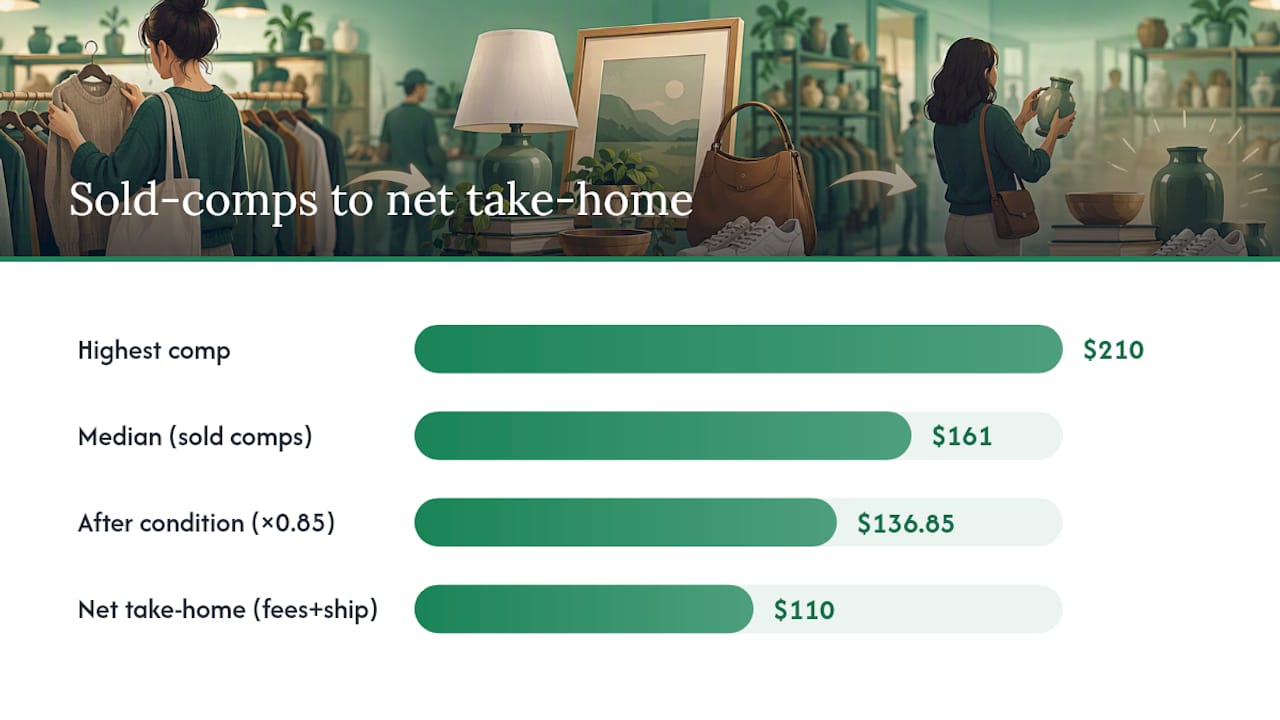
Here's a quick-worked example. Say you find a used KitchenAid stand mixer at a thrift store. You pull six sold comps in the last 60 days: $145, $150, $160, $162, $175, $210. The median is $161. The mixer you're holding has some cosmetic scuffing but works fine, so you apply a 0.85 condition factor: $161 × 0.85 = $136.85. Subtract a $15 estimated marketplace fee and $12 shipping, and your net take-home lands around $110. That's your real number, not the $175 outlier that made you excited in the first place.
The 30-Second Aisle Check: Price Before You Buy
You don't get to run a full pricing workflow while standing in a thrift store with a cart full of finds and a line forming behind you. You need a compressed version that still protects your margin. The goal is a confident buy or pass in well under a minute.
Here's the compressed version:
- Snap a photo or type the item name for a quick identification.
- Pull sold comps immediately, even a rough glance at five recent sales beats guessing.
- Check the median sold price against the marked thrift price.
- Glance at sell-through rate, meaning how many of the recent listings for this item actually sold versus sat active.
- Apply a mental floor: if your expected ROI after fees is under roughly 30 to 40%, or if the item hasn't sold more than once or twice in 90 days, pass.
Low sell-through is the trap that catches new resellers constantly. A pair of sneakers with one $300 sale and fifteen unsold active listings looks like a goldmine until you realize that $300 sale might have been a fluke, and your pair could sit for six months.
Pro Tip: If you can't confirm three to five matching comps in under a minute, treat the item as low-confidence. Either pass, or only buy if the thrift price is already deep enough that you'd profit even on a worst-case resale.
How Condition, Rarity, and Sell-Through Change Your Number
A median sold price is a starting point, not a finished price. Condition and how fast similar items actually move both push that number up or down before it becomes your listing price.
Most experienced resellers work off four rough condition tiers:
- Like-new / unworn: 90 to 100% of median, tags attached or barely used items hold full value.
- Excellent / gently used: 75 to 90% of median, minor wear that doesn't affect function or appearance from a normal viewing distance.
- Good / visible wear: 55 to 75% of median, noticeable scuffs, fading, or minor flaws buyers will factor into their offer anyway.
- Fair / heavily used: 30 to 55% of median, functional but showing real age or damage.
Sell-through rate is the number that keeps your condition-adjusted price honest. It's calculated as sold listings divided by sold plus active listings, times 100. A rate above 50% is considered hot, 30 to 50% is solid, and anything under 20% signals a slow mover regardless of how attractive the median looks.
This matters because a high median paired with a low sell-through rate is a warning sign, not a green light. One or two sales in 90 days with dozens of unsold active listings means the market is flooded, and your item could sit for months even at a fair price. Seasonality compounds this: a used snowblower's median might spike in November and collapse by March, and a mixer missing its original box or attachments should be priced against comps with the same gaps, not against pristine complete sets.
Net Take-Home: The Math Sellers Skip
The sold-comp median is not your profit. It's the top-line number before marketplace fees and shipping take their cut, and skipping that subtraction is how resellers convince themselves a bad flip was a good one.
Marketplace fees typically run somewhere between 10 and 15% of the sale price, though the exact figure varies by platform and category, so it's worth checking current fee schedules before you commit to a price. Shipping is the other silent margin killer. Buyers increasingly expect free shipping, which means the cost doesn't disappear, it just gets baked into your list price instead of charged separately. If you ignore that, you'll underprice the item and eat the shipping cost out of your own profit.
Here's the calculation in order:
- Find your median sold price from filtered comps.
- Apply your condition factor.
- Subtract estimated marketplace fees.
- Subtract estimated shipping cost.
- What's left is your real net take-home.
| Step | Example figure |
|---|---|
| Median sold price (5+ comps) | $161 |
| After condition factor (0.85) | $136.85 |
| Minus marketplace fee (~10%) | $15 |
| Minus estimated shipping | $12 |
| Net take-home | $110 |
That last row is the number that actually matters. Everything above it is just steps to get there.
When to Let AI Handle the Comp-Hunting
Manually filtering sold listings, tossing out counterfeits and installment artifacts, and calculating a median across multiple marketplaces takes real time, and time is the one resource resellers sourcing in bulk don't have. This is where an AI research tool earns its keep: it can gather sold, asking, and new listing data across platforms in seconds, filter out the noise automatically, and hand you a clean price range instead of forty tabs of eBay history.
That said, automation isn't the right call for everything. High-value collectibles, suspected counterfeits, or unusual items with thin sales history still deserve a slower, manual look, and possibly a specialist opinion, before you commit real money.
There are AI price research tools that fit into this workflow by allowing you to snap a photo or type an item's name, then pulling sold listings, current asking prices, and new listing data from multiple marketplaces, often linking back to actual sales so you can verify the numbers yourself instead of relying solely on an algorithm.
- Use it for fast identification when you don't recognize a brand or model on sight.
- Use it to batch-price a cart full of finds via photo or CSV upload instead of one at a time.
- Use it to double-check your own manual median before you commit cash.
Pro Tip: Run the AI estimate and a quick manual eBay sold-comp check side by side on your first few items. If they consistently agree, you can trust the faster tool for routine sourcing and save your manual research for the tricky, high-dollar finds.
Building a Fast In-Store Pricing Workflow
Speed is the actual constraint most resellers face while sourcing, not knowledge. You already know condition tiers and fee math. The problem is applying them fast enough to make dozens of buy decisions in a single thrift store visit without holding up the checkout line or losing your nerve on a good find.
A workable in-store routine looks like this: identify the item first, either by reading the label or snapping a photo for instant recognition. Then pull a price range immediately, even a rough one, rather than waiting until you get home. Compare that range against the thrift tag price and do quick mental math on your likely fees and shipping. If the gap between thrift price and expected net take-home clears your minimum bar, buy it. If it's marginal, set it aside and revisit after you've finished the rest of the store, since a full cart gives you more perspective on whether this find is genuinely good or just felt good in the moment.
The mistake most new resellers make here is treating every item with the same depth of research. That's how you end up spending fifteen minutes pricing a $4 mug while ignoring a $60 opportunity three aisles over. Reserve careful, multi-comp research for items where the price gap looks significant, and use a fast tool or a quick gut check for lower-stakes buys. The goal isn't perfect precision on every item. It's making enough good decisions, fast enough, that your average per-item profit stays healthy across an entire sourcing trip.
Why Timing and Location Move Your Price
The same item can be worth noticeably different amounts depending on when and where you're selling it, and ignoring that is how solid pricing math still produces a bad outcome.
Seasonal demand is the more predictable of the two. Winter coats, holiday decor, patio furniture, and snow gear all swing hard by month. Pull comps in October for a snowblower and you might see a healthy median. Pull the same search in April and that median could be half as high, because buyers simply aren't looking. The fix is straightforward: always check the date range on your comps, and be skeptical of a median built from sales that happened during a different season than the one you're selling in.
Local demand is trickier because it doesn't show up cleanly in national sold-comp data. A snow blower has near-zero local resale value in Phoenix regardless of what national comps say, while it might move fast and above median in Minneapolis. Regional sports team merchandise, local college gear, and climate-specific items (heavy coats, humidifiers, dehumidifiers) all behave this way. If you're selling locally through a marketplace app rather than shipping nationwide, weight your local market's active listings and recent local sales more heavily than a national median, even when a national tool is your starting point.
The practical rule: use national sold comps as your baseline, then adjust up or down based on the current month and your actual selling region before you commit to a final list price.
Recognizing Brand Value Hiding in Plain Sight
Thrift stores routinely mis-tag valuable brands as generic merchandise, and that gap between shelf price and real resale value is where experienced resellers make their margin. A plain-looking sweater with no visible logo can still carry a designer label sewn into the collar. A scuffed pair of boots might be a limited colorway worth four times what an identical-looking generic pair sells for.
The skill here isn't memorizing every brand, it's building the habit of checking labels, tags, and stitching details before you price anything from a "generic" bin. Vintage clothing especially rewards this kind of scrutiny: a decades-old band t-shirt or a discontinued denim cut can carry serious collector value that has nothing to do with the item's physical condition. Brand recognition also extends to model numbers and generation markers on electronics and appliances. A stand mixer or blender that looks identical to a newer model might be an older, more sought-after version that collectors specifically hunt for.
Once you've identified a brand or model with real resale demand, treat your sold-comp search accordingly: filter specifically by that brand and model, not just the general item category, since generic category comps will badly undervalue anything with genuine brand equity. This is also where a quick photo-based identification tool earns its keep, since it can catch a logo, tag, or model number your eye might skip past in a crowded rack.
Pricing for the Buyer You're Actually Selling To
The same jacket priced at $45 might sell in three days on one platform and sit for three months on another, and the difference usually isn't the jacket. It's who's shopping there. Marketplace demographics shape what a "fair" price looks like far more than most resellers account for.
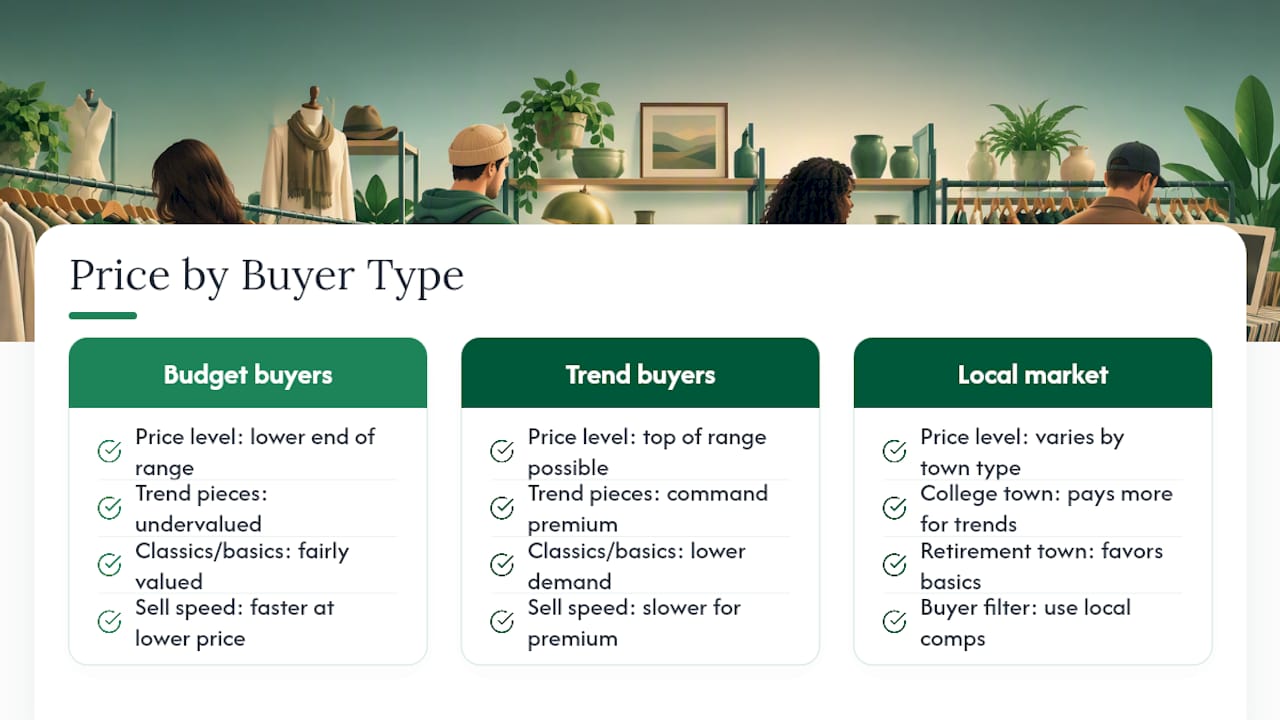
A platform skewing toward younger, trend-driven shoppers will support higher prices on current streetwear and lower prices on classic, formal, or "parent generation" brands, regardless of actual quality or original retail cost. A platform with an older or more budget-conscious buyer base will do the opposite, undervaluing trend pieces and paying reasonably for practical, durable basics. Local marketplace apps add another layer: a buyer base in a college town will pay differently than a buyer base in a retirement community, even for the exact same physical item.
This means your sold comps need a demographic filter, not just a condition filter. If you're listing on a platform or in a local market where your typical buyer skews budget conscious, price closer to the low end of your condition-adjusted range to move inventory faster. If your buyer base skews toward collectors or trend chasers willing to pay a premium for the right item, you can price closer to the top of your range and accept a slightly longer sell time in exchange for a better margin. Matching your price to the actual buyer in front of you, rather than a generic national average, is often the difference between a two-week sale and a two-month one.
The Pricing Mistakes That Quietly Kill Margins
Most pricing mistakes in resale aren't dramatic, they're small, repeated errors that add up across dozens of items. The first and most common is anchoring on active listings instead of sold ones. Seeing three other sellers ask $60 for the same jacket feels like validation, but if none of those listings have actually sold, you're pricing against hope, not demand.
The second mistake is using average instead of median. A single outlier sale, whether unusually high or suspiciously low, drags an average in the wrong direction. Median resists that distortion because it simply reflects the middle of the pack, which is why every serious pricing formula defaults to it.
The third mistake is forgetting fees and shipping until after the item sells, at which point you're stuck with whatever margin is left rather than the margin you planned for. Build the subtraction into your price before you list, not after you get paid.
The fourth mistake is ignoring sell-through rate entirely and chasing the highest median you can find. A dazzling median built on one or two sales in three months is a trap, not an opportunity, since low sales volume alongside a high price often means the item simply isn't in active demand.
Finally, treating every item with the same pricing depth wastes time on low-value finds and rushes the high-value ones. Match your research effort to the size of the opportunity in front of you.
A Practitioner's Note on Discipline Over Instinct
Educated guessing feels efficient until you've sat on unsold inventory for two months. Sold comps are slower in the moment but faster over a full sourcing season, because they stop you from buying items that only look good on a shelf. The real skill isn't speed or accuracy alone, it's knowing which one the situation calls for: fast in-aisle judgment for routine buys, and a slower, comp-heavy pass once the item is home and about to get listed.
— Ish
Try Pricexpoint: Instant Comps Without the Spreadsheet
Pricexpoint turns the sold-comp workflow above into a single photo scan instead of twenty open browser tabs. Snap a picture or type an item's name, and you get real sold, asking, and new listing prices pulled from multiple marketplaces, each one linked back to its actual source so you can verify the number yourself.
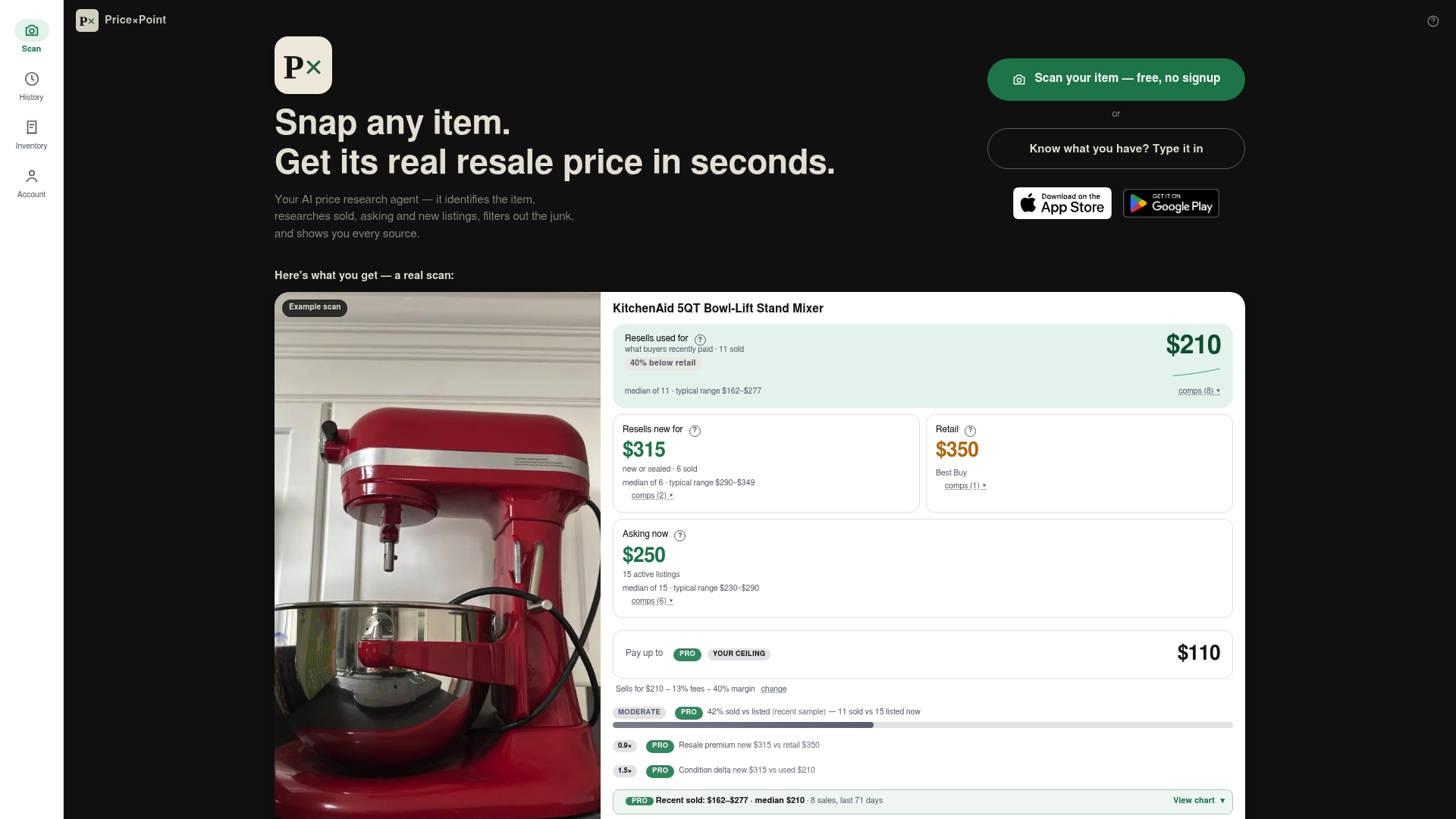
For resellers pricing one item at a time, the free lookup tool is the fastest way to sanity-check a thrift find against real market data before you commit cash. If you're sourcing in volume, the Pro plan runs $9.99 per month and supports the kind of repeat lookups a regular sourcing trip demands, while token packs starting at $5.99 for 100 tokens give you flexibility without a subscription. Compare the full lineup, including Basic and Power, on the pricing page.
Next time you're standing in front of a find you're not sure about, scan it, check the median against your own quick mental math, and see how close the two land. That single comparison will tell you more about your pricing instincts than any guide can.
Sources
For deeper reading on the mechanics above, BundleLive's guide to sold comps covers eBay's filtering process in detail, ShipBob's sell-through rate explainer breaks down the velocity math, and ResaleSonar's pricing formula walks through condition adjustments step by step.
- How to Price Items on eBay Using Sold Comps (Step-by-Step Guide) | BundleLive Blog
- Sell-through rate guide | ShipBob blog
- How to Price Items for Resale: A Simple Formula | ResaleSonar
FAQ
How Many Sold Comps Do I Need to Price an Item?
Aim for at least five recent sold comps matching condition and completeness within the last 30 to 90 days. Fewer than that, and a single unusual sale can skew your median badly enough to mislead your pricing decision.
Why Use the Median Instead of the Average?
The median resists distortion from outlier sales, whether unusually high or suspiciously low, while an average gets pulled toward whichever extreme sold. Every practical pricing formula for resale defaults to median for this reason.
What Is Sell-Through Rate and Why Does It Matter?
Sell-through rate measures sold listings divided by sold plus active listings, showing how fast similar items actually move. A rate above 50% signals strong demand, while under 20% warns that even a good median might mean months of waiting for a sale.
Can I Price Items Quickly Without Full Manual Research?
Yes, for routine or lower-value items, a fast photo scan through a tool like Pricexpoint can pull sold comps and a suggested range in seconds. Save deeper manual research for high-value or unusual finds where getting the number wrong actually costs you.
Does Pricexpoint Show Real Sold Prices or Just Estimates?
Pricexpoint links every price estimate back to actual sold, asking, or new listings across multiple marketplaces, so you can verify the source data yourself. Current plan pricing, including the free tier, is listed on the pricing page.