
AI for resellers gives fast resale price estimates by identifying items from photos or names and linking estimates to actual sold listings. We built PriceXPoint around that exact workflow. A well-designed tool handles common items quickly and reliably, but rare, modified, or heavily customized pieces still need your own judgment and a closer look at the evidence behind any estimate.
TL;DR:
- AI resale tools are most reliable for common items with abundant recent sold comps, while rare or heavily modified items still require manual judgment.
- Accurate identification relies on layered techniques like vision embeddings, OCR, and language models, but misreads and hallucinations remain risks.
- Verifying sold listing links, item condition, and serial numbers before pricing helps prevent costly mistakes and ensures estimates are evidence-backed.
- Bulk workflows and recordkeeping features are essential for high-volume resellers to save time and calibrate AI accuracy over time.
- Data privacy, marketplace permissions, and training dataset limitations can impact trustworthiness and should be carefully considered in choosing tools.
Table of Contents
- 1. What these tools do for your pricing workflow
- 2. How modern AI builds a resale estimate from a photo
- 3. Workflows for sourcing checks, bulk valuations, and listings
- 4. A checklist for verifying an AI price estimate
- 5. Where AI pricing tools fail and how to avoid costly mistakes
- 6. Privacy and data security considerations when using AI for reselling
- 7. Training data sources and customization options for reseller-specific AI models
- 8. Case studies or examples of successful AI adoption by resellers
- 9. Cost and subscription models for AI tools tailored to resellers
- 10. PriceXPoint's approach to avoiding false precision
- Try PriceXPoint: scan one item or explore the plans
- FAQ
- Sources
1. What these tools do for your pricing workflow
A capable AI price research tool starts with identification. You snap a photo or type an item name, and the system extracts the brand, model, condition, and variant details it needs to find comparable sales. From there it searches sold, asking, and new listings across multiple marketplaces and separates them clearly, because sold prices are what actually tell you what buyers paid, not what sellers hope to get.
That distinction matters for every pricing decision you make. Asking prices on open listings get inflated by sellers testing the market. New listing prices reflect retail, not resale. Sold prices are the only number that reflects a completed transaction, which is why they anchor a usable resale estimate.
For resellers working at volume, bulk workflows matter as much as accuracy. A tool that accepts a CSV of SKUs or a batch of photos and returns pricing for dozens of items at once saves hours compared to manual lookups one item at a time.
- Item identification from a photo or typed name, with attributes like brand, model, and condition pulled automatically
- Clear separation of sold, asking, and new listing prices so you know which number to trust
- Bulk scanning through CSV uploads or multi-photo batches for lot valuations
- Exportable scan history for bookkeeping, tax records, and inventory tracking
- Links to the actual sold listings behind each estimate, with timestamps showing how recent the data is
That last point separates a trustworthy tool from a black box. An estimate with no evidence trail is a guess dressed up as data.
2. How modern AI builds a resale estimate from a photo
The identification step behind these tools relies on a few distinct techniques working together, and knowing how they fit helps you judge when to trust an output and when to double-check it.
- Vision embeddings and zero-shot attribute generation. Approaches like ViOC-AG combine CLIP-style image embeddings with a task-customized text decoder, letting a model infer attributes such as color, material, or style directly from a photo without any typed description. This technique extracts attributes from images and reduces hallucination when corrected with OCR and language model outputs.
- OCR and object detection. YOLO-style detection models locate text and label regions in an image, and OCR reads serial numbers, size tags, or model codes, which anchors identification to something more concrete than visual guesswork. A YOLO and OCR pipeline deployed for real-time processing showed this combination works reliably even on visually busy source material like retail flyers.
- Fusion with prompt-based language model outputs. Candidate attributes from OCR and vision models get cross-checked against frozen language model outputs, which corrects out-of-domain predictions before they reach you as a finished estimate.
This layered approach exists because any single method has blind spots. Vision models can hallucinate attributes that aren't actually in the photo, and OCR can misread a worn label. Fusing the two is how a system catches its own mistakes before you see the result.
A real-world test of this kind of pipeline found precision of 72.9% and recall of 77.9% for product identification, which means even well-built systems miss or misidentify items often enough that confidence scores and evidence links aren't optional extras. They're the mechanism that lets you catch the gap between a model's best guess and the actual item in your hand.
3. Workflows for sourcing checks, bulk valuations, and listings
Most resellers end up using AI price research in three or four recurring situations, and each one calls for a slightly different workflow.
- Single-item sourcing. At an estate sale or thrift store, a quick photo scan gives you a price range in seconds. Check the evidence links before you buy, not after.
- Bulk lot valuation. When you pick up a storage unit or a wholesale pallet, a CSV upload or multi-photo batch scan values the whole lot at once, saving the hours a manual search would take.
- Pre-listing validation. Attaching sold-price evidence links directly to your listing description gives buyers a reason to trust your price and cuts down on lowball offers and disputes.
- Recordkeeping and calibration. Exporting your scan history and comparing it against your actual final sale prices over time shows you where the estimates run high, low, or right on target for your specific inventory.
Pro Tip: Run the AI scan before you negotiate a purchase price, not after. An estimate that comes with sold-listing evidence gives you a ceiling to negotiate against on the spot.
That recordkeeping loop is easy to skip but worth the ten extra seconds. Comparing scan estimates to what items actually sold for teaches you which categories the AI handles well and which ones need your own eye.
4. A checklist for verifying an AI price estimate
Before you commit to a purchase or publish a listing based on an AI estimate, run through a short verification pass.
- Open the sold listing links. Check the date, the platform, and the photos in each comp to confirm they actually match your item and aren't stale or from a different condition tier.
- Confirm variant and condition details. Size, color, edition, and completeness (original box, manual, accessories) can swing a price significantly, so verify these match what the AI assumed.
- Check OCR-read serial numbers and UPCs. A single misread digit can pull in comps for the wrong model entirely.
- Know when to price manually. Rare collectibles, repaired or heavily modified items, and anything with only one or two sold comps deserve your own research rather than blind trust in an automated number.
Pro Tip: If an estimate comes back with fewer than three sold comps, treat it as a starting point rather than a final number and widen your own search before pricing.
This checklist takes under a minute once it becomes habit, and it's the difference between an estimate you can defend to a buyer and one that falls apart the first time someone asks where the number came from.
5. Where AI pricing tools fail and how to avoid costly mistakes
No identification system is immune to the conditions it's photographed in. Occlusion, odd angles, and poor lighting all reduce how accurately a model can match your item to the right category, so always glance at which reference images the tool used for its match.
Zero-shot models can also generate attributes that aren't actually present in the photo, a failure mode generally called hallucination, which is why fusing OCR and prompt-based language model corrections reduces out-of-domain predictions rather than relying on vision alone.
- Niche, vintage, or region-specific items often lack enough sold comps, producing noisy or wide-ranging estimates.
- The same item can fetch very different prices across platforms or seasons, so a single estimate isn't a universal number.
- Large multimodal product datasets used to train these systems have real coverage gaps. The EMMa dataset contains 2.8 million objects but only about 69% include price data, and when multiple sources disagree, median price is typically used rather than a single authoritative figure.
That gap is exactly why showing the distribution of comps, not just one number, matters more than polish.
6. Privacy and data security considerations when using AI for reselling
Any tool that processes photos of your inventory is handling data you likely consider sensitive, whether that's images of valuable collectibles, personal documents accidentally in frame, or your sourcing locations. Before relying on a pricing app regularly, check how it handles the photos you upload: whether they're stored, for how long, and whether they're used to improving the underlying models without your knowledge.
Scan history and export features raise a related question. If you're keeping records for bookkeeping or tax purposes, you want that data to stay under your control and be exportable in a format you can archive independently, rather than locked inside a single platform.
Marketplace account connections introduce another layer. Tools that pull listing data directly from your seller accounts should be clear about what permissions they request and whether they can modify listings or only read pricing data. Read-only access for price research is a reasonable expectation; broader permissions deserve a second look at why they're needed.
For resellers handling higher-value or rare items, treating photo uploads with the same caution you'd apply to any cloud storage service is a reasonable baseline. Favor tools that are transparent about their data practices over ones that bury the details in lengthy terms you're unlikely to read closely.

7. Training data sources and customization options for reseller-specific AI models
The accuracy of any photo-based pricing tool depends heavily on what it was trained to recognize. General-purpose vision models trained on broad product datasets handle common categories like electronics, sneakers, and small appliances reasonably well, since these categories are well represented in large multimodal datasets used across the industry.
Specialized or collectible categories are a different story. Items like vintage tools, regional antiques, or discontinued hobbyist gear are underrepresented in most training sets, which is part of why sold-comp counts run thin for these categories and why estimates for them carry more uncertainty.
Some tools allow a degree of customization, letting frequent sellers in a specific niche correct misidentified attributes over repeated scans, which can improve results for that user's typical inventory over time. This kind of correction loop depends on the system actually surfacing its confidence and reasoning rather than hiding behind a single final number, since you can't correct what you can't see.
8. Case studies or examples of successful AI adoption by resellers
Resellers who adopt AI price research tend to see the biggest time savings in two specific situations: high-volume sourcing events and bulk lot liquidation. A reseller clearing out a storage unit full of mixed household goods, for example, can scan dozens of items in the time it would otherwise take to manually search sold listings for even a handful.
The pattern that separates a good outcome from a frustrating one is almost always verification habits. Resellers who treat AI estimates as a first pass, checking evidence links before finalizing a listing price, report more consistent results than those who copy the number directly into a listing without review. The tools that perform best in practice are the ones that make checking easy: visible sold-listing links, timestamps, and a clear count of how many comps fed into a given estimate.
Small resellers running a single online storefront benefit differently than someone managing inventory across multiple marketplaces at once. For the latter group, exportable scan history that reconciles against actual sale outcomes becomes a practical tool for spotting which product categories the AI handles well and which ones consistently need manual correction.
9. Cost and subscription models for AI tools tailored to resellers
Pricing for AI resale tools generally follows one of two models: a flat monthly subscription or a pay-as-you-go token system, and many tools, including ours, offer both so occasional sellers aren't locked into a recurring fee they don't need.
At PriceXPoint, our Basic plan runs $4.99 per month, our Pro plan is $9.99 per month, and our Power plan is $24.99 per month, scaling up in lookup volume and features as your selling activity grows. For sellers who prefer not to commit to a subscription, one-time token packs are available at several price points.
The right model depends on how often you're pricing items. A casual seller listing a handful of items a month gets more value from token packs purchased as needed. Someone sourcing weekly or running a bulk resale operation typically comes out ahead on a monthly plan given the volume of lookups involved.
10. PriceXPoint's approach to avoiding false precision
We built PriceXPoint around a simple rule: never show a price without showing the sold listings behind it. Every estimate links back to the actual sales we found, with the platform and date attached, so you can check our work in seconds rather than taking a number on faith.
We also ask you to confirm the item identification before locking in an estimate, because research on real-world product recognition systems recommends exposing uncertainty and inviting user confirmation rather than presenting a single confident guess. Scan history exports and bulk CSV support round out the workflow for sellers pricing more than one item at a time.
— PricexPoint
Try PriceXPoint: scan one item or explore the plans
Pricing an item shouldn't mean digging through five marketplace tabs to guess what it actually sold for. We built PriceXPoint to do that research for you in seconds, with the sold listings attached so you can see exactly where the number comes from.
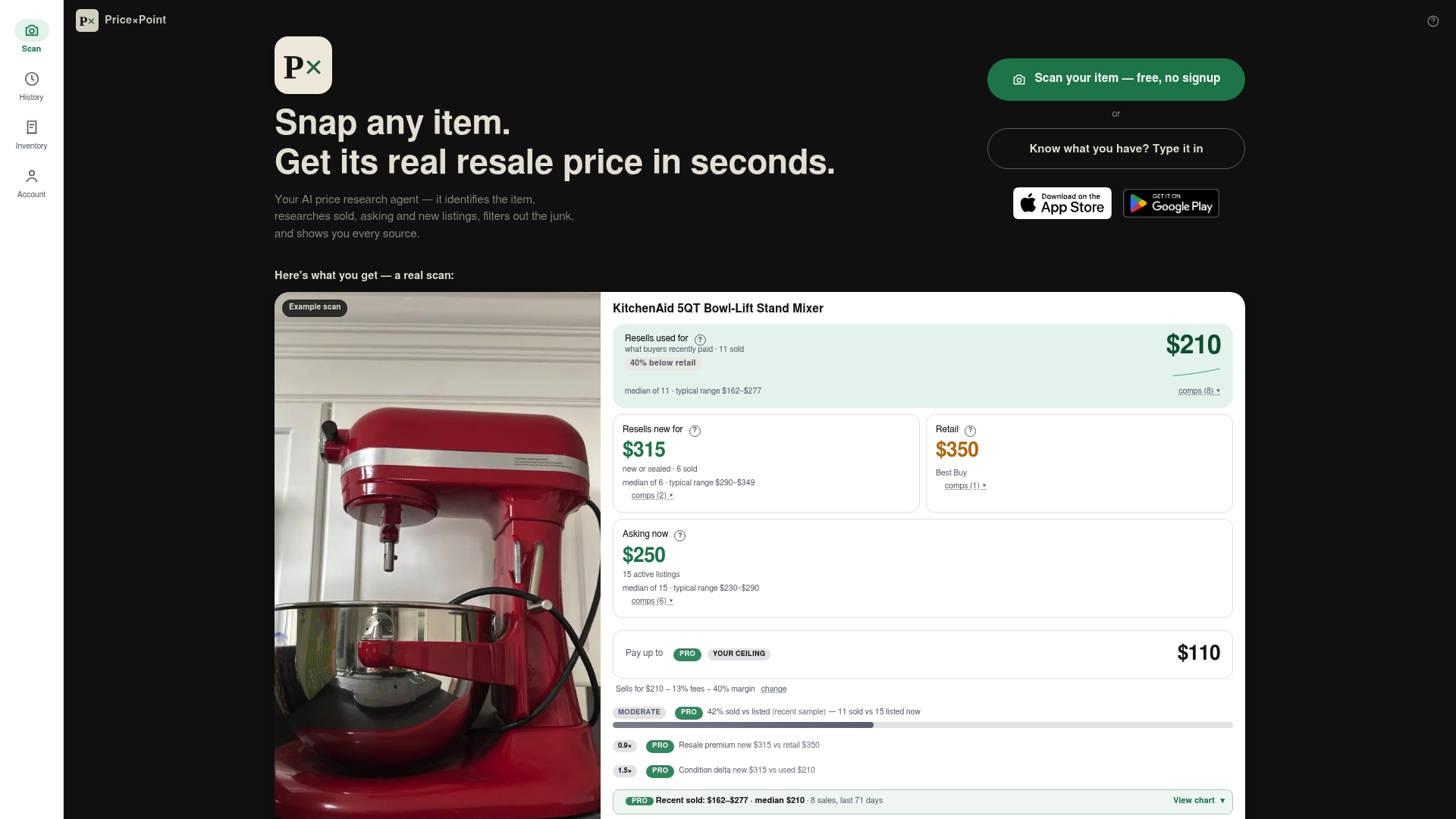
- Photo or name-based identification that pulls brand, model, and condition automatically
- Evidence-linked sold prices, not just asking prices, with dates and platforms shown
- Bulk CSV and multi-photo support for lot valuations and inventory scans
- Exportable scan history for bookkeeping and price calibration over time
See the workflow in action on our Vitamix 5200 worth page or check plans and token packs to find the option that fits how often you price items. Structured, evidence-backed product data like this is also reshaping how AI improves eCommerce listings more broadly, and resale pricing is one of the clearest places that shows up.
FAQ
What is AI for resellers and how does it work?
AI for resellers refers to tools that identify an item from a photo or name and then search sold, asking, and new listings across marketplaces to produce a resale price estimate. The best versions link each estimate to the actual sold listings used, so you can verify the match and the price before acting on it.
How accurate are AI price estimates for resale items?
Accuracy varies by category and condition of the source photo, with one real-world evaluation reporting precision of 72.9% and recall of 77.9% for product identification. Common, well-documented items tend to price more reliably than rare, modified, or niche collectibles, which often have too few sold comps for a tight estimate.
Can AI pricing tools replace manual research entirely?
No single automated estimate should replace checking the evidence for rare, heavily modified, or low-comp items. For common categories with several recent sold comps, AI estimates are usually reliable enough to use directly once you confirm the identification and check the linked listings.
How much does PriceXPoint cost?
PriceXPoint offers a Basic plan at $4.99 per month, Pro at $9.99 per month, and Power at $24.99 per month, plus one-time token packs starting at $5.99 for 100 tokens. The right option depends on how frequently you need price lookups.
Why do sold prices matter more than asking prices?
Sold prices reflect what a buyer actually paid in a completed transaction, while asking prices often get inflated by sellers testing the market. Resale estimates built on sold comps give a more realistic picture of what you can expect to get for an item.
Sources
These findings on attribute extraction, detection, and dataset coverage inform the methods described above.
- A real-world framework for automated product recognition and catalog generation: dataset, model, and analysis | Scientific Reports
- Visual Zero-Shot E-Commerce Product Attribute Value Extraction
- Automated product and price information extraction from retail promotional flyers using YOLO and OCR | Discover Artificial Intelligence
- An extensible multimodal multi-task object dataset with materials (EMMa)