
The right Etsy pricing strategy starts with a floor, not a guess: calculate your true unit cost, validate that number against real market comparables, then refine it through controlled testing. Skip the floor and you risk selling below break-even; skip the market check and you risk pricing yourself out of buyers' reach. Etsy's own fee structure and advertising programs change your net revenue enough that they belong in the math from day one.
TL;DR:
- Calculating your true unit cost and market comparables is essential to set a profitable minimum price and avoid selling below break-even or outpricing buyers.
- Using the denominator formula to build a break-even price helps incorporate all costs and fees, ensuring you set a sustainable selling price, particularly for multi-quantity or personalized items.
- Regular price testing over 30-day periods and tracking metrics like conversion and profit per order allows data-driven adjustments rather than relying on hunches.
- Automated tools like PriceXPoint streamline competitor research by pulling verified sold prices, saving hours on manual comparisons, and improving pricing accuracy at scale.
Table of Contents
- Etsy fees and how they affect your net revenue
- Calculate true unit cost and break-even price
- Market research: building qualified comparables using sold prices and listing data
- Practical pricing strategies and when to use each on Etsy
- Price testing: treating price changes like controlled experiments
- Regional pricing, shipping presentation, VAT, and Etsy programs that change net revenue
- Actionable price-setting workflow: an 8-step playbook to publish and optimize prices
- Tools and software recommendations for pricing analysis and automation
- Common Etsy pricing mistakes worth avoiding
- How PriceXPoint speeds up your Etsy comp research
- Sources
- FAQ
Etsy fees and how they affect your net revenue
Every Etsy sale gets trimmed by a stack of fees before you see your payout. Etsy charges a $0.20 listing fee per item, a 6.5% transaction fee on the total order amount, and a payment processing fee that includes a fixed charge plus a percentage that varies by the seller's country. That last one matters: two sellers in different countries can pay noticeably different processing rates on an identical sale.
Then there's advertising. Offsite Ads charge a fee only when a buyer clicks an ad and purchases within 30 days, and that fee runs 15% or 12% depending on shop revenue, capped at $100 per order. Shops that have made $10,000 or more in the trailing 365 days can opt out; newer shops generally cannot. Share & Save works differently, refunding a portion of eligible fees when buyers use a shared listing link, which nudges net revenue back up rather than down.

Etsy sellers pay a 6.5% transaction fee on the total order amount, which means fees scale with shipping charges too, not just the item price.
On a $100 order with standard fees, here's a rough shape of the deductions:
- Listing fee: $0.20 flat, negligible at this order size.
- Transaction fee: $6.50, calculated on the full $100.
- Payment processing: a fixed fee plus a percentage that depends on your country's schedule.
- Offsite Ads fee (if the sale came from a clicked ad): up to 15% or 12%, so as much as $15 on this order.
Before shipping costs and taxes, that $100 sale can easily leave $75 to $85 in your pocket depending on your country's processing rate and whether Offsite Ads applied. Check your Payment account for your exact processing schedule before setting prices, since guessing here is the single easiest way to underprice your work.
Calculate true unit cost and break-even price
Your break-even price is the number below which every sale loses money. Etsy's Seller Handbook recommends building it from materials, time, labor, overhead, selling costs, shipping, and desired profit, in that order.
- List direct costs: materials, packaging, and any component you buy specifically for that item.
- Cost your labor: track the minutes it takes to make one unit, then multiply by the hourly rate you'd want to earn, not a token amount.
- Allocate overhead: divide your monthly fixed costs (studio rent, software, tools) by your planned unit volume for the month.
- Add selling costs: Etsy's listing and transaction fees, payment processing, and an estimate for Offsite Ads exposure.
- Apply a denominator formula: divide your summed cost by (1 minus your fee percentage minus your target margin) to solve for the retail price that actually delivers your desired profit after every deduction.
The denominator approach matters because fees are percentages of the sale price, not the cost. Adding a flat dollar amount for fees on top of cost undercounts what you'll actually lose once the transaction fee, processing fee, and any ad fee all take a cut of the final number, not your cost basis.
Pro Tip: For multi-quantity listings or personalization options, cost each variation separately: a monogram or an extra size can add minutes of labor that a single blended price will hide.
Overhead allocation is where most new sellers guess wrong. If you make 40 units a month and your studio costs $200, that's $5 of overhead per unit regardless of how fast any single item sells. Get that number wrong and every price built on top of it inherits the error.
Market research: building qualified comparables using sold prices and listing data
A break-even price tells you the floor. It doesn't tell you what buyers will actually pay, which is why market research comes next. Etsy's own seller policy notes that visible sold prices can reflect discounts, shipping charges, item condition, variations, and timing, so a single low price you spot in someone else's shop is not a reliable target. The instruction is to compare like with like: materials, size, personalization, condition, delivery promise, reviews, and photography quality all affect what a price actually represents.
Build a small set of qualified comparables rather than eyeballing a category page.
- Search your exact product type and note five to ten recently sold listings that match your materials and size.
- Record the final sale price, whether a discount applied, whether shipping was bundled in, and the item's condition or personalization level.
- Cross-check listing photos and review counts, since a higher-reviewed shop with professional photography can often sustain a higher price for a comparable item.
- Note search placement: a listing buried on page five sold for less attention than one on page one, which affects how much weight to give its price.
- Aim for three to seven comps that are genuinely close matches before you draw any conclusion about your market range.
A manual log in a spreadsheet works fine at small scale, and it forces you to record the qualifiers instead of just the number. As your catalog grows, that manual process gets slow, which is where aggregated sold-price tools start to earn their place in the workflow, a point worth returning to once you've seen how testing works.
Sales velocity is its own signal. A comp that sold within days at a given price tells you more about demand than one that sat for months before selling at a discount.
Practical pricing strategies and when to use each on Etsy
Once you know your floor and your market range, you choose a strategy that fits the product and the buyer you're trying to reach.
- Cost-plus pricing is your break-even number plus a fixed margin; treat it as the required floor for every listing, never the ceiling.
- Value-based pricing lets you charge above cost-plus when you have real differentiation: a distinct style, a strong shop reputation, or materials competitors don't use.
- Tiered pricing and bundling offer a lower entry item alongside a premium version, which widens your buyer pool and lifts average order value without discounting your best work.
- Psychological or charm pricing, ending a price in .95 or .99, can nudge conversion slightly, but Etsy's pricing guidance is clear that any discount must be genuine: an inflated "original" price used only to manufacture a markdown is not allowed.
New sellers with no reviews and no comps history generally do better starting closer to cost-plus, since buyers have no other signal to trust yet. Sellers with a distinct, hard-to-copy product can lean into value-based pricing immediately, especially if early reviews back up the quality claim. Seasonal clearance is the one place a genuine, time-limited discount off a real established price makes sense, since Etsy's rules protect buyers from markdowns that were never real prices to begin with.
Pro Tip: Run cost-plus and value-based pricing on the same product line for a season and compare profit per order, not just units sold, to see which model actually earns more.
Price testing: treating price changes like controlled experiments
A price is a hypothesis until you've tested it against real buyer behavior, keeping in mind the distinctions between business valuation vs. asking price can help sellers understand how to set profitable pricing strategies. Etsy's guidance on testing pricing and promotions frames this as a controlled experiment: change one variable at a time, and keep a dated journal of every action so you can attribute a sales shift to the right cause.
- Change a single major variable, price, one photo, or one tag, never several at once.
- Log the date, the exact change, and any concurrent promotion or sale event.
- Track visits, conversion rate, revenue, profit per order, average order value, and repeat buyer rate.
- Hold the test for roughly 30 days to smooth out day-to-day noise before drawing a conclusion.
- Calculate contribution profit separately for organic traffic, Offsite Ads traffic, and shared links, since each channel carries different fees.
A meaningful test typically needs a full 30-day window to separate a real signal from ordinary week-to-week variation, since a handful of sales in either direction can look significant when they're just noise.
Contribution profit by channel matters because a sale attributed to Offsite Ads can carry a 15% or 12% fee that an organic sale never pays. Two identical $50 sales can deliver meaningfully different profit depending on which channel brought the buyer, so any price test that ignores channel mix risks the wrong conclusion. Aggregated sold-price datasets, the kind that compile verified sold listings across sources, cut the time spent hand-building comps for each test and reduce the noise of relying on one or two visible listings.
Regional pricing, shipping presentation, VAT, and Etsy programs that change net revenue
Where your buyer is located changes what you actually keep from a sale, even at an identical listed price.
- Etsy lets sellers set domestic, US-specific, and global pricing on the same listing, with bulk editing available for up to 500 listings at once, though heavy variation counts can complicate a bulk update.
- Sellers shipping into the US should factor in estimated tariffs when deciding whether a US-specific price is warranted.
- VAT collection on seller fees depends on your location and business status, and eligible sellers can avoid VAT on Etsy's own fees by submitting a valid VAT ID.
- Offsite Ads fees (15% or 12%, capped at $100 per order) and Share & Save refunds both move your net revenue after the sale closes, so they belong in any regional profit calculation, not just your base price.
Shipping presentation is a conversion lever as much as a pricing one. Etsy's own Pricing Basics guidance notes that baking shipping into the item price can improve conversion in some markets, but only if you calculate total net revenue afterward rather than just comparing gross listing prices across sellers. Review your Payment account periodically. Processing rates and VAT rules shift, and a rate you calculated a year ago may no longer match what you're actually charged today.
Actionable price-setting workflow: an 8-step playbook to publish and optimize prices
This is the sequence, start to finish, that turns everything above into a repeatable process rather than a one-time calculation.
- Audit your true costs: materials, labor, overhead, and current fee exposure for the specific listing.
- Build three to seven qualified comparables, recording discounts, shipping, and condition for each.
- Set an initial price using the denominator formula, then sanity-check it against your comps range.
- Publish the listing with your shipping presentation decision (bundled or itemized) already made.
- Run a 30-day test without changing any other major variable.
- Track your metrics: conversion, revenue, profit per order, AOV, and repeat buyers.
- Iterate: adjust the one variable you tested, based on what the data showed, and log the change.
- Review quarterly: costs, comps, and fee schedules all drift, so a price that worked in spring can lag by fall.
Pro Tip: Label every test in your journal with a short code (like "PRICE_UP_10PCT_MAR") so months later you can find exactly what you changed and when.
As a worked example: say your true unit cost, including materials, labor, and overhead, comes to $18. Dividing $18 by (1 minus 0.10 minus 0.30) gives a retail price of $30. Check that number against your comps range before publishing, and adjust only if the market data suggests buyers expect meaningfully more or less.
Tools and software recommendations for pricing analysis and automation
A spreadsheet handles cost calculations fine, but comparable-building and price monitoring get slow once your catalog grows past a handful of SKUs. Etsy's own shop statistics dashboard is the first stop for conversion and revenue tracking tied directly to your test journal. Spreadsheet software like Google Sheets or Excel still does the heavy lifting for the denominator formula and overhead allocation, since those calculations rarely need anything more specialized.
For gathering sold-price comparables at scale, AI-driven price research tools can pull real sold, asking, and new listing data across marketplaces in seconds instead of the hours a manual comp search takes. That speed matters most when you're testing prices on multiple SKUs at once and need fresh comps for each without spending a full afternoon on research. Bulk lookup features, where you can process a CSV of item names at once, help sellers with larger catalogs keep comps current without doing it one listing at a time.

Whatever tool you use, the standard doesn't change: a price recommendation is only as good as the sold-listing evidence behind it, and any tool worth trusting should show you the actual sales it drew from rather than asking you to take a number on faith.
Common Etsy pricing mistakes worth avoiding
Sellers underprice most often by undercounting their own labor, treating an hour of finishing work as free because it "doesn't feel like work." A close second is ignoring Offsite Ads leakage entirely, then wondering why a listing that sells well nets less than expected. Copying the lowest visible price in a category, without checking whether it included a discount or bundled shipping, compounds both errors. Price protects your business before it attracts a buyer: get the floor right first, then test upward with real data and a dated journal, not a hunch.
— PricexPoint
How PriceXPoint speeds up your Etsy comp research
Building qualified comparables by hand works, but it eats the hours you'd rather spend making product. PriceXPoint identifies an item from a photo or a name and pulls real sold, asking, and new listing prices across multiple marketplaces in seconds, filtering out the misleading listings that would otherwise skew your comps range.
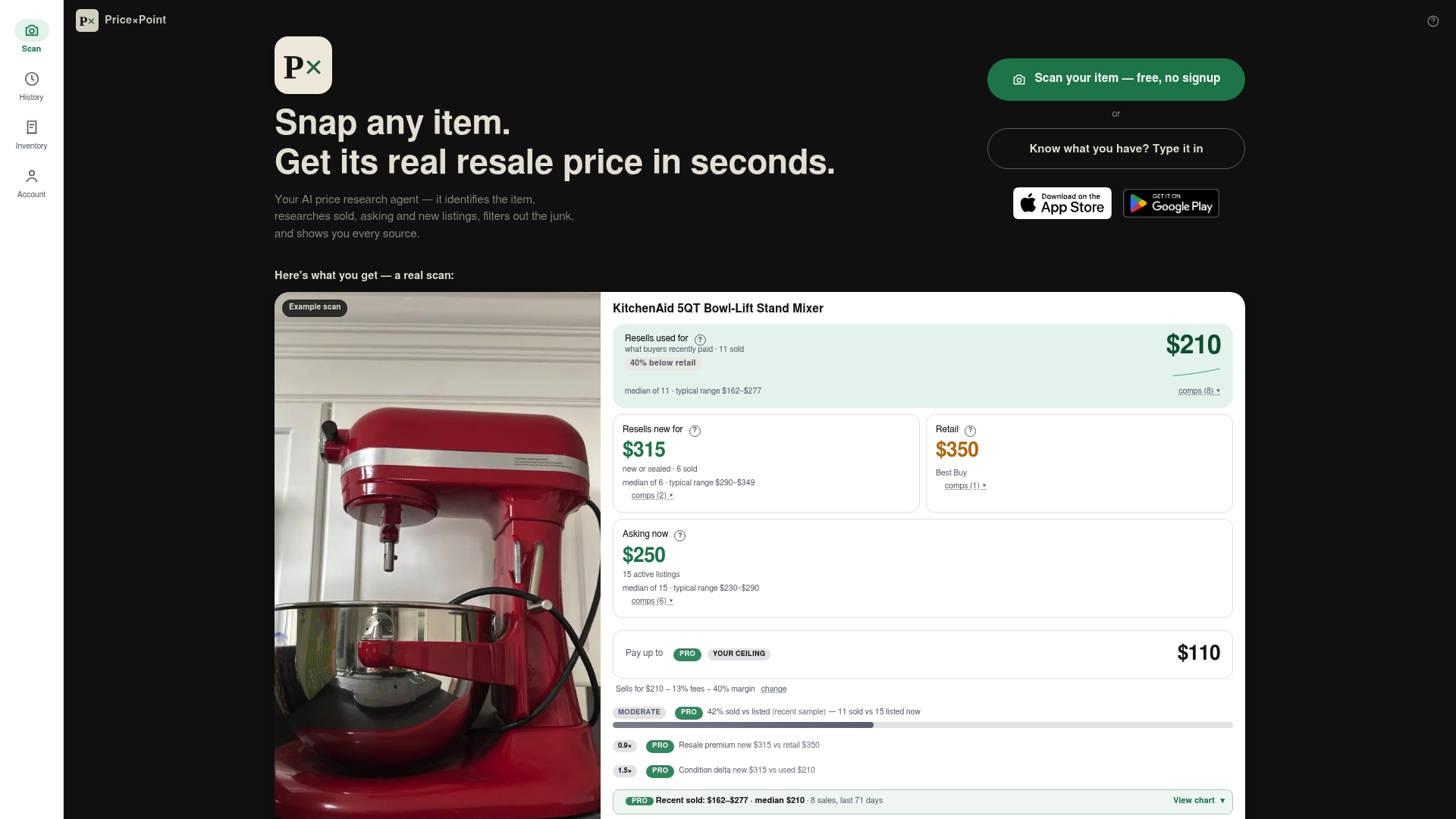
- Scan a product photo or paste an item name to get sold-price data linked back to its original listing.
- Use bulk CSV upload to price an entire catalog's worth of comps in one pass instead of one listing at a time.
- Review saved scan history later to track how a category's sold prices shift across a season.
That turns a task that used to take an evening of manual searching into a few minutes of verified data you can drop straight into your pricing spreadsheet. Check the Basic, Pro, and Power plans to find the token allowance that matches your catalog size, or start with a quick lookup on the PriceXPoint homepage to see how the comps you'd build by hand compare.
Sources
FAQ
How much does Etsy take from a $100 sale?
On a $100 order, Etsy deducts a $0.20 listing fee, a 6.5% transaction fee ($6.50), and a country-specific payment processing fee.
Why are so many people leaving Etsy?
Public discussion of seller dissatisfaction often centers on rising fees, Offsite Ads costs that sellers can't fully opt out of below the $10,000 revenue threshold, and increased marketplace competition. This article doesn't have sourced data on platform-wide seller departure rates, so treat any specific figure you see elsewhere with caution.
Who is Etsy's biggest competitor?
Etsy competes with a range of online marketplaces and platforms that let independent sellers list handmade or vintage goods, along with general e-commerce marketplaces. This article does not have sourced data naming a specific dominant competitor.
What is the $29 fee on Etsy?
This article's sources don't document a specific fee tied to Etsy's current published fee schedule. Etsy's standard published costs are the $0.20 listing fee and 6.5% transaction fee, plus country-specific payment processing; check your Payment account for any charge not covered by those categories.