
To sell a used item fast, price it just below what comparable items have recently sold for, not just below what other sellers are asking. Start from real sold prices, match your item's condition honestly, subtract fees and shipping so you know your floor, then list at a price that makes a buyer say yes without haggling. If nothing happens in a few days, cut the price in planned steps instead of waiting.
This guide covers everyone selling secondhand goods in the US, from electronics and bikes to books and collectibles. (If you landed here looking to sell a house, that is a different process with agents and appraisals. This article is about the everyday things you sell online or locally.)
TL;DR
- Anchor your price to recent sold listings of the exact item. Asking prices show what sellers hope for, not what buyers paid.
- A fast-sale price sits modestly below the typical sold price. Decide your floor first (fees, shipping, the least you will accept), then choose how far above it to list.
- Photos, a clear description and quick replies matter almost as much as the number itself.
- Set a review schedule before you list: if there are no offers after a few days, drop the price in small steps and refresh the listing.
- Collectibles and valuable pieces need a closer look before you take a quick-sale price.
Table of Contents
- What "fast" really means for pricing
- Step 1: Find what the item actually sold for
- Step 2: Adjust for condition, completeness and demand
- Step 3: Work out your floor before you list
- Step 4: Choose the listing price
- Step 5: Make the listing do half the work
- Step 6: Time your listing
- Step 7: Protect yourself from scams
- What to do if it does not sell
- Perspective: why we price from sold data only
- Collectibles and valuable items: slow down first
- Price a whole batch in minutes
- FAQ
- Sources
What "fast" really means for pricing
A fast price is not the lowest price. It is the price at which a typical buyer who is already searching for your item sees a good deal and acts without thinking about it for a week.
That means you are trading a small slice of money for time. Before you pick a number, decide how much time is worth to you:
- Need it gone this week (moving, a deadline, a cluttered garage): list near the low end of the sold range.
- Would like it gone within a few weeks: list around the middle of the sold range and plan one or two price cuts.
- No hurry: list near the top and wait. This is not a fast sale, so it is not what this article is about.
The mistake most people make is guessing. They look at three similar items on a marketplace, see asking prices, and copy the cheapest one. The cheapest ask may be a listing that has been sitting for two months, which proves nothing about what the item is worth.
Step 1: Find what the item actually sold for
The core of a good price is sold data. An asking price is an opinion. A sold price is a fact: a buyer and a seller agreed on it.
Gather sold listings for your exact item: same make, model, size, edition or version, and as close to the same condition as you can find. Three to five good matches beat twenty loose ones. Throw out the extremes at both ends. One unusually high sale (a bidding war, a rare variant, a mislabeled listing) can pull your whole estimate off, which is why we wrote about checking sold prices before you trust a number.
If you can't find exact matches, widen the search carefully. Similar items from the same brand, of a similar age and style, can stand in as a rough guide, as a resale pricing guide suggests when exact comps are missing. Treat anything found this way as a range, not a point.
Compare sold with asking and new
Use the three kinds of prices together:
| Price type | What it tells you | How to use it |
|---|---|---|
| Sold | What buyers actually paid | Your main anchor |
| Asking (active) | Your competition right now | Check you are not far above the cheapest comparable listings |
| New (retail) | The ceiling for used | If your price is close to new, buyers will buy new |
If active listings are all far above the sold prices, the market is full of optimistic sellers. Follow the sold data, not them. If there are few active listings and several recent sales, demand is healthy and you can sit comfortably in the middle of the sold range.
Doing this by hand across several marketplaces takes a while. That is the reason we built PricexPoint: you snap a photo or type the item name and see sold, asking and new prices side by side, with links to the listings behind each figure. If you want a feel for it first, the what used items sell for pages show real sold prices for individual items.
Step 2: Adjust for condition, completeness and demand
Sold prices come from items in all kinds of shape. Your job is to place yours honestly within the range.
Move toward the top of the range if you have:
- The original box, cables, manuals or accessories
- Proof it works (a short video, a tested note, a serial number you can show)
- A popular color, size or edition
- Little wear and clean, recent photos
Move toward the bottom if the item:
- Has cosmetic damage, missing parts or an unknown history
- Is an older generation with a newer model just released
- Sells in a niche where few buyers search
Be stricter with yourself than a buyer would be. An item you call "like new" that arrives with scuffs creates disputes and returns, and those slow you down far more than a slightly lower price would.
Category-specific guides help here, because condition matters differently for each thing. We have walked through this for used bikes, game consoles, tablets, used books and PC parts. For anything else, our guide to calculating the resale value of almost anything covers the general method.
Step 3: Work out your floor before you list
A quick sale is only a good sale if you still come out ahead of your minimum. Calculate that minimum first.
- Marketplace fees. The Better Business Bureau notes that fees vary by marketplace, and sellers should understand whether they pay a percentage, a flat rate or both. Read the fee page of the platform you plan to use before you list.
- Shipping and packaging. Add the real cost of the box, tape and postage, or decide that you will sell locally and skip it.
- Your personal floor. The lowest amount you would be happy to accept in cash today.
Here is a simple worked example with made-up numbers. Say recent sold listings for your item cluster around $120. You want it sold fast, so you plan to list at $110. Fees and shipping come to about $18, which leaves $92. If your floor is $85, you have room for one small price cut. If your floor is $100, you should either list higher or sell locally where fees and shipping disappear.
The point is to know this before a buyer offers $90 and you have to decide in the moment.
Local or shipped?
Bulky items that are hard or costly to ship are often better sold locally. Portland's city sustainability office, for instance, points residents to local marketplaces for bulky items that are difficult or expensive to ship, naming Facebook Marketplace, Craigslist and Nextdoor. Local selling also cuts out shipping and often fees, which makes a lower fast-sale price less painful. We broke down the economics in Facebook Marketplace pricing for sellers, and if you sell handmade or vintage goods there is an Etsy pricing playbook.
Step 4: Choose the listing price
Now combine the pieces. A practical approach:
- Take the typical sold price for your condition level (the middle of your three to five comps).
- For a fast sale, list slightly under it, enough that your listing is among the better-priced ones in the search results.
- Check that the result stays above your floor after fees and shipping.
- Decide whether you accept offers. If you do, build in a little room, or state clearly that the price is firm.
Pricing at a clean, believable number helps. Buyers scanning a list of results tend to trust a price that looks researched. Whether your platform lets buyers sort by price low to high matters too: if they do, being just under a round threshold can put you ahead of similar listings.
Firm price or open to offers?
If you must sell this week, a firm, fair price saves time. If you have a few weeks, you can list slightly higher and accept an offer near your target. Either way, make the decision before you list, not while a buyer is waiting.

Step 5: Make the listing do half the work
The price brings people in. The listing closes the sale. The most practical advice here is consistent: use the best photos you can, write a clear and compelling description, set a competitive price and reply to inquiries quickly.
Some specifics that help:
- Photos: natural light, a plain background, every side, and close-ups of flaws. Honest flaw photos reduce questions and returns.
- Title: brand, model, size or version, and condition, in the words a buyer would type.
- Description: what is included, how it has been used, any defects, and why you are selling.
- Speed of reply: buyer interest fades if negotiations drag. Answer within hours when you can.
If you are selling electronics, listing details matter even more because buyers are wary of dead batteries and fake parts. A used-Mac buying checklist shows what a careful buyer looks for, which is useful to know when writing your own description and deciding what proof to include.
Step 6: Time your listing
The same item can sell faster or slower depending on when it is listed. The BBB recommends researching seasonal trends, with examples like listing winter coats in early fall or exercise equipment in January to catch buyer interest. Think the same way about your own item: patio furniture in spring, bikes as the weather warms, school items in late summer.
Timing matters for big-ticket goods too. If you are selling a vehicle, timing a used car sale is a good example of how the season and the moment you list affect interest.
Also think about the day: many people browse in the evening and on weekends, so a listing posted just before then gets seen while it is fresh.
Step 7: Protect yourself from scams
Speed makes sellers careless, and scammers know it. The BBB warns against accepting payment outside the platform and stresses waiting for payment confirmation before you ship anything.
In practice:
- Ship only after the payment has cleared and shows in your account, not when a buyer sends a screenshot.
- Keep the conversation and payment on the platform.
- For local sales, meet in a public place and take payment before handing the item over.
- Be suspicious of buyers who overpay and ask you to refund the difference.
A price that is a few dollars lower is never worth a lost item.
What to do if it does not sell
This is where most guides stop, and where fast sellers win. Decide your schedule at listing time so it is a plan and not a mood.
A simple schedule you can adapt:
| Day | Signal | Action |
|---|---|---|
| 1 to 3 | Views but no messages | Check the photos, title and category before touching the price |
| 3 to 5 | Few views | Fix the title keywords, relist or refresh the listing |
| 5 to 7 | Views and questions but no offers | Cut the price a little, enough to show on a "price drop" notice if the platform has one |
| 7 to 14 | Still nothing | Cut again, and compare against new sold listings, since the market may have moved |
| After 14 | No interest | Revisit your floor, bundle with related items, or choose a different channel |
The signal matters more than the calendar. No views means a visibility problem. Views without messages means a price or photo problem. Messages without a sale means a trust or detail problem. Cutting the price only solves one of the three.
Avoid giant drops. Several small cuts keep your listing near the top of "newest" or "price drop" views and let you find the price that works without overshooting. And re-check sold data after each cut: the market may have shifted since you first looked.
Perspective: why we price from sold data only
We built PricexPoint on one belief: a resale price without evidence is a guess, and guesses are why people either leave money on the table or wait months for a sale.
Most pricing mistakes come from one of two places. Sellers read asking prices as if they were sale prices, or they let one unusually high sale set their expectations. Our approach is to show estimates tied to actual sold listings from several marketplaces, name every data source, and decline to give a figure when there is no evidence behind it.
We also let you check and correct the item identification, because a wrong match is the quietest way to get a wrong price. When you can see the sales behind a number, you can decide how much of a discount you are willing to give for speed, instead of discovering the cost afterward.
PricexPoint
Collectibles and valuable items: slow down first
A fast-sale price works well for everyday goods. It can be expensive for rare or valuable pieces, where a quick sale to the first buyer might undervalue the item badly.
For antiques or artwork worth more than $1,000, the BBB suggests getting a written opinion from a professional appraiser, and for jewelry made with precious metals or stones, an official appraisal. If your collectible is somewhere in between, check whether the sold listings you found are truly the same edition, grade and condition. For rare items, one or two close sales are not a market, and an expert's view is worth the wait.
Price a whole batch in minutes
If you are clearing out a closet, a storage unit or a shop shelf, pricing item by item is what makes people give up and dump everything cheaply. PricexPoint lets you price a batch from a CSV or a multi-item photo, and saves your scan history with export options so you can list from your results later.
Plans are billed monthly: Basic is $4.99 per month, Pro is $9.99 per month and Power is $24.99 per month. If you prefer not to subscribe, token packs are one-off purchases: 100 tokens for $5.99, 300 tokens for $12.99 and 1000 tokens for $34.99. There is also a free tier. You can see what each includes on the pricing page, or start from the PricexPoint home page.
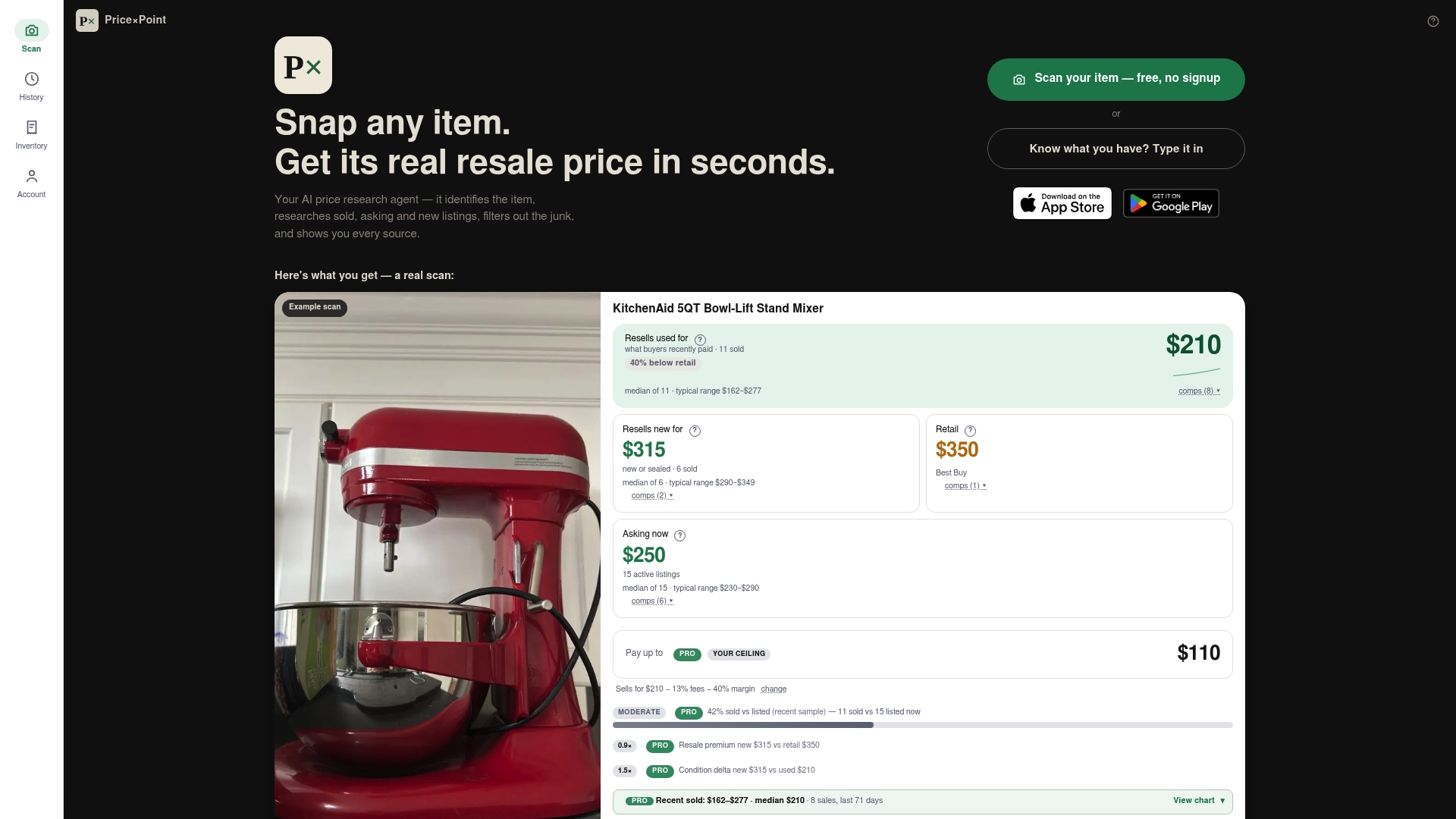
Snap one item, see the sold prices behind it, and set a number you can defend when a buyer pushes back.
FAQ
How can I sell something quickly?
Price it near the low-to-middle of what similar items recently sold for, use clear photos and an honest description, and reply to buyers fast. Choose the right channel: local marketplaces suit bulky goods, and shipped platforms suit small, in-demand items. Keep the payment on the platform and confirm it before you ship.
How much below market price should I list to sell fast?
There is no universal percentage, because it depends on how much room you have above your floor and how crowded your category is. A sensible approach is to list slightly under the typical sold price for your item's condition, so you rank among the best-priced listings, then cut in small steps if you get views but no offers.
Should I use sold prices or asking prices?
Use sold prices as your anchor, since they show what buyers paid. Check asking prices only to see your current competition. If asking prices are well above recent sales, follow the sales.
When should I lower the price of an item that is not selling?
First work out why: no views points to the title, photos or timing, while views without offers point to price. If the listing is getting looked at, cut a little after about a week, check fresh sold data, and cut again if needed rather than making one big drop.
Sources
- BBB Tip: Decluttering? Tips for selling your used items online
- Sell it | Portland.gov
- How to Sell Stuff Online Fast
- How to Price Your Items for Resale
- How to Buy a Used Mac Without Getting Scammed
- Why Timing Matters When Selling Your Used Car