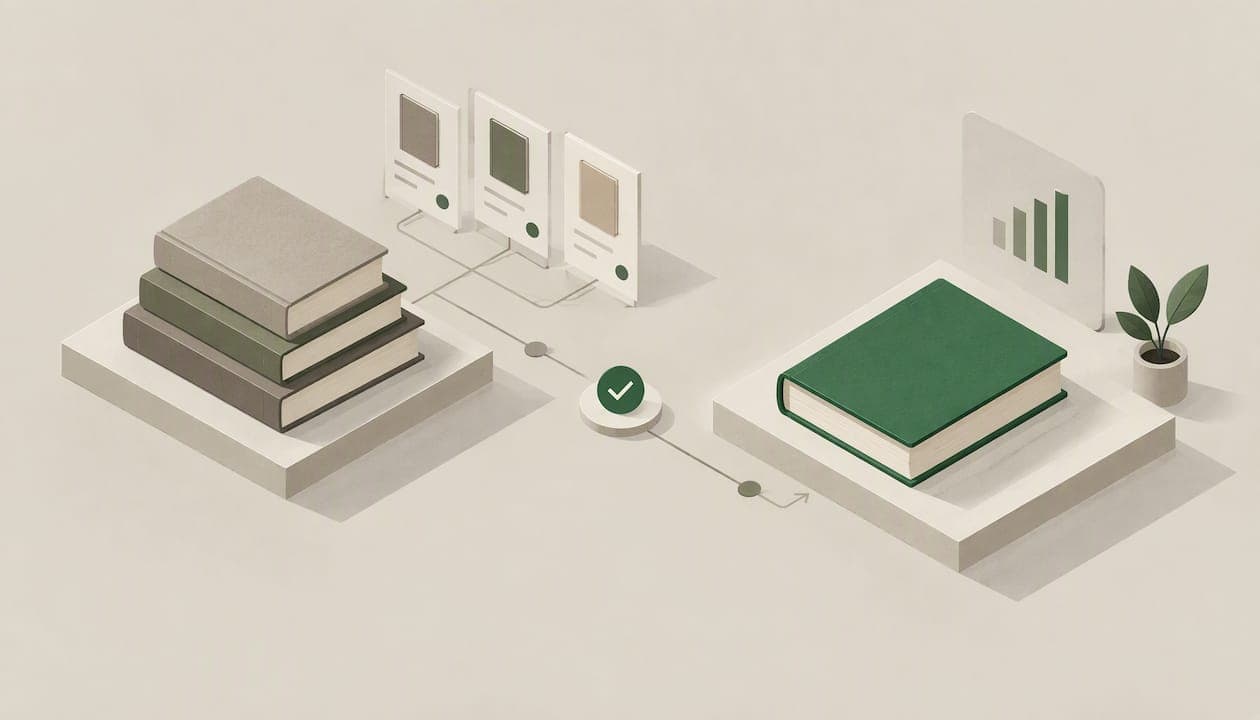
Most used books sell for roughly 20% to 50% of their original price, but that range is only a starting point. The real number depends on condition, edition, demand and what identical copies actually sold for recently. This guide shows you how to get from a rough guess to a defensible price, and how the same method carries over to used laptops and new old stock.
TL;DR
- Start with the 20%–50% of cover price rule, then adjust for condition and demand.
- Trust sold prices over asking prices. One hopeful listing at $80 proves nothing.
- For collectible books, edition, printing and the dust jacket move the price more than anything else.
- Low-value novels sell faster in bundles than as single listings.
- The same sold-listing method works for used laptops and new old stock, with different adjustments.
Table of Contents
- A starting point: the share of the original price
- What actually moves a book's price
- Asking prices versus sold prices
- What buyback offers tell you
- Pricing low-value books: bundles
- Pricing a book collection in bulk
- The same method for used laptops
- Valuing new old stock
- Where to look for comparison prices
- Perspective: why we insist on evidence
- Price a whole shelf in minutes
- Common mistakes to avoid
- FAQ
- Sources
A starting point: the share of the original price
The Spruce reports that used books typically sell for about 20% to 50% of their original price. A book in poor condition may bring 20% or less. One in excellent condition can reach 50% or more when demand is strong.
That gives you a quick sanity check before any research. A $30 hardcover in very good shape might reasonably land between $6 and $15. If you find yourself pricing it at $28, you need a strong reason, such as a scarce edition.
The rule has limits. It works for ordinary trade books. It fails at both ends:
- Common paperbacks and old bestsellers often sell for far less than 20%, because copies are everywhere.
- Out-of-print, signed, first-edition or niche titles can sell for several times the cover price.
So treat the percentage as a floor for your thinking, not a price tag.
What actually moves a book's price
Prices follow supply and demand, shaped by condition. Three groups of factors do most of the work.
Condition
Condition is the factor you control least and buyers check first. Grade honestly: cover wear, creases, highlighting, water marks, a cracked spine, a missing page. Buyers who receive a copy worse than described return it, and that costs you more than a lower price would have.

For collectible books, the dust jacket matters enormously. Biblio notes that a missing or poor-condition dust jacket can cut a collectible book's value by more than 50%. Photograph the jacket separately, front and spine.

Edition and printing
Check the copyright page. A first edition in poor condition can be worth less than you expect, and Intelligent Collector points out that if a first edition is out of reach, a second or third edition in the best shape you can afford is a sensible alternative. The flip side for sellers: a later printing of a famous title is not a first edition, however old it looks. Look up the publisher's printing identifiers before you claim anything.
Demand and scarcity
Textbooks, technical manuals, niche-interest titles, out-of-print books and film-linked titles tend to hold stronger prices than ordinary mass-market fiction, according to experts quoted by This Is Money in a 2023 report on the UK market. The reason is simple: fewer copies chase more buyers.
Demand can also move for reasons nobody predicts. Nostalgia is a big factor, and Intelligent Collector quotes a rare-book specialist saying Harry Potter prices rose quickly, a jump that could not have been forecast. Do not assume today's price is permanent.
Asking prices versus sold prices
This is where most sellers go wrong. Search for your title on any marketplace and you will see asking prices. Some are realistic. Many are optimistic, set by sellers who will wait months or never sell. A few are priced absurdly high by sellers who do not know the market.
Sold prices are what buyers actually paid. They are the only evidence of value. We cover the logic in detail in why one high sale can mislead, but the short version is:
- Find at least five recent sold copies of the same edition.
- Match condition and binding (hardcover, paperback, signed, ex-library).
- Discard the highest and lowest outliers.
- Price within the middle of what remains.
If you cannot find five sold copies, the book is either very scarce or very common. Scarce means you should research harder before pricing. Common means you should price low and bundle.
A worked example
Say you have a hardcover novel with a $28 cover price, very good condition, no jacket damage.
| Step | What you do | Result |
|---|---|---|
| 1 | Apply the 20%–50% rule | $5.60 to $14.00 |
| 2 | Check recent sold copies, same edition and condition | Most sold in a narrow band |
| 3 | Throw out one outlier far above the rest | Cleaner picture |
| 4 | Price near the middle of the band, with shipping in mind | Your listing price |
The percentage rule gave you the corridor. The sold data told you where inside it to sit. If the sold data falls outside the corridor, trust the data and ask why: an edition difference, a signed copy, or a recent movie tie-in.
What buyback offers tell you
Buyback services pay less than you can get selling directly, because they need margin. Treat their offers as a floor. A company guide published in October 2026 by SellBookMedia says accepted books receive offers of about $0.50 to $20, with current textbooks and technical books reaching $10 to $20 or more, and many common books worth well under $5.
If a buyback offer is $3 and direct sales of the same book show $9 after fees, you know selling yourself is worth the effort. If the best direct price is $4, take the buyback and save the time.
Pricing low-value books: bundles
A $4 novel does not justify a photo session, a listing and a trip to the post office. For these, bundling helps. Your Money Your Life suggests selling low-value novels in sets, for example ten books for a set price, because they sell faster than single listings. Group by author, series or genre so the lot looks like something a buyer would want.

Pricing a book collection in bulk
A box of 200 books is a different problem. You cannot research each one for ten minutes. A workable approach:
- Sort quickly into three piles: probably valuable (older, signed, specialist, textbooks), ordinary, and junk.
- Research only the first pile individually.
- Price the second pile at a flat low rate or in bundles.
- Donate or recycle the third.
For larger lots, scanning by barcode, photo or spreadsheet saves hours. This is the kind of job PricexPoint was built for, which we come back to below.
The same method for used laptops
Readers who price books often end up pricing a used laptop next, and the logic is identical: depreciation sets a corridor, sold listings set the price.
An e-waste recycler's 2026 valuation guide, eWaste Atlanta, says used laptops retain about 60% to 70% of their original price after one year and about 18% to 25% after five years. Within a tier it suggests adding roughly 10% to 15% for excellent condition and a healthy battery, and subtracting 15% to 25% for visible damage or a degraded battery. It also names processor generation as the next biggest driver after the model, and notes that a spinning hard drive instead of an SSD lowers the value.
Treat those as estimating ranges, not guarantees. To price a laptop:
- Identify the exact model and configuration: model number, processor generation, RAM, storage type and size.
- Note battery health and screen condition.
- Find recent sold listings with the same configuration.
- Adjust for condition against those sales.
For an example of what real sold data looks like, see what a Lenovo IdeaPad Slim 3 Chromebook 14M868 sells for. The same applies to e-readers: check the Amazon Kindle Paperwhite 11th generation sold prices rather than guessing from the retail price. For the general method behind all of this, read how to calculate the resale value of almost anything.
Valuing new old stock
New old stock means unused items, often discontinued, that sat in a warehouse or on a shelf. A bookstore with leftover copies, or a reseller with sealed older electronics, faces two separate questions: what can it sell for, and what is it worth on the books?
What it can sell for
Sealed, original-packaging goods often attract collectors, especially for discontinued or hard-to-find items. Price them the way you price anything scarce: look at sold listings of sealed examples, not used ones, and keep them separate. Mixing the two skews your numbers.
What it is worth on the books
For accounting, the rule of thumb in UK tax guidance is to compare the estimated selling price, less the cost of completing and selling, with the carrying amount. HMRC's business income manual says that if the stock is impaired, it is reduced to that selling price less costs, typically with a stock provision. It also stresses that slow-moving stock is not by itself a reason to write down below cost, because it may still sell at a profit, as with antiques and jewellery. That guidance is UK-specific. If you operate in the US, ask your accountant which rules apply to you.
If you track many items, inventory software makes the numbers easier to maintain. A system such as inventory management for online shops can keep stock counts and valuation in one place, so your resale prices and your books stay in step.
Where to look for comparison prices
You have three kinds of evidence, and a good price uses all of them:
- Sold listings on the marketplaces where your book would actually sell. Strongest evidence.
- Current asking prices for the same edition. They show the ceiling and how many competitors you have.
- Buyback offers from services. They show the floor.
Book comparison sites that aggregate listings from many sellers can help you see the range quickly, and BookBuzz recommends comparing prices from multiple sellers instead of relying on a single number. Just remember that aggregated lists are mostly asking prices. Always confirm against what sold.
For antiques, old maps and anything pre-1900, the process is slower and the stakes higher. Our five-step guide on pricing antiques with sold prices and the one on pricing collectibles in under ten minutes cover it.
Perspective: why we insist on evidence
We built PricexPoint because most price guidance fails in the same way: it hands you a number with no proof. For books, that is dangerous. A single mislabeled edition can turn a $6 book into a $60 book or the reverse.
So we do three things differently. Every estimate links back to actual sold listings from several marketplaces. We name every data source. And if there is no supporting evidence, we do not produce a figure. We also let you correct the identification, because the edition is where most pricing mistakes begin.
Our view: a price you cannot verify is a guess. Sellers who check sold data price faster, sell sooner and leave less money on the table. Buyers who check it avoid overpaying for a copy that is common.
— PricexPoint
Price a whole shelf in minutes
PricexPoint identifies an item from a photo or a name, then shows sold, asking and new prices across multiple marketplaces, with links to the sales behind each number. It supports bulk pricing through CSV or multi-item photos, and it saves your scan history with export options, which suits a box of books or a full inventory.
Pricing is token-based, with a free tier. Monthly plans are Basic at $4.99, Pro at $9.99 and Power at $24.99. If you would rather not subscribe, token packs are a one-off $5.99 for 100, $12.99 for 300 or $34.99 for 1000. See the current details on the pricing page, or browse real sold prices for used items first.
Common mistakes to avoid
- Pricing from asking prices. Unsold listings tell you what sellers hope for.
- Ignoring shipping. Books are heavy. A $9 book with $5 shipping competes differently from a $12 book with free shipping.
- Misreading the edition. Book club editions, later printings and reprints are not first editions.
- Overgrading condition. Disputes cost more than a slightly lower price.
- Holding for a rise. Demand can jump, as with nostalgia titles, but it cannot be predicted. Do not hold a stack of common books waiting for it.
- Spending an hour on a $3 book. Match effort to value. Bundle or donate.
FAQ
What is a good price to sell used books for?
As a starting point, aim for about 20% to 50% of the original price, with poor condition near or below 20% and excellent condition near or above 50% when demand is strong. Then check recent sold copies of the same edition and adjust. Common paperbacks often fall below this range, while scarce titles can exceed it.
How do I find the value of an old book?
Identify the exact edition and printing from the copyright page, grade the condition honestly, then find recent sold listings of matching copies. Check whether a dust jacket is present, since a missing or damaged one can cut a collectible's value by more than half. For very old or signed books, consider a specialist appraisal.
Are asking prices a reliable guide?
No. They show what sellers want, not what buyers paid. Use them to see the ceiling and the competition, and rely on sold prices to set your own.
How do I price a used laptop?
Identify the exact model and configuration, then compare it with recent sold listings. Adjust upward for excellent condition and a healthy battery, and downward for damage or a worn battery. Processor generation and SSD versus spinning drive matter a great deal.
Sources
- How to Sell Your Used Books in 2026, The Spruce
- Book value: How much is your book worth?, Biblio
- Collector's Guide to Rare Books, Intelligent Collector
- How to make the most cash selling used books online, This Is Money
- How Much Is My Book Worth?, SellBookMedia
- How to sell used books online, Your Money Your Life
- How Much Is My Old Server/Laptop Worth?, eWaste Atlanta
- BIM33150 Stock: valuation: stock provisions, HMRC
- A Guide to Buying Used Books Online, BookBuzz