
Shipping included pricing means the delivery cost is already inside the price you see, so the checkout total matches the listing price. For a seller, the job is to fold the real carrier cost into the item price without losing margin or pricing yourself out of the market. For a buyer, the job is to compare totals, not sticker prices. Both come down to one number: the delivered price.
This guide shows the formula, a worked example, the costs people forget, when separate shipping is the smarter call, and how to check what comparable items really sold for.
TL;DR
- "Shipping included" means ground delivery is built into the displayed price. It is not the same as the seller absorbing the cost, because the cost is still paid, just by the buyer inside the price.
- Sellers should price with this formula: (item cost + shipping + other costs) divided by (1 minus fee percentage minus target margin).
- Buyers should compare delivered totals: item price plus shipping, taxes and mandatory fees.
- Heavy, bulky or far-away items often work better with calculated shipping, because a flat built-in amount can erase your margin.
- Check sold listings before you set the number, since asking prices only show what sellers hope for.
Table of Contents
- What shipping included actually means
- Why buyers respond to included shipping
- How to calculate a price with shipping included
- Costs to include before you commit to a number
- When separate shipping is the better choice
- How buyers should compare listings
- Check what items actually sold for first
- Price research with PriceXPoint
- Our perspective
- Common mistakes with included-shipping prices
- FAQ
- Sources
What shipping included actually means
A price with shipping included has the delivery cost baked in. One retailer's help page spells out the distinction clearly: shipping included is not the same as free shipping. Standard ground shipping is built into the item's displayed price, there is no separate freight line, and in that retailer's case it applies only in the contiguous 48 states and excludes expedited service. Terms like these vary by seller, so always read the fine print on the listing.
The practical difference from "free shipping" is mostly one of framing. Either way, somebody pays the carrier. Marketplace guidance says as much: Etsy notes that the simplest way to make free shipping work is to price your items to include the shipping cost in the list price, and that you still pay the carrier to deliver the order. A media piece by marketing researcher Adrian R. Camilleri makes the same point from the buyer side: shipping physical goods is never actually free, and retailers use pricing psychology to mask the cost.
So when you read "price with free shipping" or "include shipping in price," treat them as the same mechanism. The shipping cost lives inside the item price.
Why buyers respond to included shipping
Buyers rarely compare item prices alone. They compare what they will pay at the door. One eBay pricing guide gives a clean example: a $45 item with $12 shipping loses to a $52 item with free shipping, because the second total looks cleaner. The first costs $57 in total, the second $52. The cheaper shelf price was the more expensive purchase.

Shopify's seller documentation agrees on the direction: free shipping can have a positive impact on cart conversion rate, but the fees need to be accounted for elsewhere and can affect your profit margins. A common practice, it says, is to include a portion of shipping costs in product prices.
That last phrase matters. You do not have to bury the whole cost. For a light item with a predictable carrier rate, you can build in all of it. For a heavier one, you might build in part and let the buyer pay the rest.
How to calculate a price with shipping included
The core idea is simple. Your price must cover what the item cost you, what it costs to ship, what the marketplace takes, and the profit you want. Because fees and margin are percentages of the selling price, you divide rather than add.
Selling price = (item cost + shipping + other costs) / (1 − fee % − target margin %)
This is the same structure used in international pricing guidance, where duties join the numerator for cross-border sales.
A worked example
Say you bought a vintage jacket for $20. You expect to pay $8 to ship it in a poly mailer by ground service. Your marketplace charges 12% of the sale, and you want a 25% margin. These numbers are illustrative, so swap in your own.
- Costs to cover: $20 + $8 = $28.
- Percentages taken from the price: 12% + 25% = 37%, leaving 63% (0.63).
- Price: $28 / 0.63 = $44.44, which you would list at $44.99 or $45.
Check it: at $44.44, the 12% fee is about $5.33 and the 25% margin is about $11.11. Add the $28 of costs and you land back at $44.44.
Why you divide instead of adding a percentage
A common mistake is adding 37% on top of $28, which gives $38.36. At that price the fee and margin are taken from a smaller number than you assumed, and your actual margin shrinks. Markup and margin are different things, and mixing them up is one of the quietest ways to lose money on resale.
What to do with free-shipping badges and thresholds
Once you know your break-even delivered price, you can decide how to present it. Some sellers set a free-shipping threshold, such as "spend $55 to qualify." The Conversation piece notes that thresholds work by pushing shoppers to add items rather than pay a separate fee. If you run a larger store, checkout conversion optimization is worth studying alongside your shipping offers, because the checkout page is where hidden costs cause abandoned carts.
Costs to include before you commit to a number
Shipping is the line everyone remembers. These are the ones people forget.
- Postage and packaging. Count the box, tape, mailer and label, not just the carrier rate.
- Marketplace fees. Many platforms charge a percentage of the total the buyer pays, which can include shipping. Check your platform's current fee page. For a side-by-side look at the major resale platforms, see our marketplace fee comparison.
- Payment processing. Sometimes folded into the platform fee, sometimes separate.
- Returns. The Conversation article points to research showing that free shipping leads to higher return rates. Budget for some of them.
- Duties, taxes and insurance on international orders. Landed cost is the total of product cost, shipping, duties, taxes, insurance and customs fees, as laid out by one logistics provider. If you ship abroad, your included price must cover all of it or you must tell the buyer who pays.
If you sell on Etsy, our Etsy pricing playbook walks through folding these costs into a shop-wide strategy. Selling locally instead? The Facebook Marketplace pricing guide covers a setting where shipping may not matter at all.
When separate shipping is the better choice
Included shipping is not right for every item. Weight, size and distance change the math quickly.
The same eBay guide that recommends building carrier cost into the price adds a caveat: for heavy or bulky items, calculated shipping that quotes the real cost to each buyer's location usually protects margin better than a flat free-shipping price. A lamp that costs $9 to ship to the next state may cost $22 to ship across the country. A flat $15 built into the price means you win on one order and lose on the other.
A simple rule of thumb:
| Item type | Usually works best |
|---|---|
| Light, small, predictable rate (clothing, books, small electronics) | Shipping included in the price |
| Medium weight, moderate rate variation | Included for the typical zone, or a partial contribution |
| Heavy, bulky or fragile | Calculated shipping at checkout |
| International | Often clearer to show shipping separately, with duties explained |
The table is a starting point, not a rule. Your own carrier quotes decide it.
How buyers should compare listings
If you are shopping second-hand, listings will mix three styles: shipping included, shipping charged separately and shipping calculated at checkout. A fair comparison turns all three into one number.
- Find the shipping cost. eBay's help center explains that the shipping cost is always shown separately from the item cost. Select "See details" next to it or open the "Shipping and payments" tab to see the options, such as express services or combined shipping discounts, and whether tracking is available.
- Add up the total. Item price plus shipping, plus sales tax and any mandatory fees, minus discounts.
- Compare the totals. A $50 item with $10 shipping is more expensive than a $55 item with free shipping, even though the shelf price looks lower. A pricing analytics article makes this exact comparison, and the arithmetic is the whole point.
- Check combined shipping. If you are buying several items from one seller, the per-item shipping often drops. Included-shipping sellers sometimes cannot offer this discount, so run both scenarios.
- Weigh the non-price factors. Condition, delivery time, seller reputation and return terms can matter more than a few dollars.
Keep a short note of whether each listing's shipping was free, included, calculated or conditional. It takes a minute and stops you from comparing apples to oranges.
Check what items actually sold for first
The most common pricing error has nothing to do with shipping. It is starting from the wrong number. Active listings show asking prices, which are wishes. Sold listings show what buyers actually paid. If you build a shipping-included price on top of an inflated asking price, you will get a tidy formula and an item that does not sell.
Before you run the formula, find out the going rate for your item in its condition, and note the shipping terms on the sold listings you rely on. Was the winning sale shipping-included or not? A $40 sale with free shipping and a $40 sale plus $9 shipping are not the same price. Our guide to checking sold prices for resale explains why one high sale can mislead, and our post on AI tools that show sold listings covers how to speed up the research.
If you want a quick look at real sold figures for a specific item, our sold-price pages are a good place to begin.
Price research with PriceXPoint
PriceXPoint is an AI price research agent. Snap a photo of an item or type its name, and the app pulls sold, asking and new listings across multiple marketplaces, filters out misleading ones, and links each figure back to its sales source. You can then add your own shipping cost on top using the formula above, knowing the base number rests on real sales.
The free tier lets you try it. Paid plans are Basic at $4.99 per month, Pro at $9.99 per month and Power at $24.99 per month. If you prefer one-off token packs, 100 tokens cost $5.99, 300 tokens cost $12.99 and 1000 tokens cost $34.99. Bulk pricing works through CSV or multi-item photos, and scan history can be saved and exported. See the current options on the pricing page.
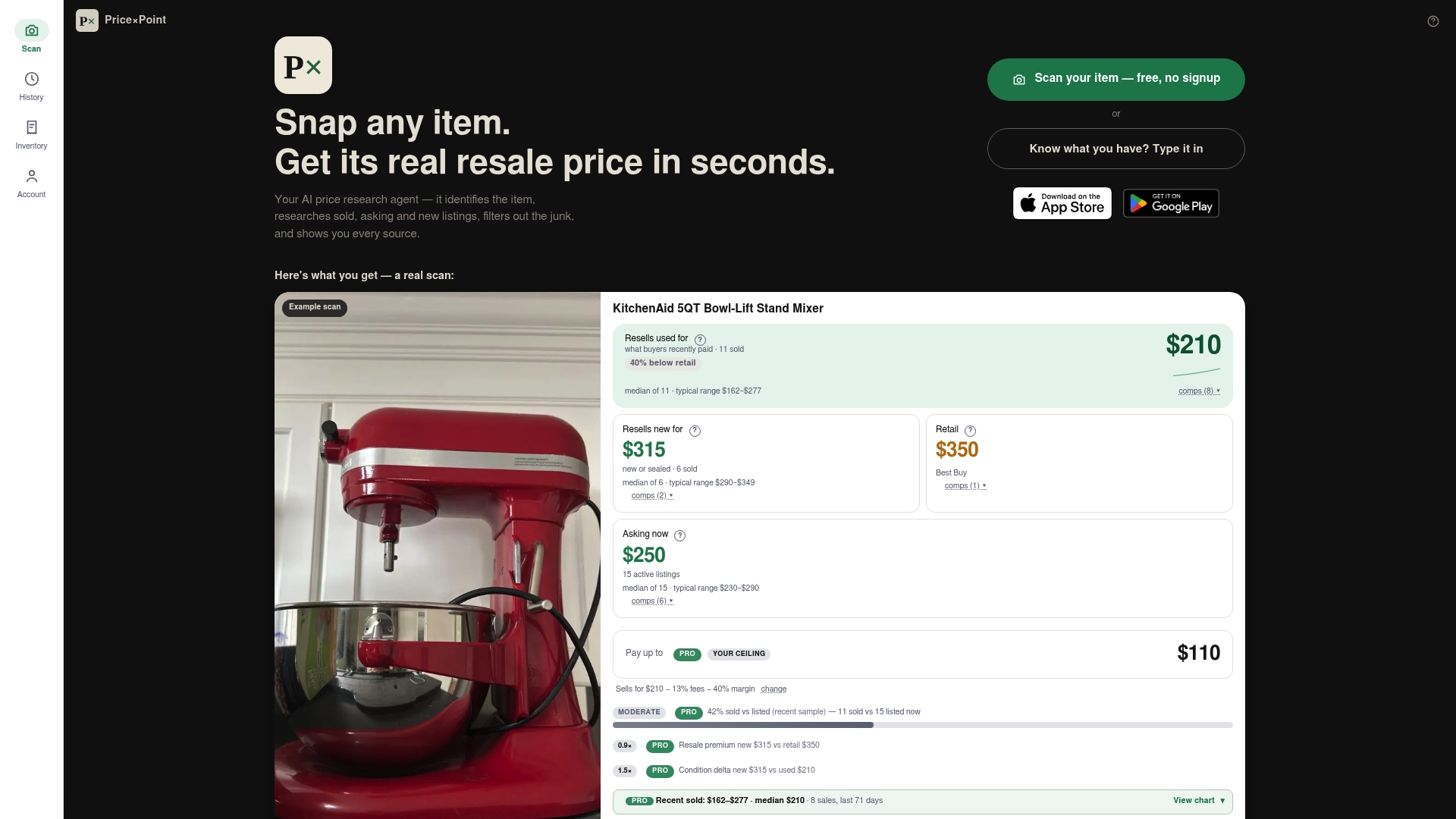
If you are pricing a batch of inventory, start with your five most expensive items to ship. Those are the ones where a wrong shipping assumption costs the most.
Our perspective
Most pricing mistakes with shipping start before shipping enters the picture. A seller finds a few asking prices, adds a guess for postage, and lists. The delivered price looks reasonable, but nothing in it was checked against what buyers really paid.
We built PriceXPoint around a different order of operations. First, find out what the item sold for, with the listings in front of you. Second, add your real costs. Third, decide how to present shipping. Our estimates link directly to actual sold listings from several marketplaces, and we name every data source, because a price you cannot trace is a price you cannot trust.
That matters even more with included shipping, because the shipping amount is hidden inside the number. If the base figure is wrong, the buyer sees a wrong total and you cannot easily tell why it did not sell. We do not provide figures without supporting evidence, and we let you verify and correct the item identification, so the number you start from is the right one for the right item.
Use the formula, keep your carrier quotes current, and let sold data set the ceiling.
PricexPoint
Common mistakes with included-shipping prices
Using one flat amount for every destination. Zone-based carrier rates differ. Build in the typical cost for your likely buyers, or use calculated shipping on items where the spread is wide.
Forgetting to re-check carrier rates. Rates change. Quote your most common package size a few times a year, and update your listings when it moves.
Comparing your item price to rivals' item prices. Compare your delivered price with theirs. A seller guide suggests checking shipping on individual items at several competitor shops and adding a few items to the cart to see what combined shipping comes out at. It is an older, Australian guide, but the method works anywhere.
Pricing off the cheapest listing. One underpriced sale can be a mistake, a damaged item or a lot sold in a rush. Look at the range, not the minimum. For electronics, our PC parts pricing guide shows how sold price checks keep you from overpaying or underpricing.
Ignoring bundles. Shipping two items together costs far less than shipping them separately. A bundle pricing strategy lets you pass part of that saving to the buyer while keeping your margin.

FAQ
Is shipping included the same as free shipping?
Functionally they are close, because the carrier is paid either way. Shipping included usually means ground delivery is built into the displayed price, often with limits such as the contiguous 48 states and no expedited service. "Free shipping" is the marketing label; the cost is still recovered through the price.
How do I include shipping in my price?
Add your item cost, postage, packaging and other costs, then divide by one minus your fee percentage minus your target margin. Round to a clean listing price. Test the result against the delivered prices of comparable sold listings before you publish.
Should I always offer free shipping?
Not always. It can lift conversion, but the cost has to be covered somewhere. For heavy, bulky or far-traveling items, calculated shipping usually protects your margin better than a flat built-in amount. Light items with predictable rates suit included shipping best.
How do I compare listings when some include shipping and others do not?
Add shipping, taxes and mandatory fees to each item price and compare the totals. Then weigh condition, delivery time, seller reputation and return terms. Note whether each listing's shipping was free, included, calculated or conditional so you compare like with like.
Sources
- Is Shipping Included Free Shipping? (Amcon Labs)
- How to Offer Free Shipping (Etsy Help Center)
- Creating a shipping strategy (Shopify Help Center)
- Shipping rates for buyers (eBay)
- Does free shipping really exist? (The Conversation)
- What Is a Landed Cost? (Easyship)
- eBay pricing strategy: price to keep your margin (Shopappy)
- How to Price Products for International Shipping (SellerGains)
- How to Calculate Your Optimal Price Point with Market Data (PriceShape)
- How to price your products (All About Planners)
- Checkout Conversion Rate Optimization guide (Zip)