
To price a power tool, identify the exact model number, check what the same tool actually sold for recently, then adjust for what is in the box (batteries, charger, case) and the condition it is in. Asking prices show what sellers hope for. Sold prices show what buyers paid. For a new tool, compare the total cost at several retailers, including tax, shipping and anything the tool needs to run.
This guide covers both sides: how to read new-tool prices as a buyer, and how to price a used drill, saw or router as a seller.
TL;DR
- Start with the full model number. "DeWalt drill" is not a price; a specific model, bare tool or kit, is.
- Use sold listings, not asking prices, as your benchmark for a used tool. Asking prices include many tools that never sell.
- Batteries, chargers and cases can move a price more than light wear, so price a bare tool and a kit separately.
- For new tools, compare the total cost: item price, shipping, sales tax and any battery or charger you still need to buy.
- A single high sale can mislead you. Look at several recent sales of the same configuration and use the middle of the range.
Table of Contents
- Start with the exact model, not the brand
- How new power tool prices work
- How to price a used power tool
- What changes a used tool's price
- Fees, shipping and location
- Pricing many tools at once
- Perspective
- Price your tools with real sold data
- A quick checklist before you list
- FAQ
- Sources
Start with the exact model, not the brand
Most pricing mistakes begin with a loose identification. A cordless drill from one brand can come in a dozen versions: bare tool, one-battery kit, two-battery kit, brushed motor, brushless motor, older and newer generations. Each has its own market price.
Look for the model number on the data plate, usually near the battery mount or on the housing. Write down:
- The full model number, including suffixes. A "-20" or "Z" ending often marks a bare tool, while a "C2" or "M1" ending often marks a kit with batteries. Confirm this against the manufacturer's listing for your model.
- The voltage and battery platform (12V, 18V, 20V MAX and so on).
- Brushed or brushless motor.
- What came in the original kit.
The Federal Trade Commission's shopping advice says the same thing in plain terms: note the manufacturer or model number and details such as size and color, then compare the item across trustworthy comparison sites. That applies whether you are buying or selling.
If you cannot read a model number, a photo-based lookup can narrow it down. You can then check the match yourself before trusting any number it gives.
How new power tool prices work
A new tool's price is a mix of what it costs to build, how the maker positions the brand, and how the retailer is selling it that week.
What drives the sticker price
On the manufacturing side, one industry report on OEM cordless tools says the battery pack (30 to 40%) and the motor (15 to 20%) together account for up to 60% of unit cost. The same source lists gearbox quality, tooling, certification and packaging as further cost factors, with freight and duties affecting landed cost. That explains why brushless tools and larger battery packs cost more, and why a bare tool is so much cheaper than a kit.

Brand support matters too. A review of two six-tool combo kits noted that DeWalt offers a 3-year warranty on tools and batteries, while some budget alternatives offer shorter standard coverage. Warranty length is part of what you pay for.
Why the same tool has different prices
Retail pricing swings a lot. At the time of our research, a Home Depot listing showed a Milwaukee M18 FUEL compact router kit at $229.00, reduced from $389.00. That gap is why a "list price" is a poor anchor. Bundles, promotions and clearance of older models all change what the tool is really worth.
Where you buy matters as well. Reporting on one major brand's sales channels found that Ryobi tools were priced identically on its official site and at a big-box retailer, a result of an exclusive retail partnership. Meanwhile, buying another brand's tools from a retailer that is not an authorized seller may mean a shorter warranty or none at all.
When a new model launches, the older one often gets discounted. One retailer's guide suggests you separate a new model's real improvements from introductory pricing, bundles and clearance deals. If the upgrade is small, the older model at clearance is often the better value for you and a better comparison point when you sell.
Compare the total, not the tag
A tool that looks cheap can cost more once you add what it needs. Shipping, sales tax, and the cost of a battery and charger can change the final price, so add whatever it takes to put the tool into service to the product price. The FTC makes the same point: include shipping, handling, delivery and taxes in the total cost.
A quick worked example, with illustrative numbers only:
| Item | Store A | Store B |
|---|---|---|
| Bare drill | $99 | $119 |
| Battery and charger needed | $79 | Included |
| Shipping | Free | $9 |
| Total to start working | $178 | $128 |
Store A had the lower tag and the higher real cost. Run this check before you decide a tool is a deal.
Prices also move daily. One price tracker explains that its checks record the price shown on the date checked and warns that prices change daily, so you should confirm on the retailer's listing before buying. Comparison tools that let you search by model number and review price history against the current price, like the workflow described by a retailer price-comparison service, help you see whether today's price is actually low.
How to price a used power tool
Used tools hold their value better than most household goods, especially cordless tools on popular battery platforms. But "holds value" is not a number. The honest way to find one is a short process.
Step 1: Pull sold comparables
Search for your exact model and filter to sold or completed listings. On the large auction marketplaces this shows what buyers paid over a recent window. One reseller's guide recommends checking sold listings from roughly the past 90 days so that unsold items do not distort your view. Marketplace research tools built on historical data can also help sellers spot seasonal trends and set starting prices that attract buyers.
Seasonality is real for tools. Demand tends to rise before holidays and in building season, and fall at other times. A few weeks of patience can matter on a high-value kit.
Step 2: Match the configuration
Only compare like with like. Sort your comparables into these groups:
- Bare tool, no battery or charger.
- Tool with one battery and charger.
- Full kit with two batteries, charger and case.
- Combo kits with several tools.
A bare tool listed against a full kit will look absurdly cheap, and the other way round it will look like a bargain you cannot match. Keep the groups separate.
Step 3: Ignore outliers, use the middle
One unusually high sale may be a bidding war, a rare variant, or a buyer who overpaid. One unusually low sale may be a broken tool listed "for parts." Take five to ten recent sales for the same configuration, drop the extremes, and work from the middle. We go deeper on this in our guide to why one high sale can mislead you.
Step 4: Decide your speed
Your price depends on how fast you want to sell:
- Quick sale: price in the lower half of recent sold prices.
- Normal sale: price near the median.
- Patient sale: price toward the upper end, and only if your tool is clean, complete and tested.
If you want to see what real recent sales look like for specific tools, our sold price pages show examples, such as the DeWalt DCD771C2 cordless drill, the Makita XPH12Z hammer driver-drill and the Milwaukee M12 FUEL compact band saw.
What changes a used tool's price
Once you have a benchmark, adjust for the details. These are the factors that buyers actually weigh.
Batteries and chargers
For cordless tools, the battery is often the most valuable part. A tool sold with two healthy batteries and a charger is a different product from the same tool bare. State the exact battery model and amp-hour rating, and say whether the charger is included. Test the batteries before you list them: a pack that will not hold a charge is a defect, and you should say so.

Battery platform matters because buyers often already own batteries for one system. Tools on a widely used platform tend to attract more buyers than tools on a niche one.
Condition and testing
Be specific rather than vague. Check and note:
- Does the trigger, speed switch and direction selector work?
- Does the chuck grip bits without wobble?
- Are there cracks in the housing, or damage to the blade guard or base plate?
- Is the cord (for corded tools) intact, with no exposed wire?
- Does it run under load, not just spin freely?
Photos of the data plate, the tool powered on, and any wear remove doubt and protect your price. Light cosmetic wear usually costs you little. Missing parts, a damaged base or a motor that sounds rough costs a lot.
Age and generation
An older brushed model competes with newer brushless ones that are often available new at a modest premium. If the newer version is on sale, your used price has a ceiling. Check what the current version sells for new and make sure your used price is clearly below it.
Accessories and original packaging
Cases, side handles, depth rods, blades, bits and manuals all add up. Original boxes help with higher-value items. If you include accessories, list them. If you leave them out, say so, so nobody feels misled.
Bundles
Selling a drill and impact driver together can raise your total sale, but not always by the sum of the parts. Our piece on bundle pricing and attach rates explains how to check whether bundling helps before you cut prices.
Fees, shipping and location
What you net is not what you list. Subtract marketplace fees, payment processing and shipping from your price when you plan. Tools are heavy, so shipping can be a large share of a low-priced sale. Factor in the cost of packaging, and decide whether local pickup makes sense for bulky items like table saws or compressors.
Sales tax and shipping also change what buyers will pay, so a price that looks right on paper may be too high once it reaches the checkout. Buyers compare the total, as above.
Cordless tools raise a special shipping question. Lithium-ion batteries are regulated goods in transit, and the rules get stricter for air and international shipments. If you sell across borders, read up on shipping lithium batteries internationally before you promise a buyer a delivery option. For a domestic sale, check your carrier's current rules for batteries.
Currency matters if you sell abroad. Buyers paying in a foreign currency can face bank or card conversion fees, a point that consumer guidance in the European Union flags for cross-border purchases. Mentioning the total cost up front keeps those buyers from backing out.
Pricing many tools at once
If you are clearing a garage, a closed shop or an estate, researching one item at a time takes forever. Group tools by type and platform, then price each group. Start with the highest-value items, since they matter most to your total. Bulk and multi-item lookups save the most time here, and our post on AI that shows sold listings describes how resellers speed up this step without guessing.
The approach to a bike or any other used durable is similar, as in our guide to pricing a used bike: identify the exact model, check sold prices, adjust for condition.
Perspective
We built PriceXPoint around one belief: a price without evidence is a guess. With power tools, guessing is especially costly, because the same drill can sell for very different amounts depending on whether it comes with batteries, which generation it is and where it is listed.
That is why we link each estimate to actual sold listings from several marketplaces and name every data source. We would rather show you the sales behind a number than hand you a figure to take on trust. If the app misidentifies an item, you can verify and correct the identification so the pricing follows the right model.
For tool sellers, this changes the job. Instead of scrolling through pages of asking prices, you see what buyers actually paid, filtered to remove misleading listings. For buyers, it works the other way: you can check whether a used tool's asking price is in line with real sales before you send an offer.
Our advice is simple. Identify the exact model, look at sold prices, separate bare tools from kits, and price for the speed you want. Do those four things and most of the uncertainty goes away.
PricexPoint
Price your tools with real sold data
If you have more than a couple of tools to price, PriceXPoint lets you snap a photo or type the name and see sold, asking and new prices across marketplaces, with links to the sales behind them. It supports bulk pricing through CSV or multi-item photos, and it saves your scan history with export options.
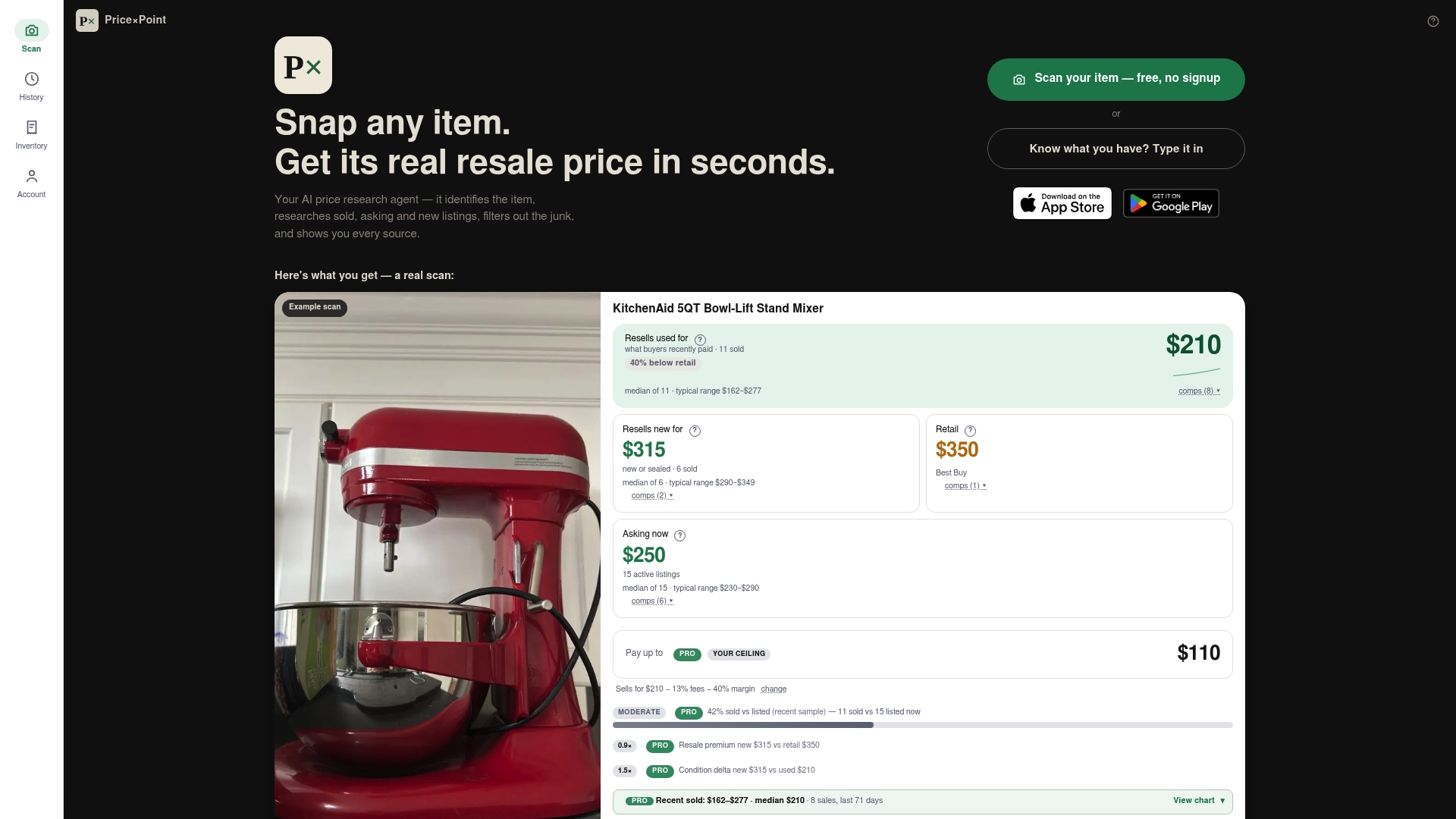
There is a free tier to try it. Paid plans are Basic at $4.99 per month, Pro at $9.99 per month and Power at $24.99 per month, and token packs are available as one-off purchases: 100 tokens for $5.99, 300 tokens for $12.99 and 1000 tokens for $34.99. Start at PriceXPoint and check your first tool.
A quick checklist before you list
- Confirm the full model number and kit contents.
- Pull five to ten recent sold listings for the same configuration.
- Drop the highest and lowest sales and note the middle.
- Adjust for battery health, missing parts and wear.
- Check what the current new version costs, including battery and charger.
- Subtract fees and shipping to see what you net.
- Photograph the data plate, the tool running and any damage.
- Set your price for quick, normal or patient sale and relist after a few weeks if it does not move.
Following this takes about ten minutes per tool by hand, and far less with a research app.
FAQ
How much is a used power tool worth compared with new?
There is no single percentage. It depends on the brand, battery platform, whether batteries are included and the condition. The reliable method is to find recent sold prices for the exact model and configuration, then adjust. Any rule of thumb is only a starting point.
Should I use asking prices or sold prices to price a used tool?
Use sold prices as your main benchmark. Asking prices include listings that never sell, so they run high. Use them only to see your competition, and price slightly below the lowest comparable if you want a quick sale.
Is it better to sell a tool bare or with the battery?
That depends on the batteries. A tool with healthy batteries and a charger usually appeals to buyers who do not own the platform yet. Buyers who already own batteries may prefer a bare tool. Check sold prices for both and compare how your total changes if you split them.
How do I price a power tool when I cannot find the same model?
Look for the closest sibling: the same line and generation, with a similar motor and battery system. Note how it differs, and price a little under it if yours is older or has fewer features. A photo-based lookup can also help you identify the model before you search.
Sources
- Online Shopping, Federal Trade Commission consumer advice
- ToolHoard price comparison
- ToolboxTop10 price tracker
- OEM Power Tool Pricing Decoded
- Milwaukee M18 FUEL compact router listing, Home Depot
- Harbor Freight vs DeWalt 6-tool combo kit, SlashGear
- Which is cheaper: buying Ryobi tools, House Digest
- Stop buying your Milwaukee tools from Home Depot, Yahoo Shopping
- How to compare tool prices during new model launches
- How to compare tool prices across big-box stores and online retailers
- How to search completed listings and find sold prices
- New Business Seller Guide
- Pricing, payments and price discrimination in the EU
- How to ship lithium batteries internationally from the USA