Model train pricing comes down to three things: identify the exact item, grade its condition honestly, and compare it with what similar pieces actually sold for, not what sellers hope to get. Do those in order and a dusty box from the attic turns into a defensible number. Skip one and you will be off by hundreds of dollars, in either direction.
TL;DR
- Identify first: manufacturer, catalog number, scale, road name and road number decide which comparable sales apply.
- Price from sold listings. Asking prices are wishes, and guide values are rules of thumb.
- Condition, completeness and original boxes move value more than whether the train runs.
- New retail, used and vintage prices follow different logic, so never mix them in one comparison.
- Three to six close sold comps beat any single number from a book or listing.
Table of Contents
- Start with identification, because price follows the exact model
- Use sold prices, not asking prices
- What drives a model train's value
- Lionel train value: what the numbers look like
- New, used, vintage and collectible: four different price logics
- Why prices move, and why location matters
- Our perspective: price the evidence, not the story
- Price a whole collection without losing a weekend
- A worked example: pricing an unknown locomotive
- Mistakes that cost sellers money
- FAQ
- Sources
Start with identification, because price follows the exact model
Two locomotives that look alike can be worth $60 and $600. The difference is often a number stamped on the underside. Classic Toy Trains notes that a manufacturer's part number is usually stamped on the side or undercarriage, and that reference books can map it to production years and estimated value.
Before you search for any price, write down:
- Manufacturer (Lionel, Bachmann, Kato, Märklin, Athearn and so on).
- Catalog or stock number, often on the underframe or inside the shell.
- Scale or gauge: O, HO, N, Standard Gauge. If it is not marked, measure between the rail heads on the track it runs on, as TrainStash's identification guide suggests.
- Road name and road number printed on the side, for example a New York Central Hudson.
- Variations: paint color, lettering style, couplers, wheels.
Photograph every face of the piece, including the bottom. Those photos also feed any photo-based lookup later.
A concrete example of why details matter: Lionel's 700E was a 1:48-scale O-gauge model of the New York Central J-1e Hudson, cataloged from 1937 through 1942 at an original price of $75. A different Hudson from another era is a different item with a different market, even if the silhouette is similar.
Use sold prices, not asking prices
Open any marketplace and you will see a range of listings for the same engine, some absurdly high. An asking price tells you what one seller wants. A sold price tells you what a buyer paid. The Spruce Crafts advises comparing completed or sold listings rather than active ones, and using condition, rarity, variations, modifications and demand to narrow your comparisons.
Price guides have a place, but a limited one. Classic Toy Trains says guide figures are rules of thumb, not binding values, and they often reflect reported sales from the previous year. Use a guide to orient yourself, then check against recent real sales.
A simple sold-comp routine
- Search the exact catalog number plus the manufacturer.
- Filter to sold or completed results only.
- Keep only comps in the same condition grade, with or without the box, matching yours.
- Throw out outliers: a lot with extra cars, a repainted piece, a damaged one.
- Take the middle of the three to six best matches as your working range.
If you want the same method applied to another hobby, see how we handle diecast car pricing with sold comps and pricing collectibles with real sold prices.
What drives a model train's value
For Lionel, the Trains.com Store guide points to rarity, condition, completeness and historical significance. The same logic carries over to most brands and scales.
Condition
Collectors commonly use the Train Collectors Association-style scale from C-1 to C-10, where C-10 is factory-fresh and C-1 is suitable only for parts. According to the Trains.com Store guide, many collectible examples fall around C-6 to C-8. Original paint, intact lettering, working mechanisms and no rust or corrosion all push a piece up the scale.
An unusual point for newcomers: cosmetic condition can matter more to collectors than whether the train runs. Classic Toy Trains lists chips, dirt, fingerprints and missing original packaging as material valuation details. Do not clean aggressively or touch up paint before selling; you can erase the originality that buyers pay for.
If you want to see how another collecting category turns condition into price, this breakdown of condition criteria shows the same grade-then-price thinking applied to trading cards.
Completeness
A locomotive without its tender, a set missing cars, or a piece without its box or paperwork sells for less. List everything you have, and photograph the box corners and any inserts.

Originality
Collector Wylie Stivers, quoted by Invaluable, says buyers strongly prefer all-original trains, and that compromised originality can make prices fall sharply. Replaced wheels, repainted shells and swapped parts all count.
Rarity and demand
Rarity only helps if someone wants the piece. The same Invaluable article describes the market as increasingly buyer-oriented because of supply and demand, and argues that a shrinking pool of pre-war collectors can increase supply relative to demand. In practice that means high-grade, all-original examples hold up best, while common, worn pieces can drift down.
Lionel train value: what the numbers look like
Lionel is the most searched name in this hobby, so a few anchors help. Invaluable's guide says pre-war Lionel pieces can sell from about $20 to several thousand dollars, depending on rarity and condition. It cites a realized price of $12,810 for a 1937 Standard Gauge No. 378W set and $1,050 for a pre-war Standard Gauge 400E locomotive and tender.
Those are illustrations of the spread, not a quote for your piece. A 378W set is a top-end item; most attic finds are nowhere near it. Your number comes from the comps for your exact catalog number in your exact condition.
Quick Lionel checklist
| Question | Why it moves the price |
|---|---|
| Which era: pre-war, postwar or modern? | Each has its own collector base and supply |
| Is the stamped number a common or scarce variation? | Variations can multiply value |
| Is the original box present? | Packaging is part of completeness |
| Is it all original? | Repaints and replacements cut demand |
| Does it include tender, cars, paperwork? | Missing pieces reduce value |
New, used, vintage and collectible: four different price logics
Do not compare a shelf price to a sold collectible. They answer different questions.
New retail. Manufacturers publish prices that can change. Lionel's official 2025 catalog says items are subject to change in price, color, size, design and availability. It lists examples such as $1,299.99 for a Minneapolis & St. Louis LEGACY F3AA set and $649.99 for a matching LEGACY F3B. New retail is your ceiling for recent models, not your selling price.
Used, recent production. Typically sells below retail and depends on condition and whether the box is included. Sold comps are essential here, because the same engine may appear at many price points.
Vintage. Priced by era, rarity and originality, as above.
Auction. Auction results can be strong evidence, but check the fees. One recent LiveAuctioneers train catalog lists a 23% buyer's premium, which means the hammer price is not what the buyer ultimately paid. Decide whether your comparison uses hammer or total price and stay consistent.

Why prices move, and why location matters
Train values shift with collector demographics, reissues of popular models, and how many pieces come to market at once. Check the date on every comp: a sale from several years ago may not reflect today's market.
Region matters too. A piece that sells slowly in one country may do better where the brand has a stronger following. Auction houses recognize this: Special Auction Services says its recurring Trains Galore sales cover model railways from N Gauge to Gauge III and are publicized worldwide, which widens the buyer pool. If your item is something local buyers undervalue, an online marketplace or international auction may find you a better price, once you account for shipping and fees.
Our perspective: price the evidence, not the story
Most mispriced trains are not mispriced because the seller was careless. They are mispriced because the evidence was thin: one listing, one book value, one memory of what a similar set "went for." What we see across collecting categories is that a handful of close sold comps, each one clickable so you can read the real listing, produces more reliable numbers than any single average.
That is how we built PriceXPoint. You snap a photo or type the name, and the app researches sold, asking and new listings across several marketplaces, filters out misleading ones, and links each estimate to the sales behind it. We name our data sources and we refuse to give a figure without supporting evidence. If the app misidentifies your locomotive, you can correct the identification and see the price update, which matters in a hobby where a catalog number changes everything.
Our advice for model trains in particular: spend your time on identification and condition, and let the sold data answer the rest.
— PricexPoint
Price a whole collection without losing a weekend
If you have one locomotive, a manual sold-comp search is fine. If you inherited forty boxes, it gets slow. PriceXPoint supports bulk pricing through CSV or multi-item photos, and saves your scan history with export options.
Plans are Basic at $4.99 per month, Pro at $9.99 per month and Power at $24.99 per month. If you prefer one-off purchases, token packs are 100 tokens for $5.99, 300 tokens for $12.99 and 1000 tokens for $34.99. There is also a free tier. See the current plans and token packs to choose what fits your volume.
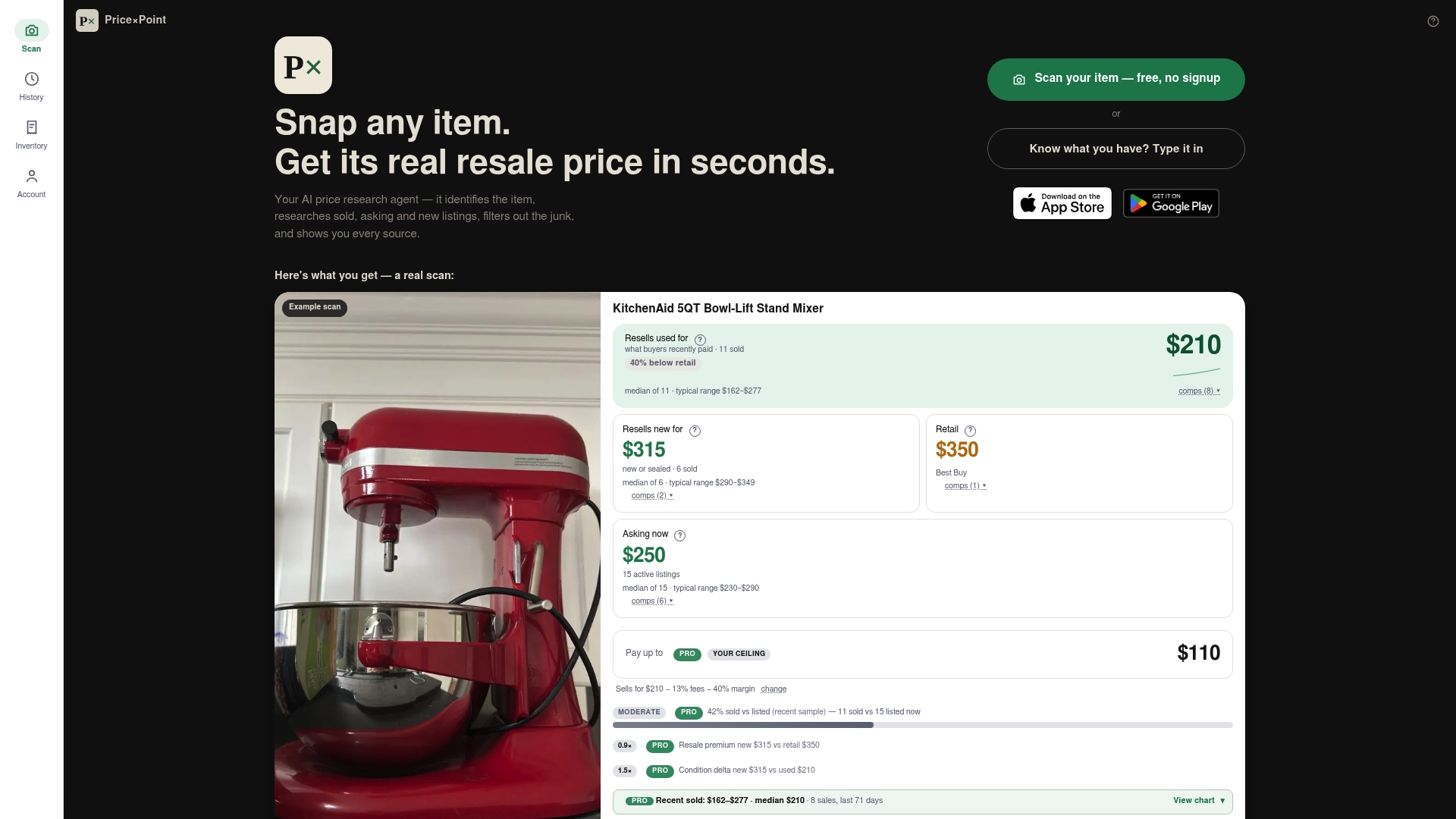
You can also browse real sold prices for used items before you sign up.
A worked example: pricing an unknown locomotive
Say you find a black steam locomotive with no box. Here is how the process plays out.
- Identify. Turn it over. You find a stamped number and a manufacturer name. The road name on the tender gives you the railroad. You measure the track gauge and confirm O gauge.
- Grade. Paint is mostly intact with a few chips, no rust, the lettering is clear, and the motor runs. You are honest: that is a mid-scale grade, not near mint.
- Check completeness. The tender is present, but the original box and paperwork are not.
- Pull sold comps. You look for the same catalog number, no box, similar wear. You find several sold results, drop the one that included extra cars and the one with a repaint, and keep the rest.
- Set the range. Your working range comes from the middle of those comps. You list it slightly above that range if you are willing to wait, or at it if you want a quick sale.
- Document. Save the comps and links. If a buyer pushes back on the price, you have the evidence.
The same five-step logic works for antiques, stamps and coins, which is useful if your late relative collected more than trains.
Mistakes that cost sellers money
- Pricing from active listings. Sellers asking high do not set the market.
- Ignoring the box. Packaging can be a big part of what collectors pay for.
- Cleaning or repainting. It can reduce originality and the price.
- Mixing scales. HO comps tell you nothing about an O gauge piece.
- Forgetting fees. Auction premiums and marketplace fees change what you actually net.
- Using a single comp. One sale can be an outlier; use three to six.
FAQ
How do I find out what an old model train is worth?
Identify the manufacturer, catalog number, scale and road name, then grade the condition honestly. Search for that exact item in sold listings and keep the closest three to six matches. Treat price guides as a starting point only.
Does a model train need to run to have value?
Not necessarily. Collectors often care more about cosmetic condition, originality and completeness than whether the motor runs. A running engine with chipped paint and no box may sell for less than a clean, original piece that needs service.
Is a Lionel train always worth more than other brands?
No. Lionel has a large collector base, but value depends on the specific model, era, condition and demand. Common pieces from any brand can be inexpensive, and scarce pieces from smaller makers can bring strong prices.
Should I price from new retail prices?
Only for recent, unused models, and even then as a ceiling. Retail prices can change, and used pieces usually sell below them. For anything vintage, rely on sold comps rather than catalog prices.
Sources
- What are my old trains worth? | Classic Toy Trains
- How to Identify a Model Train You Own
- The Lionel 700E Hudson steam engine | Trains
- Appraising the Value of Toy Trains | The Spruce Crafts
- How to Find Undervalued Lionel Trains | Trains.com Store
- Lionel Trains: Value, History and What Collectors Should Know | Invaluable
- Lionel 2025 catalog
- Spring Vintage and Modern Train Auction | LiveAuctioneers
- Trains Galore | Special Auction Services