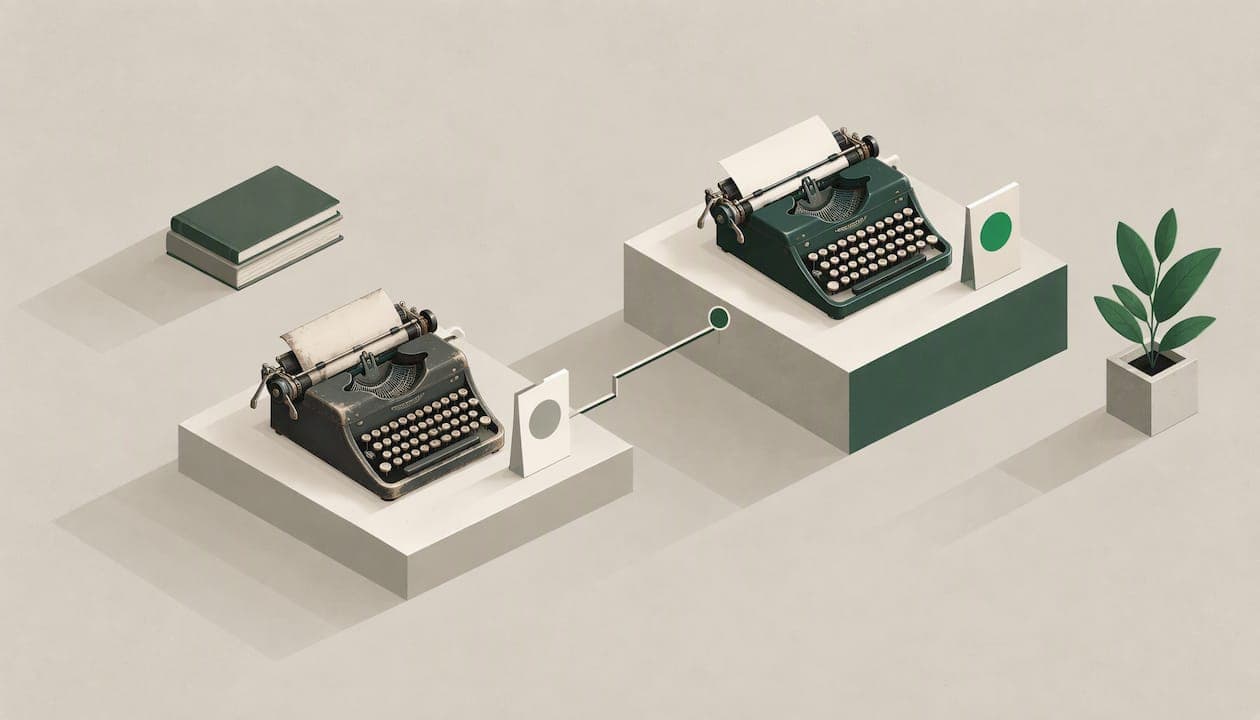
Most typewriters sell for far less than their listings suggest. A common mid-century machine in unknown condition is worth about $5 to $25, a serviced one from a repair shop tops out around $500, and only rare models, unusual typefaces or documented ownership push a price into four or five figures. The gap between those numbers is condition, model and proof, and this guide shows you how to read all three.
TL;DR
- Typewriters made after 1930 in unknown condition usually fetch $5 to $25, and serviced machines from a repair shop peak near $500.
- Condition, model, typeface and provenance set the price. "Rare" in a listing title proves nothing.
- Asking prices are wishes. Sold prices are evidence, so price from completed sales.
- Buying to type on? A serviced machine costs more up front but avoids a restoration bill.
- We built PricexPoint to show sold prices with links to the actual sales, so you can check any machine in seconds.
Table of Contents
- What typewriters sell for right now
- Why shop prices and auction prices differ
- What pushes a typewriter's value up or down
- Be skeptical of "rare" listings
- How to price a typewriter step by step
- Buying a typewriter to use, not to collect
- Selling a typewriter: what to do before you list
- Our perspective: price from sold evidence
- Check a typewriter's sold prices in seconds
- FAQ
- Sources
What typewriters sell for right now
There is no single market, so think in tiers. The figures below combine published guides and shop listings. Treat them as ranges, not quotes.
| Type of machine | Typical price | Notes |
|---|---|---|
| Dusty, untested, or non-working common model | $25 to $150 at the high end | Often a fixer-upper priced $25 to $150; many sell far below that |
| Working common vintage (Royal, Smith-Corona, Underwood) | $100 to $300 | Clean examples reach the top of the range |
| Serviced, restored machine from a repair shop | $350 to $600 | Price includes cleaning, lubrication and adjustment |
| New electronic typewriters (current production) | roughly $230 to $350 | For example a portable word-processing typewriter listed at $299.99 |
| Reconditioned electric office models | $550 to over $1,000 | Depends on model and condition |
| Design-icon portables in excellent shape | $200 to $700 | One appraisal guide puts mid-century portables such as the Olivetti Lettera 32 and Hermes 3000 at $200 to $700 |
| Early index and 19th-century machines | hundreds to thousands | Specialist auction territory |
The ranges overlap on purpose. A Royal portable might be $40 at an estate sale and $450 on a repair shop's shelf, and both prices are honest. They describe different products.
Why shop prices and auction prices differ
Typewriter experts keep making the same point: a machine is worth what a buyer will pay, and where you sell matters. Collector and repair enthusiast Chris Aldrich explains that shop retail prices run well above auction prices because the shop is selling labor: someone cleaned, oiled, adjusted and tested the machine.
So when you compare numbers, ask what each one includes.
- Estate sale or thrift store: the machine as found. You carry the risk and the repair bill.
- Online auction, sold: a real buyer's price, usually for a machine described by an unknown seller.
- Repair shop or dealer: a tested machine, often with a short warranty, at a premium.
- Insurance or appraisal value: a different question again, and not what a quick sale brings.
The same logic applies in other collecting fields. If you want to see how dealer pricing, bid results and local resale diverge for another vintage category, this walkthrough on reading auction prices and adjusting bids uses guitars, but the habit of separating hammer price from shop price transfers directly to typewriters.
What pushes a typewriter's value up or down
Condition comes first
The biggest divide in this market is between as-is machines and serviced ones. Sellers often blur it, listing non-working machines at prices that only make sense for refurbished units. Those listings sit unsold, and buyers who do pay end up disappointed.
What to check, whether you are buying or listing:
- Carriage movement. Does it travel smoothly and advance with each key?
- Type bars. Are any bent, sticking or missing? Do all keys strike and return?
- Platen. Hardened, cracked rubber costs money to replace.
- Ribbon and spools. Usually cheap, so "just needs a ribbon" is rarely the full story.
- Cosmetics. Paint wear, rust, cracked keys and a missing case all pull the price down.
- Extras. Original case, manual and receipt help.
Model and typeface
Some models are simply wanted. Design-forward portables and writers' machines hold value better than the heavy office standards that were made in huge numbers. Typeface matters too. Specialist font styles such as script or the "Vogue" face can change the price dramatically: one source describes a 1930s Royal Model P with a Vogue font selling for over $1,400 on eBay, where a standard one in the same condition might bring about $100. Check the typeface before you decide you own an ordinary machine.

Provenance
Documented history can multiply a price. A typewriter Jack Kerouac used for his last book carried an auction estimate of $18,000 to $20,000. Without paperwork, "my grandfather wrote a novel on it" adds sentiment, not dollars. Original receipts, letters and manuals are what buyers pay for.
Age is a weaker signal than people think
Old does not mean valuable. Early machines can be worth serious money, but a 1920s office Underwood is common. At a European fairground and mechanical-music auction, early American index and keyboard machines carried estimates from roughly €500 to €1,800, and the genuinely scarce examples, like an 1873 Sholes & Glidden, reach into five figures. That is the top of the market, not the middle.
Be skeptical of "rare" listings
The typewriter market has no central, authoritative valuation database. Experienced collectors warn that generic "rare" claims and "working, just needs a ribbon" descriptions often hide common models with mechanical problems. A seller who writes "RARE" in capitals has usually not checked what the model actually sells for.
The same applies to asking prices. Marketplace search pages show hundreds of machines at $300, $400, even $900. Many of those listings will never sell at that number. Reading only asking prices inflates your sense of value by a wide margin.
How to price a typewriter step by step
Here is the method we would use for any machine, whether you plan to sell it, buy it or insure it.
- Identify it exactly. Read the brand and model on the body, check the serial number, and note the typeface. A "Royal" is not one price. A Royal Quiet De Luxe, an office model and a 1930s portable are three different markets.
- Grade the condition honestly. Use the checklist above. Decide whether you are selling "as found" or "tested and working," and only claim the second if you have typed on it.
- Pull sold comparables. Look for completed sales of the same model in similar condition, from the last few months. Throw out asking prices and outliers.
- Separate the channel. A shop-serviced sale is not a comparable for a dusty estate-sale find. Match like to like.
- Adjust for extras. Case, manual, unusual typeface, original box. Add or subtract based on what comparable sales included.
- Set a price range, not a point. A floor you accept for a quick sale and a higher price for patient listing.
Most of the effort sits in steps 1 and 3. Identification errors and mixed-up comparables are where people go wrong.
Buying a typewriter to use, not to collect

If you want to write on it, the cheapest machine is rarely the best deal. Writers' guides suggest a professionally serviced machine at $350 to $600 rather than a $40 to $70 as-is unit that probably needs expensive, time-consuming restoration. Repair parts, shipping and your own time add up quickly.
Two practical tips:
- Buy a machine for which ribbons are still easy to find.
- Ask for a video of the machine typing, or a return window.
New electronic typewriters and e-ink writing devices are a different category. Several are priced from about $230 to $350, with premium digital writing tools going past $1,000, so they are not a substitute for a vintage price check.
Selling a typewriter: what to do before you list
- Clean it gently. Dust and a soft brush help. Avoid aggressive polishing, which can damage decals and paint.
- Photograph the details. Serial number, keyboard, type slugs, carriage ends, case interior.
- State what you tested. Say which parts work and which don't.
- Price to the right tier. An untested machine priced like a restored one will sit.
- Mention provenance only with proof.
The fastest way to lose a sale is to describe a $60 machine with a $400 story.
Our perspective: price from sold evidence
We built PricexPoint because the typewriter problem is every resale problem. The loudest number on the page is usually an asking price, and asking prices flatter. Our approach is to show estimates tied to actual sold listings across several marketplaces, name every data source, and decline to give a figure when there is no evidence behind it.
For typewriters in particular, we think the right question is never "what are they listed at?" but "what did this exact model, in this condition, sell for?" That means getting identification right first. In the app you can snap a photo or type the name, then verify and correct the identification before relying on the price. If a model is too obscure to have solid comparables, you should know that, and take it to a specialist appraiser or auction house instead of trusting a guess.
The market is also messy. Condition is hard to see in a photo, and no tool can replace someone who has tested the carriage. Use sold data to set your range, then let a hands-on look adjust it.
— PricexPoint
Check a typewriter's sold prices in seconds
If you have a machine in front of you, PricexPoint identifies it from a photo or a name and shows sold, asking and new listings, with links to the sales behind the numbers. For a one-off check the free tier may be enough. If you are working through a garage's worth of machines, the pricing page lists plans at $4.99, $9.99 and $24.99 per month, plus token packs of 100 for $5.99, 300 for $12.99 and 1000 for $34.99. You can also browse what used items sell for to see how the sold-price pages work, and our guide to pricing antiques from sold prices covers the same method for older pieces.
FAQ
What are old typewriters worth today?
Most are worth little. Machines made after 1930 in unknown condition typically sell for $5 to $25, and serviced examples top out around $500. Rare models, unusual typefaces and documented ownership are the exceptions.
What is the most affordable typewriter available?
Used, untested machines are the cheapest, often $25 to $150 and sometimes less at garage sales. New electronic typewriters run roughly $230 to $350. A cheap as-is machine can cost more once you add repairs, so price the whole job.
Can you buy typewriters anymore?
Yes. New electronic typewriters are still sold by retailers, and vintage manual and electric machines turn up at estate sales, online marketplaces and repair shops. Serviced vintage machines usually cost more than unserviced ones because the price covers the repair work.
How do I find out what my typewriter is worth?
Identify the exact model and typeface, grade the condition, then compare completed sales of the same model. Ignore asking prices. If the machine is scarce, early, or has a documented owner, get a specialist opinion or consider an auction house.
Sources
- On Purchasing Typewriters: Condition is King; Context is Queen
- What Is My Typewriter Worth?
- How Much Does a Typewriter Cost Today?
- New & Reconditioned Typewriters
- Antique Typewriters: Identification and Value
- Jack Kerouac's Own Typewriter, auction lot
- Auction Team Breker price results, May 2022
- List of commercial writerdecks