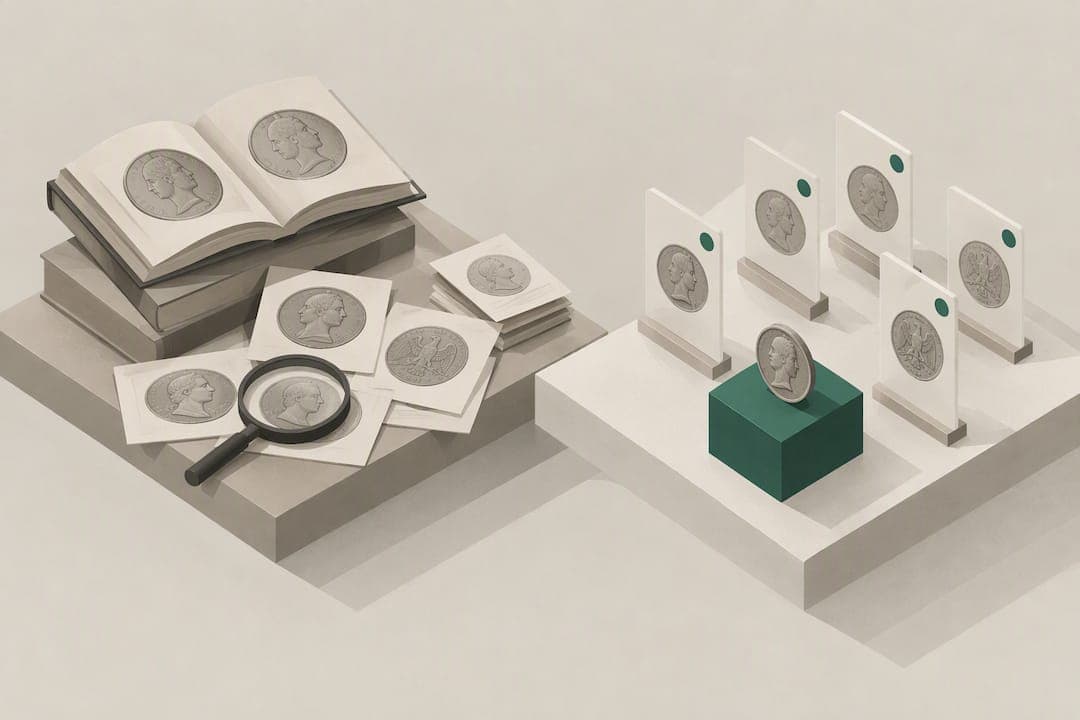
The fastest way to get a reliable coin price is to check recent sold prices for the same date, mint mark, and grade; bullion coins instead track the live spot price of their metal. Grade, date and mint mark, variety, and metal content drive most of the price swing, and a certified grade or a documented auction sale gives you the confidence to trust the number you land on.
TL;DR:
- Compare five or six recent sales for the same date and grade; the spread is more useful than one guide figure or an outlier auction.
- For common coins, skip certification when the submission fee approaches or exceeds likely value; reserve grading for scarce pieces where one point changes price.
- Bullion offers should track spot prices plus a dealer premium, while numismatic coins need collector comparisons rather than metal content alone.
- Before selling, compare multiple written offers by net proceeds after fees, shipping, and taxes; walk away from pressure tactics or quotes kept verbal.
Table of Contents
- Where collectors actually get coin prices
- What actually determines a coin's price
- A step-by-step way to check your coin's price
- Speeding up sold-price research with PriceXPoint
- A realistic view on pricing expectations
- Get instant sold-price comps with PriceXPoint
- FAQ
- Sources
Where collectors actually get coin prices
Collectors pull prices from five main places, and each one trades off accuracy against cost and speed. Printed and online price guides like Greysheet give a quick reference figure, but they update on a lag and need adjusting against current demand. Certified price databases tied to graded populations offer more precision because they separate coins by exact grade. Auction prices realized, often called APRs, show what buyers actually paid for a specific coin, which experts consider stronger evidence than a guide estimate because a single guide number rarely tells the full story. Specialist dealers will give you a written quote based on their own buy list, and pricing apps that aggregate sold listings across marketplaces compress hours of manual searching into a quick lookup.
| Source | Data basis | Cost | Best for | Verification level | Speed |
|---|---|---|---|---|---|
| Printed price guides | Published reference values | Subscription or one-time purchase | Quick ballpark checks | Low, no sale-specific proof | Fast |
| Certified price databases | Graded population data | Often free to browse | Coins already graded | Medium, tied to grading service | Fast |
| Auction APRs | Actual sale results | Often free or low cost | Verifying rare or high-value coins | High, documented sale | Moderate |
| Specialist dealers | Dealer buy lists | Free quote | Selling numismatic coins | High, written offer | Slower |
| Sold-comps pricing apps | Aggregated sold listings | Subscription or token fee | Fast verifiable comps across platforms | High, linked to sale source | Fast |
A guide number is useful for a first impression but weak on its own: it can't tell you whether your specific coin has above-average eye appeal or a cleaned surface that would drag the price down. Auction APRs solve that by showing an actual transaction, though you need enough comparable sales to spot a pattern rather than an outlier. Dealer quotes are convenient and immediate, but a single quote reflects one buyer's margin, not the market. Sold-comps apps split the difference: they pull real sale data quickly, though the result is only as good as the listings the tool filters for relevance.
What actually determines a coin's price
Condition does more to move a coin's price than almost any other factor. Grading services use the Sheldon Scale, which runs from 1 to 70, and a coin's placement on that scale can swing its value dramatically, especially for scarcer dates where a single point of grade can multiply the market price several times over.

A single grade point can matter enormously. On a scarce date, moving from one numeric grade to the next can multiply a coin's market value well beyond what the grade number alone suggests, according to NGC's grading scale reference.
A few other factors interact with grade to set the final number:
- Bullion coins like common-date American Gold Eagles trade close to the metal's spot price plus a small dealer premium, while numismatic coins carry a separate collector premium tied to rarity and demand.
- Date, mint mark, and recognized varieties split a single coin type into dozens of price tiers; a Barber Dime from a low-mintage mint can sell for many times what a common-date example brings.
- Provenance and eye appeal matter too: experienced dealers routinely price circulated coins with strong eye appeal above guide value, while a dull, over-cleaned coin sells below it.
- Cleaning is one of the fastest ways to destroy value because graders treat any cleaning as damage and downgrade the coin accordingly.
Grading isn't always worth the fee. For coins worth less than roughly what a standard grading submission costs, the fee can exceed the coin's entire value, so it typically makes more sense to sell raw. Scarcer or higher-value coins are where certification pays off, since the resulting price certainty and buyer confidence outweigh the submission cost and wait time.
A step-by-step way to check your coin's price
Follow this sequence whether you're pricing a Wheat Cent, a Morgan Dollar, or a gold Saint Gaudens $20.
- Identify the coin precisely. Note the series, date, mint mark, and any recognized variety, and separate bullion issues (American Gold Eagle, Canadian Maple Leaf) from numismatic coins where collector demand drives the price.
- Judge the condition honestly. Decide whether third-party grading makes sense by weighing the submission fee against the coin's likely value; for common lower-value coins, grading fees can exceed the coin's total worth.
- Pull comparable sold prices. Look at auction APRs and dated sold listings with photos, then adjust for grade and eye appeal differences between your coin and the comps.
- Collect multiple written offers. Compare net proceeds after fees, shipping, and any taxes rather than the headline number alone, since specialist dealers and bullion dealers pay differently depending on coin type.
- Watch for red flags. A melt-only offer on a coin with real numismatic value, a refusal to put a quote in writing, or pressure to decide on the spot are all signs to walk away and get another opinion.
Pro Tip: Keep a dated screenshot or saved link for every sold comp you use, so you can show your reasoning if a dealer's offer comes in lower than expected.
For bullion-heavy coins specifically, checking the live spot price before any conversation with a buyer keeps the negotiation grounded, since bullion coins trade closely to spot with a dealer spread built in. If you're weighing where to sell gold coins specifically, reviewing best practices for choosing a gold dealer before committing to a buyer helps you compare reputations and terms.
Speeding up sold-price research with PriceXPoint
Step three of that workflow, finding comparable sold prices, is usually the slowest part by hand. We offer a tool designed to compress the sold-price research process: snap a photo of a coin or type its name, and the app identifies the item and pulls sold, asking, and new listings from multiple marketplaces at once, filtering out mismatched or misleading listings along the way.
For coin owners specifically, that means:
- Rapid sold-comps lookups that show a current price range instead of a single guide figure.
- Bulk pricing via CSV or multi-item photos when you're clearing out an inherited collection or a dealer lot.
- Exportable results with links back to the original sale source, so you have documentation ready when you approach a dealer for a quote.
The same sold-price-first approach works across other collectibles too, as shown in how we price trading cards using linked sold comps and how we price stamps for collectors and resellers.
A realistic view on pricing expectations

A single price guide number feels authoritative, but it's really a starting point. We'd rather see a collector pull five or six recent sold comps for the same date and grade and look at the spread, because that range tells you more about what a buyer will actually pay than any one printed figure.
Grading pays off when a coin is scarce enough that one grade point meaningfully changes the price. It rarely pays off on a common coin worth less than a typical submission fee. And dealer spreads are real: two honest dealers can offer noticeably different amounts for the same coin, which is exactly why getting more than one written quote protects you before you sell.
— PricexPoint
Get instant sold-price comps with PriceXPoint
Checking sold comps by hand across multiple marketplaces eats an afternoon. We built PriceXPoint to deliver the same sold-price evidence in seconds, complete with links back to the source sales so you can verify every figure yourself.
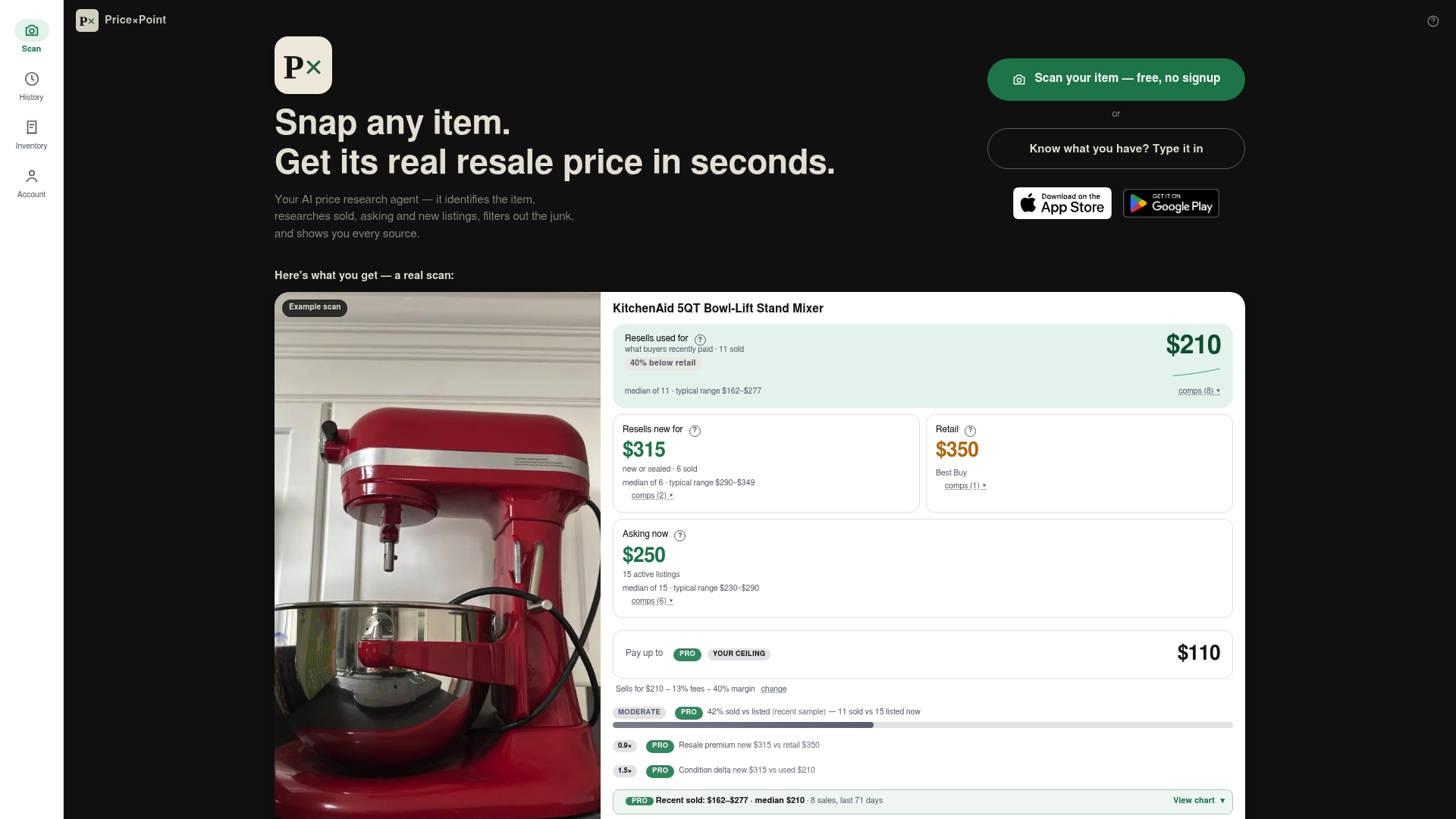
Our Basic, Pro, and Power plans cover everything from an occasional lookup to bulk pricing a full collection. Snap a photo of your next coin and see what it's actually worth before you take an offer.
FAQ
How are coins priced?
Coins are priced by comparing recent sold prices for the same date, mint mark, and grade, then adjusting for eye appeal, cleaning, or documented rarity. Bullion coins are priced differently, tracking the metal's live spot price plus a small dealer premium rather than a collector premium.
Is there a $100 coin?
Yes, the United States Mint has issued coins with a $100 face value, mostly in gold or platinum bullion and commemorative series. Their actual market value depends on metal content and condition rather than the printed face value, following the same bullion-versus-numismatic split described above.
What coin has a value?
Any coin can carry value beyond face amount if it has a low mintage, a recognized variety, strong original condition, or meaningful silver or gold content. Common-date coins in worn condition usually trade near melt value, while scarce dates or high grades can sell for many times that.
What are some good websites for coin collecting?
Numismatic education and reference sites like the American Numismatic Association's Reading Room and grading services such as NGC are solid starting points for learning grading and pricing fundamentals. For checking current sold prices directly, a sold-comps aggregator like PriceXPoint pulls live sale data rather than a static reference number.
Sources
- NGC: Grading scale
- How much should you pay for a coin? | The Reading Room
- How to sell gold coins — Where to get the best price | USAGOLD