
Price research is only useful if someone else can open it, follow it and reach the same number. To export price research well, save each item's identity, condition, sold prices, asking prices, dates and a link to every sale behind the figure, then hand it over as a file (a spreadsheet or CSV) rather than as a screenshot or a single number. We built PriceXPoint around that idea: every estimate is tied to actual sold listings, and your scan history can be saved and exported.
This guide is for resellers, collectors, sellers, buyers and small businesses who need to pass a valuation to a partner, a buyer, a bookkeeper, an insurer or their own future self. It covers what belongs in an export, how to keep the numbers honest, and how to share them so nobody has to take your word for it.
TL;DR
- Export evidence, not just a price: item, condition, sold prices, dates, marketplace and a link to each sale.
- Lead with completed sales. Asking prices show what sellers hope for, so label them separately.
- Record the date and the currency of every comp. Markets and exchange rates move.
- Share a range with a median and a short note on adjustments, not one unexplained figure.
- Use a tool that keeps history and exports, so you can reopen and update the research months later.
Table of Contents
- Why an exported price beats a screenshot
- What to put in an export
- How to run the research before you export it
- Where PriceXPoint takes work off your hands
- Recording the evidence so it stays checkable
- Sharing your export with the person who needs it
- When data is thin
- Worked example: a used camera
- Our perspective
- Start exporting your own price research
- FAQ
- Sources
Why an exported price beats a screenshot
A screenshot of a price tells the reader nothing about how you got there. Was it a sold listing or an ask? Which condition? Last week or last year? The person receiving it has two options: trust you blindly or redo the work.
An export fixes this because it carries the reasoning with the number. A bookkeeper can see which sales support a cost basis. A buyer can see that your asking price sits inside the range where matched items actually traded. A business owner tracking stock can compare this quarter's file with last quarter's and see the drift.
There is also a professional standard behind this. The International Society of Appraisers' guidance says fair market value relies on actual completed sales rather than asking prices, and that comparable sales should come from the item's most common public market. An export that follows that logic is easier to defend in any conversation about price.
What to put in an export
Think of each row as one comparable sale, and each file as one item or one batch of items. A documentation checklist from the collectibles knowledge base Collectaneum lists item identity, condition, completeness, venue, sale date, seller type, currency, URL, shipping, taxes and a confidence label as the fields worth keeping. Here is a practical version.
| Field | Why it matters | Example |
|---|---|---|
| Exact item name and model | Editions and variants can differ sharply in value | Brand, model number, edition |
| Condition | The biggest driver of spread between similar items | Used, good, with box |
| Included extras | Missing cables, inserts or accessories change the price | Charger and case included |
| Price type | Separates evidence from hope | Sold, asking or new |
| Price and currency | Keeps cross-border comparisons honest | $84.00 USD |
| Shipping and fees | Lets you compare net outcomes | Free shipping, 13% fee |
| Sale date | Shows whether the market has moved | Month and year |
| Marketplace | Different platforms behave differently | Auction site, fixed-price site |
| Source link | Lets anyone verify the sale | URL of the listing |
If your file has those nine columns, almost any reader can use it. If it has only the name and a price, it is a guess with a number attached.
Keep sold, asking and new prices apart
Only completed sales show what buyers actually paid. Asking prices show what sellers want, and new-item prices show the ceiling that used goods rarely reach. Mixing them in one column is the fastest way to inflate a valuation. Our guide on sold price versus asking price walks through why the two diverge, and your export should keep them in separate columns or separate tabs.
Record condition in plain, shared terms
Condition is where most disputes start. If you write "great shape" and your buyer reads "like new", the price gap is a fight waiting to happen. Use a consistent grading vocabulary in the file, such as the one in our item condition grades explained, so the person reading your export grades the item the same way you did.
How to run the research before you export it
The export is only as good as the research behind it. Here is the routine, step by step, including where it usually goes wrong.

Step 1: Identify the item exactly
Most bad valuations start with a wrong identification: the right brand and the wrong model year, or a reproduction treated as the original. Take clear photos, find the model number or markings, and confirm the edition. In PriceXPoint you can start from a photo or the item's name, and you can verify and correct the identification, which matters because everything downstream depends on it.
Step 2: Pull completed sales first
Gather sold prices from the marketplace where this kind of item most commonly trades. The ISA guidance says to justify your choice of market with transaction data and to avoid blending comparables from different markets, unless the item has no established market and you are using parallel items instead. A vintage camera and a used phone do not trade in the same places, so do not pool them.
The trap here is that some listings marked as sold still show the last asking price rather than the amount actually accepted, a point the marketplace-data blog Classifindr raises when comparing asking and sold prices. If a sale price looks suspiciously round or equal to the original ask, flag it in your file instead of treating it as proof.
Step 3: Filter for true comparables
Keep only sales that match on specification, condition and time frame. Throw out parts-only listings, bundles, different editions and incomplete items, or adjust for them and write down the adjustment. The ISA page advises explaining adjustments for value-relevant differences, which is exactly what a notes column is for.
Step 4: Compare on a net basis
A $100 sale with free shipping and a $90 sale with $15 shipping are not the same price. Convert everything to the same currency and account for fees and shipping so the figures compare fairly. Our breakdown of marketplace fees across eBay, Poshmark and Mercari shows how much the platform alone can change what you keep.
Step 5: Summarize as a range
Report a low, a middle and a high, and say which one you would use. The ISA guidance also notes that widely dispersed sales can make the average unreliable, so lead with the median when prices are scattered, and mention the mode if one price recurs. For a deeper walkthrough of the arithmetic, see how to calculate the resale value of almost anything.
Step 6: Export and annotate
Save the comps, the range and a two-line note: what you matched on, what you excluded, and your confidence. This is the file you share.
Where PriceXPoint takes work off your hands
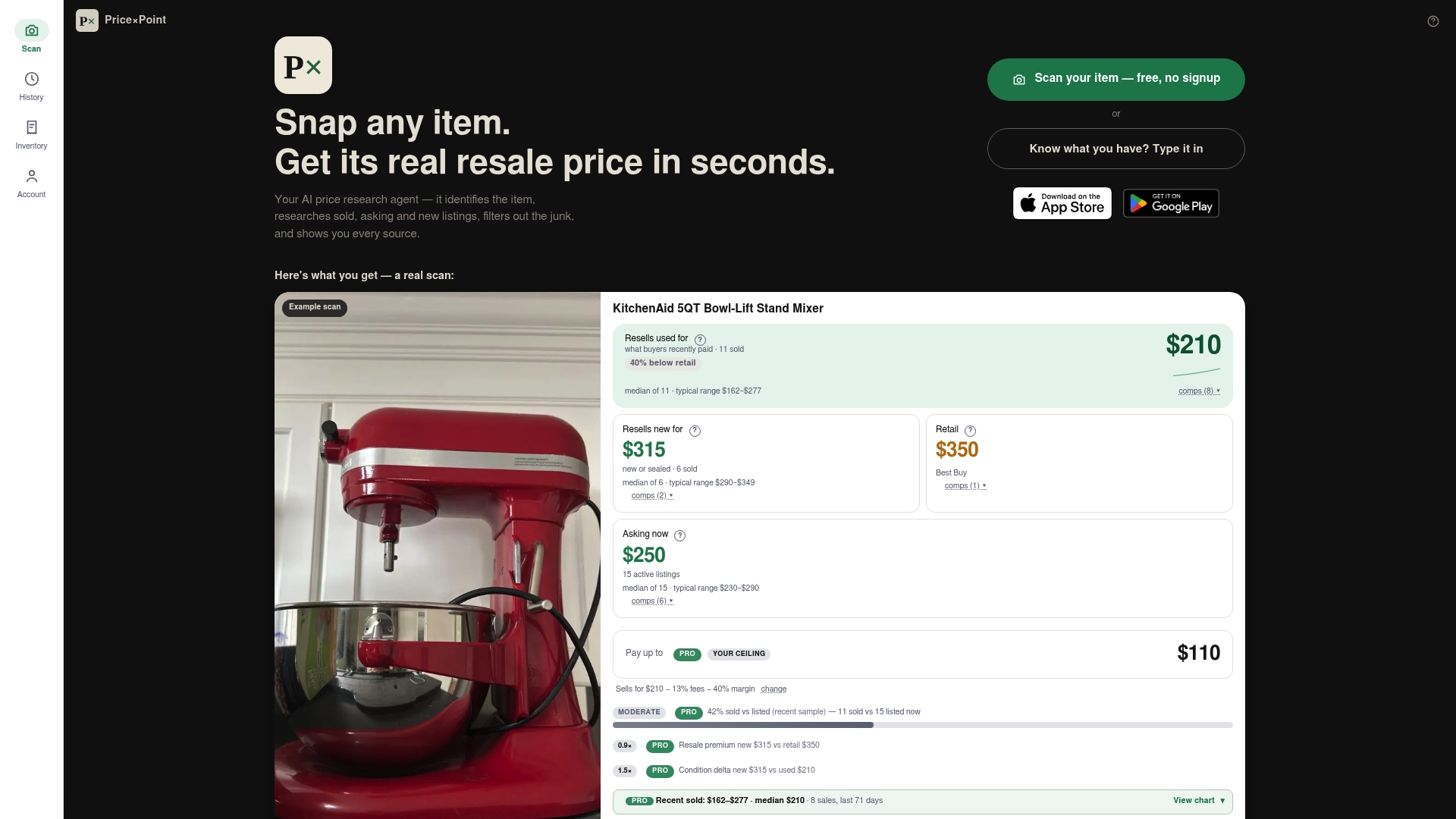
Doing the steps above by hand means opening several marketplaces, sorting sold from active listings, copying figures into a sheet and hunting for links. Our app is designed to take that load off you:
- It identifies the item from a photo or a name.
- It researches sold, asking and new prices across multiple marketplaces.
- It filters out unreliable listings and links each estimate to the sales behind it.
- It names every data source and does not show a figure without supporting evidence.
- It saves your scan history and offers export options.
For a stockroom or a garage sale, it also supports bulk pricing through a CSV file or a photo with several items, so a whole batch ends up in one place rather than as dozens of separate searches.
Recording the evidence so it stays checkable
Price data ages. A number you export today will be questioned in six months, and the question will be "when was this true?" Two habits protect you.
Log the date of the observation, not just the date you exported. A pricing-data guide from PriceToday makes the point that observation time, publication time and retrieval time are different things, and that refreshing a page changes only when you retrieved it. For resale, the equivalent is the sale date of each comp. A file full of sales from three years ago, retrieved yesterday, is an old valuation.
Keep original currency and the rate used. If you compare sales across countries, Collectaneum recommends preserving the original currency, sale date and the exchange rate you applied, because rates shift and can change the apparent result. Store the original figure alongside your converted one.
When two sources disagree, resist the urge to choose the one you like. Check that they describe the same model, condition, currency and time period. If a gap remains, report the range and say so.

Sharing your export with the person who needs it
The right format depends on who is reading.
Selling to a buyer or negotiating a price
Send a short summary: the item, your asking price, and three to five linked sold comps. Buyers respond well to evidence they can click. It turns a haggle about opinions into a conversation about records.
Handing numbers to a partner or a reseller team
Share the full file with all columns, so the person pricing the next batch can reuse your comps. If you work with someone who sources while you list, one shared file keeps both of you on the same prices.
Giving figures to a bookkeeper or insurer
They need the item, the valuation basis (sold comps, not asks), the dates and the links. Add your adjustments in writing. A documented method is far easier to accept than a bare total.
Tracking stock value over time
If you run a small business, export the same set of items on a regular schedule and compare files. Because every row carries a date, you can see which categories are rising or falling instead of discovering it at the next sale.
When data is thin
Some items rarely sell. When there are no sales of the exact item, the ISA guidance says parallel items in parallel markets can support an opinion, but the analysis should account for the item's weaker market presence. Say this plainly in your notes: which items you used as stand-ins, and why the real price could land higher or lower.
Platform differences make this harder. A peer-reviewed 2020 study in the journal Sustainability found that second-hand platforms have different characteristics and that comparing prices across them is difficult, which is why the authors proposed a system that searches several platforms and standardizes the scattered listing information. The same problem shows up for shoppers comparing a single phone model across many sellers, for instance when looking at refurbished phone marketplaces compared: storage, carrier and condition all have to line up before two prices mean the same thing.
Worked example: a used camera
Suppose you are selling a used mirrorless camera body with a charger and one battery, in good condition.
- You identify the exact model and confirm the included accessories.
- You collect eight sold listings from the last two months, in the same condition, with similar accessories. You drop two that were body-only and one with a cracked screen.
- The remaining five sold between $410 and $470, and shipping was free on four of them. You add the shipping cost to the fifth so all five compare on the same basis.
- You report a low of $410 for a quick sale, a middle of $440 where most matched examples sold, and a high of $470 for a clean listing with good photos.
- You export the five rows with links and a note: "Excluded body-only and damaged sales. Fees not deducted."
A buyer, a partner or your accountant can read that in a minute and agree or disagree with specific rows. The figures are illustrative, but the structure is what matters. For category-specific detail, see our guides to used camera pricing, console resale pricing and furniture resale pricing, or browse what used items sell for in real sold prices.
Our perspective
We think a price is only worth sharing if the person receiving it can see where it came from. That is why PriceXPoint ties its estimates to actual sold listings from several marketplaces, names every data source and does not provide a figure without supporting evidence.
Price research tends to fall apart at the handoff. The researcher knows which sales were solid and which were doubtful, but the file carries only the final number. We want the evidence to travel with the estimate: the links to the sales, the filtered-out noise, and the identification you verified and corrected yourself.
For anyone who prices more than a handful of items, that means a saved scan history, export options, and bulk pricing through CSV or multi-item photos. The point is not speed for its own sake. It is that your valuation can be opened, checked and reused by a buyer, a teammate or you next season.
PricexPoint
Start exporting your own price research
PriceXPoint has a free tier, and paid options when you need more lookups. Plans are Basic at $4.99 per month, Pro at $9.99 per month and Power at $24.99 per month. If you prefer one-off token packs, 100 tokens cost $5.99, 300 tokens cost $12.99 and 1000 tokens cost $34.99. See the details on the pricing page, or start from the PriceXPoint home page.
If you are still deciding which kind of tool fits your selling style, our comparison of the best reselling apps lays out the options by type.
FAQ
What should I include when I export price research?
Include the exact item, its condition, included accessories, price type (sold, asking or new), price and currency, shipping, sale date, marketplace and a link to each sale. Add a short note on what you excluded and why. That is enough for another person to review the work without redoing it.
Is it better to share one price or a range?
Share a range with a clearly labeled middle value. Prices for the same item vary with condition, timing and marketplace, so one number hides that spread. Professional appraisal guidance also warns that the mean can mislead when sales are widely dispersed, so the median is usually the safer anchor.
Can I use asking prices in a shared valuation?
Yes, but label them as asking prices and keep them separate from sold prices. They show what sellers hope to get and how crowded the market is, which helps you set a listing price. Only completed sales show what buyers actually paid.
How often should I refresh exported price data?
Refresh whenever you are about to make a decision on it, and compare files on a regular schedule if you track stock value. Each row should carry its sale date, so you can see at a glance how old the evidence is and whether the market has moved.
What if my item has very few recorded sales?
Use closely matched parallel items and say so in the file. State which items stand in for yours and why the real price might sit higher or lower. A transparent estimate with a stated confidence is more useful than a confident number with no support.
Sources
- Part III: Fair Market Value Guidance List, International Society of Appraisers
- Asking Price vs Sold Price, Collectaneum
- Marketplace Asking Prices vs Sold Prices, Classifindr
- Updated just now does not mean the price is new, PriceToday
- Second-hand platform price comparison study, Sustainability (2020)
- Refurbished phone marketplaces compared