
The fastest way to price used furniture is to find three to five recently sold pieces that match yours in size, material, age and condition, take the middle price, then adjust for your piece's flaws, your selling costs and how quickly you want it gone. Original retail price is a poor starting point. What a buyer actually paid for a near-identical piece is the number that counts.
This guide walks through that method, shows what moves a price up or down, and covers the costs that quietly eat your profit. It also answers the question electronics sellers keep asking, because the same logic applies.
TL;DR
- Price from sold listings, not asking prices. Asking prices show what sellers hope for, sold prices show what buyers paid.
- Match comparables on size, material, age, condition and style, and ignore the obvious high and low outliers.
- Condition, construction (solid wood versus MDF), local demand and delivery difficulty move the price more than brand alone.
- Subtract fees and shipping or hauling costs before you decide your lowest acceptable price.
- Electronics follow the same method, with model number, storage size and working condition as the matching details.
Table of Contents
- What "resale value" really means
- The five-step method for pricing used furniture
- What moves a used furniture price
- Worked example: pricing a used sofa
- Fees, delivery and your real profit
- Pricing by furniture type
- How to price used electronics
- A faster way to research prices
- Promo: price your next piece in seconds
- Perspective
- Common pricing mistakes to avoid
- FAQ
- Sources
What "resale value" really means
Resale value is what a buyer is willing to pay right now, in your market. It is not what you paid, what it would cost to replace, or what the piece means to you. Consignment Gallery makes the same distinction: resale value is what a buyer may pay in the current market, separate from original retail price, replacement cost, asking price, final sale price and sentimental value.
The IRS gives a useful formal definition in Publication 561: fair market value is the price agreed on the open market by a willing buyer and a willing seller who both know the relevant facts. The same publication says used household items such as furniture are usually worth much less than new, because they may be worn, out of style or no longer useful. It also says no single formula always applies and that you weigh all the facts and circumstances, including desirability, use and scarcity.
That is the honest answer to "how much is my couch worth?" There is no table that gives a fixed percentage. There is a method for finding the market's answer.
Why the "2/3 rule" will not help you price
People often search for the "2/3 rule for furniture" and land on pricing pages. The rule is actually an interior design proportion: a sofa is roughly two-thirds the length of the wall or rug it sits against, according to Apartment Therapy. It is useful for arranging a room, but it says nothing about what a piece sells for. Do not use it as a pricing shortcut.
The five-step method for pricing used furniture

1. Identify exactly what you have
Write down the maker or brand, the product line, the dimensions, the material and the approximate age. Look underneath drawers, on the back panel and under cushions for labels, stamps or stickers. Wirecutter recommends checking maker markings first, and the same markings help you search for comparable sales.
Two pieces that look alike in a photo can be worth very different amounts. A solid oak dresser and a laminate dresser of the same size are not comparables.
2. Pull recent sold prices
Search the marketplaces where your type of piece sells and filter to sold or completed listings. Collect three to five close matches. If you only look at active listings, you are reading a wish list. Many of those pieces have sat unsold for weeks, which is a sign the price is too high.
One high sale can also mislead you. A single buyer who paid a premium for a rare colorway does not set the market. Our guide on checking sold prices before you list explains how to spot the outlier and weigh it properly.
3. Remove outliers and take the middle
Throw out the very highest and very lowest results unless you can explain them (a famous designer, a visible defect, a set sold with extra chairs). Then take the median of what is left. That is your baseline.
The IRS makes the same point about comparable sales: their weight depends on similarity, timing and circumstances of the sale, and market conditions. A sale from last month in your region counts for more than one from three years ago across the country.
4. Adjust for condition, materials and local demand
Your baseline is for a typical piece. Move it up or down using the factors in the next section.
5. Subtract costs and set two numbers
Set a listing price, which leaves room for negotiation, and a floor price, the lowest you will accept after fees and delivery. Write both down before the first message arrives.
What moves a used furniture price
Habitat for Humanity ReStore describes its own approach this way: a baseline price is adjusted for supply and demand, brand, size, condition and availability. The baseline is where you start, not where you finish. The same logic applies to your own listing.
| Factor | Pushes price up | Pushes price down |
|---|---|---|
| Construction | Solid wood, quality veneer, steel, stone, glass | MDF, particleboard, peeling veneer |
| Condition | No stains, wobble or odors; original hardware | Scratches, pet damage, repairs, missing parts |
| Size | Fits modern apartments and standard doorways | Oversized pieces that are hard to move |
| Style | Currently sought-after design, clean lines | Dated finishes or very specific styles |
| Completeness | Full sets, matching chairs, original cushions | Single pieces from a broken set |
| Logistics | Easy pickup, ground-floor access | Stairs, tight turns, long distance |
Materials and build quality
Wirecutter notes that steel, stone, glass, lucite, solid wood and high-quality veneer are relatively durable, and that solid wood and quality veneer last longer than MDF. Buyers who have been burned by a collapsing bookcase know this, and they pay a little more for pieces that look built to last. Say so in your listing: name the material, and show a close-up of a drawer joint or an underside.

Condition checks buyers will do anyway
The same Wirecutter guide lists what careful buyers look for: odors, wobbliness, visible damage, veneer delamination, repairs, whether everything works, exact dimensions and the cost of getting it home. Go through that list on your own piece before a buyer does. A small, honestly disclosed flaw costs you far less than a failed pickup.
Brand is not an automatic premium
A famous name helps, but Consignment Gallery says product line, era, style, condition, size, materials, craftsmanship and current buyer interest still determine the price. A worn piece from a premium maker can sell for less than a clean piece from a mid-range one. Sold comparables settle the argument.
What the percentage rules of thumb really tell you
You will see rules such as "sell at 40 to 70 percent of the original price." Treat them as a sanity check only. They depend on the country and the era: OLX India, for example, offers 40 to 60 percent of original price as a rule of thumb for good furniture in India, and that is a figure for that market, not a US benchmark. A retailer that discontinued your line may leave you with no original price to compare against at all.
Averages from marketplaces are similarly local. Gumtree reported 2023 average UK listing prices of £294 for a sofa, £143 for a table and £145 for a bed, which tells you the range of the category in that market, not what your sofa will fetch in Ohio. In the US, ReStore says its average sofa price is $95, and that a well-loved loveseat and a leather sectional are priced differently. Those are thrift-store prices, typically lower than what a private seller can ask for a clean, desirable piece.
Worked example: pricing a used sofa
Suppose you have a three-seat fabric sofa, five years old, no stains, one worn armrest.
- You find five sold listings for the same model or a very close match, at $420, $450, $480, $500 and $900.
- The $900 sale included a matching chair and delivery. You drop it as an outlier.
- The median of the remaining four is about $465. That is your baseline.
- Your worn armrest is a visible flaw, so you plan to list at $450 and accept $400 as a floor if the buyer picks it up.
- You will not ship it, so you have no shipping cost. If you sold on a platform with fees, you would subtract those from the floor.
Those numbers are illustrative, not a market quote. Your own comparables will give you different figures, and that is the point.
Fees, delivery and your real profit
Your price is not your profit. Platform fees, packaging, fuel, a helper to carry a dresser downstairs: all of it comes out of the sale.
On eBay's US fee schedule, most categories carry a final value fee of 13.6 percent plus a per-order fee of $0.40 on orders over $10, with exceptions by category. On a $450 sale that is about $61 in percentage fees alone, before shipping. Local pickup through a free listing avoids most of that, which is why bulky furniture is often sold locally. Our piece on Facebook Marketplace pricing covers the local route in detail.
If you flip furniture regularly, calculate your margin per piece, not per month. Benchmarks for ecommerce profit margins are a good reminder that revenue is not the same as what you keep, and that fees, shipping and returns shape the number.
A simple floor-price formula: baseline price, minus fees, minus delivery or hauling cost, minus the cost of any repair or cleaning supplies, minus the value of your time if you are reselling for profit. If the result is below what you paid, hold out for a better offer or donate and take the receipt.
Pricing by furniture type
Couches and sectionals
Size and cleanliness dominate. Buyers pay more for a clean sofa that fits through a standard door. Leather in good condition holds its price better than worn fabric, but cracked leather drops fast. Mention the pet and smoke status honestly, since buyers ask anyway.
Dressers, desks and tables
Solid wood pieces with intact drawers do best. Check drawer slides and the top surface for water rings. Dining tables sell better as a set with chairs, but you can also test whether separating them produces a higher total.
Antiques and vintage
Age alone does not make a piece valuable. Maker, provenance, originality and demand do. For older and unusual pieces, look at sold prices for similar items from the same period, and see our guide to pricing antiques with sold prices.
Office furniture
Business buyers want function and quantity. Ergonomic chairs and sit-stand desks from known makers sell if they work properly. Price by model and test every adjustment mechanism before you list.
How to price used electronics
The same sold-comparables method works for electronics, with different matching details.
- Match the exact model. A "laptop" is not a comparable. Use the model number, processor, memory and storage size.
- Check working condition and accessories. Battery health, cracked screens, original charger and box all move the price.
- Look at sold prices from the last few weeks. Electronics lose value faster than furniture, so old sales mislead more.
- Account for newer models. When a successor launches, the older model often drops.
- Remove your data and say so. Buyers value a factory-reset device.
Again, rules of thumb vary by market. OLX India says one- to three-year-old electronics often sell for 50 to 70 percent of the original price there, depending on condition and brand. In the US, trust sold listings for your exact model over any percentage.
A faster way to research prices
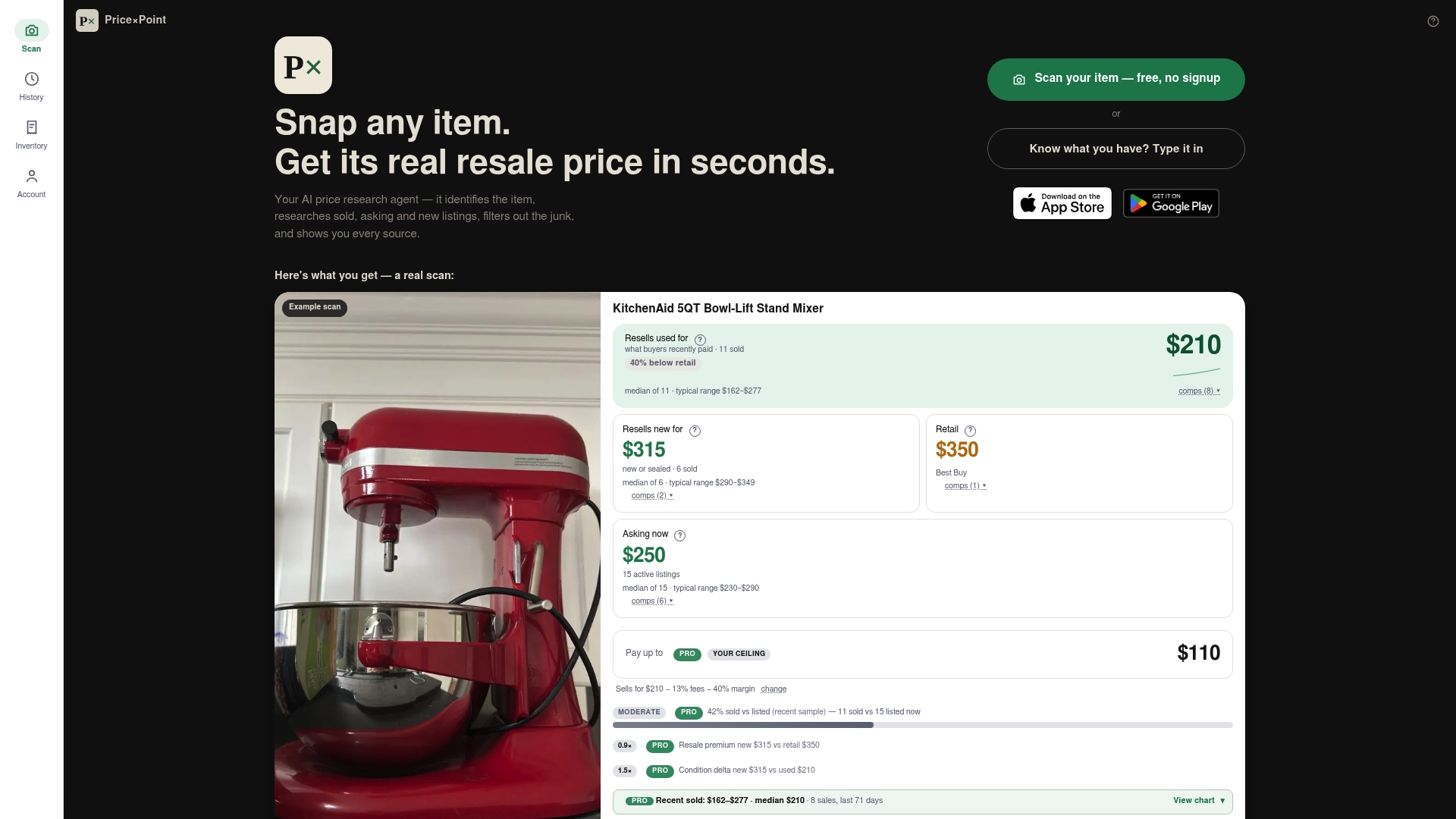
Doing this by hand across several marketplaces takes time, and it is easy to confuse asking prices with sold ones. That is the gap PriceXPoint is designed to close. You snap a photo or type the item name, and the app looks up sold, asking and new listings across multiple marketplaces, then links each estimate to the sales behind it so you can check the evidence. If it misidentifies a piece, you can correct the identification and the pricing updates.
For a sense of the output, browse what used items sell for, with real sold prices behind every figure. For general method beyond furniture, our walkthrough on calculating resale value applies to almost anything, and AI for resellers shows how sold listings fit into a sourcing workflow.
Promo: price your next piece in seconds
If you list furniture or electronics more than occasionally, a subscription pays for itself in saved research time. PriceXPoint plans start at $4.99 per month for Basic, $9.99 per month for Pro and $24.99 per month for Power, and you can buy token packs instead: 100 tokens for $5.99, 300 tokens for $12.99 or 1000 tokens for $34.99, all one-off. Bulk pricing through CSV or multi-item photos helps when you are clearing a whole house. See the plans and token packs to pick what fits.
Perspective
We built PriceXPoint around one belief: a price without evidence is a guess. Furniture is where guessing is most expensive, because pieces are bulky, hard to ship and slow to sell if you start too high.
Most sellers check asking prices because they are easy to find. But asking prices include every overpriced piece that never sold. Our approach is to show sold listings first, name every data source, and decline to give a figure when there is no supporting evidence.
We also think the seller should stay in control. If the app identifies your dresser wrongly, you can correct it and see the estimate change. The goal is to give you a range you can verify, so you can set your listing price and your floor price with confidence.
PricexPoint
Common pricing mistakes to avoid
- Anchoring on what you paid. The market does not care about your receipt.
- Using asking prices as comparables. Filter to sold listings whenever the platform allows.
- Ignoring delivery. A beautiful 300-pound sideboard that nobody can collect is worth less to most buyers.
- Pricing at the exact floor. Leave room for negotiation, since most buyers will offer less.
- Never re-checking. If a listing gets no messages in a week or two, the price, the photos or the title is wrong. Check the market again before dropping the price.
For thrift and shop owners pricing many pieces at once, thrift store pricing in four steps shows how to build a market-backed aisle price.
FAQ
How do I calculate the value of used furniture?
Find three to five recently sold pieces that match yours in material, size, age and condition, remove outliers and take the middle price. Then adjust for your piece's flaws and local demand. The IRS notes that no single formula always applies, so comparable sales are your best evidence.
How much should I charge for a used couch?
It depends on size, fabric, condition and your area, so start from sold prices for the same model. Thrift stores price low, with ReStore reporting an average sofa price of $95. A private seller with a clean, desirable sofa can usually ask more than a thrift shop. Set a listing price slightly above your floor.
What is the best way to sell my used furniture?
For bulky pieces, local selling usually keeps the most money because it avoids shipping and most fees. Take clear photos in daylight, list exact dimensions and material, and disclose flaws. Consignment is an option if you would rather not handle buyers, though it takes a share of the sale.
Does brand matter when pricing used furniture?
It helps, but it does not guarantee a premium. Product line, era, condition, size and current buyer interest still decide the price, as Consignment Gallery points out. Check what your exact piece sold for.
Sources
- IRS Publication 561, Determining the Value of Donated Property
- How Consignment Stores Price Used Furniture
- The Two-Thirds Rule Helps You Pick Correctly Sized Furniture, Apartment Therapy
- Expert Tips for Buying Used and Vintage Furniture, Wirecutter
- Your Questions, Answered: Pricing, Habitat for Humanity ReStore
- How to Determine the Right Price for Your Second-Hand Items, OLX India
- Tips on How to Price Your Second-hand Items, Gumtree
- Understanding selling fees, eBay