
To price sports memorabilia, identify the item exactly, find recent completed sales of the same item in the same condition, and take the middle of those sales rather than the highest asking price. Then adjust for authentication, condition and provenance. That is the whole method. The hard part is doing it quickly and without mixing in listings that never sold. PriceXPoint identifies an item from a photo or a name and shows sold, asking and new listings with links to the sales behind each figure, so every number you use has evidence you can check.
TL;DR
- Price from sold listings, not asking prices. An asking price is a hope, a sold price is a fact.
- Identify the item precisely first: player, year, brand, set, card number, parallel, grade or condition. A wrong match gives a wrong price.
- Use the middle of 3 to 7 close comps from the last 30 to 90 days, then adjust for authenticity, condition and provenance.
- When few comps exist, widen the range and triangulate from neighboring grades or similar items instead of guessing a single number.
- Re-check a price whenever news hits the player, and review a collection every few months.
Table of Contents
- Why sold prices beat asking prices
- Step 1: Identify the item exactly
- Step 2: Pull recent sold comps
- Step 3: Take the middle, not the extreme
- Step 4: Adjust for authenticity, condition and provenance
- Step 5: What to do when there are few comps
- Know your net, not just your price
- How often to update your estimate
- Promo: price your next item with evidence
- Perspective: why we insist on linked sold comps
- Common mistakes to avoid
- FAQ
- Sources
Why sold prices beat asking prices
Every sports memorabilia listing carries a number, and most of those numbers are wishful. A listing can sit for months at a price nobody will pay. A sold price tells you what a real buyer paid on a real day.
The distinction matters even among sold prices. Sports Collectibles coverage from SI points out that auction results give a better read on market value than fixed-price sales, because several bidders help set the price. Its example: a card that normally sells for $800 at auction and once goes for $1,000 at a fixed price is not suddenly worth $1,000.
So your hierarchy looks like this:
- Completed auction sales of the exact item.
- Completed fixed-price or accepted best-offer sales of the exact item.
- Current asking prices, used only as a ceiling and a sanity check.
A listing that keeps getting relisted at the same number is a warning sign, not a comp. If you want a deeper look at the difference, we break it down in sold price vs. asking price.
Step 1: Identify the item exactly
Bad identification ruins more estimates than bad math. A 1986 basketball card and its reprint can look alike in a thumbnail and sell for wildly different amounts.
For a card, write down:
- Player and year
- Brand and set
- Card number
- Edition or parallel (base, refractor, numbered, rookie or not)
- Grade and grading company, or "raw" if ungraded
For memorabilia, write down:
- Item type (ball, jersey, bat, helmet, photo, ticket stub, program)
- Who signed or used it, and when
- Maker and model (a game-model helmet is not the same as a replica)
- Any certificate of authenticity, tag number or photo evidence
- Visible flaws: fading, creases, stains, repairs
Where it goes wrong: typing a vague title such as "signed baseball" into a search bar returns thousands of unrelated results. Reading a card number off a worn corner. Treating a reprint as the original.
What we do here: in PriceXPoint you snap a photo or type the name, and the app identifies the item. You can then verify and correct that identification before you trust the price, which is where most pricing errors are caught. For bulk lots, you can price many items at once with multi-item photos or a CSV file.
Step 2: Pull recent sold comps
A comp, short for comparable sale, is a completed sale of an item that matches yours as closely as possible. Sporting News describes the practice plainly: comping means comparing recent completed sales to set market value, and most people average the last three to five sales.
How far back should you look? A reasonable window is 30 to 90 days. Use the longer end for items that rarely trade and the shorter end for items that sell daily. A guide from a collector site suggests extending toward 180 days for thin markets and tightening to 30 days for busy ones, which fits common sense: old sales on a hot item are stale, and a short window on a rare item gives you nothing.
Three to seven good matches beat a hundred loose ones. Quality of match matters more than quantity.
Where it goes wrong:
- Mixing conditions. Compare raw to raw, and a graded copy to a copy with the same grade from the same company. A PSA 9 sale tells you little about a PSA 10, and neither tells you about a raw copy.
- Counting lots, damaged items or "best offer accepted" listings that show the original asking price instead of the accepted offer.
- Including shill-looking or obviously mispriced sales.
What we do here: PriceXPoint pulls sold, asking and new listings across multiple marketplaces, filters out unreliable listings, and links every figure to the sale it came from. That means you are not hunting through search tabs and you can open the source of any comp. We also name every data source and do not give a figure without supporting evidence. A walkthrough for cards specifically is in our guide to pricing trading cards with linked sold comps.
Step 3: Take the middle, not the extreme
Once you have your comps, resist the urge to anchor on the best one. Use the middle of the set.
Sporting News gives a clean example. Recent sales of $89, $104, $98, $115 and $90 put the market value at roughly $100. A fair buyer offer sits around 80% of that, so about $80. The same range tells a seller where to list and tells a buyer where to open.
Here is the same logic in table form:
| Comp set (sold, same grade, last 60 days) | Sale prices | Middle value | Use it as |
|---|---|---|---|
| Five close matches | $89, $90, $98, $104, $115 | $98 | Market value near $100 |
| Three close matches | $40, $45, $52 | $45 | Market value near $45 |
| One outlier among four | $60, $62, $64, $140 | $63 | Ignore the $140, check why it spiked |
When one sale is far above the rest, find out why before you ignore it. It might be a mislabeled item, or it might be a real signal: a player's big game, a milestone or an award can push the most recent sale above the older ones. Sporting News notes that after news, an injury or an accolade, the most recent comp may matter more than the average.
Step 4: Adjust for authenticity, condition and provenance
Comps give you a baseline. Three factors then move your item above or below it.
Authentication
For signed items and game-used pieces, authentication is the foundation of value. Kelly Insurance Group, which writes coverage for collectors, notes that the value of signed and game-used items depends entirely on the authenticity of the signature or provenance. An autographed ball with paperwork from a recognized authenticator is a different asset than the same ball with no documentation, and your comps should reflect that split.

Condition and grade
The same source notes that a PSA 10 and a PSA 8 of the same item can differ by orders of magnitude in value, and that the population report, meaning how many copies exist at each grade, is a key driver. Scarcity at a high grade is where premiums come from. For ungraded items, photograph every flaw and compare against sold items with similar wear.
Provenance and photomatching
Provenance is the documented history of an item: receipts, letters, certificates, photographs. The CFA Institute reports an expert's view that the biggest variable to grow in memorabilia value is whether an item is photomatched, meaning a photo of it in use can be tied to a specific game or moment. If you have that kind of evidence, say so in your listing and look for comps that carry it too.
A simple way to organize this: start with the comp range, then add or subtract for authenticity, condition and provenance, and express your confidence honestly. Where your item has paperwork the comps lack, you can lean toward the top of the range. Where the comps are all authenticated and yours is not, lean toward the bottom.
Step 5: What to do when there are few comps
Some items just do not trade often: a one-off game-worn piece, a regional team's oddity, a low-population card. When exact matches are missing:
- Widen the window. Go back 180 days or further, and note that older sales may not reflect today's market.
- Triangulate. Compare your item to close substitutes in the same set, era or player tier, then infer from neighboring grades. One expert example suggests that in thin markets a PSA 10 may be estimated by subtracting about 15% from the PSA 9 price. Treat that as a starting point and not a rule.
- Give a range, not a number. A range of $150 to $220 with a stated reason is more honest and more useful than a false $187.
- Use asking prices only as a ceiling. If three similar pieces are listed at $300 and none has sold, your item is probably worth less than $300.
For non-card collectibles such as helmets, balls and equipment, the same method applies. You can see how it plays out in real sold-price pages like the Riddell SpeedFlex worth page and the Adidas miCoach Smart Ball page, which show what actual buyers paid. Browse more at what used items sell for.
Know your net, not just your price
A sold price is not what lands in your pocket. Marketplace fees, payment processing, shipping, insurance and any authentication or grading costs come out of it. Before you decide to sell, subtract those from your estimate to get net proceeds. A $100 card that costs $15 to sell and ship nets $85, and a buyer who knows this will often offer less.

For resellers sourcing at estate sales or flea markets, the reverse applies: your maximum buy price is the expected sale price minus your costs and the profit you need. Our guide on pricing collectibles with real sold prices walks through that math in under ten minutes.
How often to update your estimate
A price is a snapshot. For a collection you are holding, a review every three to six months is a sensible rhythm, according to a collector's valuation guide, and cards tied to players with swinging performance deserve more frequent checks.
Re-price sooner when:
- The player wins an award, sets a record, retires or enters a hall of fame discussion.
- A player is injured or traded.
- A season starts or the playoffs begin.
- You are about to list, insure or sell the item.
Because PriceXPoint saves your scan history with export options, you can compare today's figure to the one you saw last quarter without starting over.
Promo: price your next item with evidence
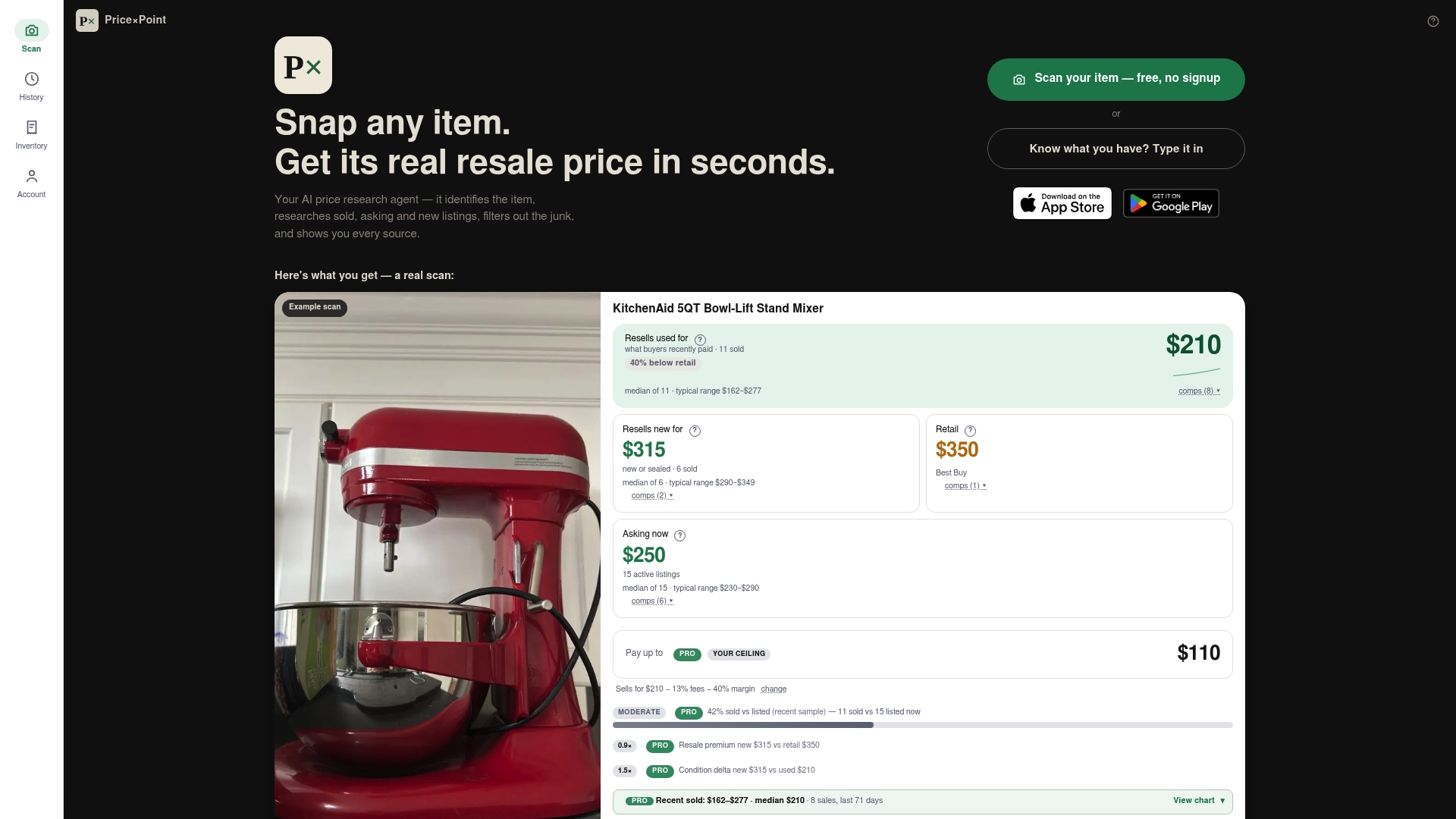
PriceXPoint is built around one idea: a price should come with its proof. Take a photo of your jersey, ball or card, or type its name, and you get sold, asking and new listings with links to the sales. There is a free tier to start, and you can step up when you have more to price.
Paid plans on our pricing page:
| Plan or pack | Price |
|---|---|
| Basic | $4.99 per month |
| Pro | $9.99 per month |
| Power | $24.99 per month |
| 100 tokens | $5.99 one-off |
| 300 tokens | $12.99 one-off |
| 1000 tokens | $34.99 one-off |
If you price a few items now and then, a token pack fits. If you price every week, a monthly plan fits.
Perspective: why we insist on linked sold comps
Sports memorabilia is a market where one wrong assumption costs real money. A reprint mistaken for an original, an asking price mistaken for a sale, a raw card compared to a gem mint sale: each one moves your number by a lot.
That is why we built PriceXPoint to show its work. Every estimate is linked to actual sold listings from several marketplaces, every data source is named, and we do not hand you a figure without evidence behind it. You can verify and correct the item identification, because the most accurate price starts with the right item.
We think resellers, collectors and buyers should be able to open the sale behind a number and judge it themselves. A price you can trace is a price you can negotiate with.
PricexPoint
Common mistakes to avoid
- Pricing from active listings. The most common error, and the most costly.
- Ignoring grade. One grade step can change the price several times over.
- Letting one hot sale set the price. Check whether it is a pattern or a spike.
- Forgetting fees. Estimate net, not just gross.
- Skipping documentation. Certificates, receipts and photos are part of the value. Keep them with the item.
- Never re-checking. The market moves with the players.
If you want to compare tools for this work by type, our guide to apps that tell you what something is worth covers what to look for, and the piece on AI that shows sold listings explains why evidence matters.
FAQ
How do I price sports memorabilia I know nothing about?
Start by identifying it: item type, player, year, maker and any markings or paperwork. Then search for completed sales of the same item and take the middle of three to seven close matches. In PriceXPoint you can start with a photo and correct the identification if needed.
Is an asking price ever useful?
Yes, as a ceiling. If similar items are listed at $300 and none has sold, your item is unlikely to bring more. For the estimate itself, use sold prices, because they show what buyers actually paid.
How many comps do I need?
Three to seven close, recent matches are usually enough. A few precise comps beat a long list of loose ones. If the item rarely sells, widen the time window and give your estimate as a range.
Does a certificate of authenticity change the price?
It can, a lot. The value of signed and game-used items depends on the authenticity of the signature or provenance, so compare your item against sales that carry the same kind of documentation.
How often should I re-price?
Review a collection every three to six months, and re-check right away after news about the player, such as an award, injury or trade, or before you list or insure an item.
Sources
- Sporting News: how to comp sports cards
- SI Collectibles: using comps to value your cards
- Kelly Insurance Group: sports memorabilia coverage
- CFA Institute: investing in sports memorabilia
- The Smarter Collector: valuing a sports card collection