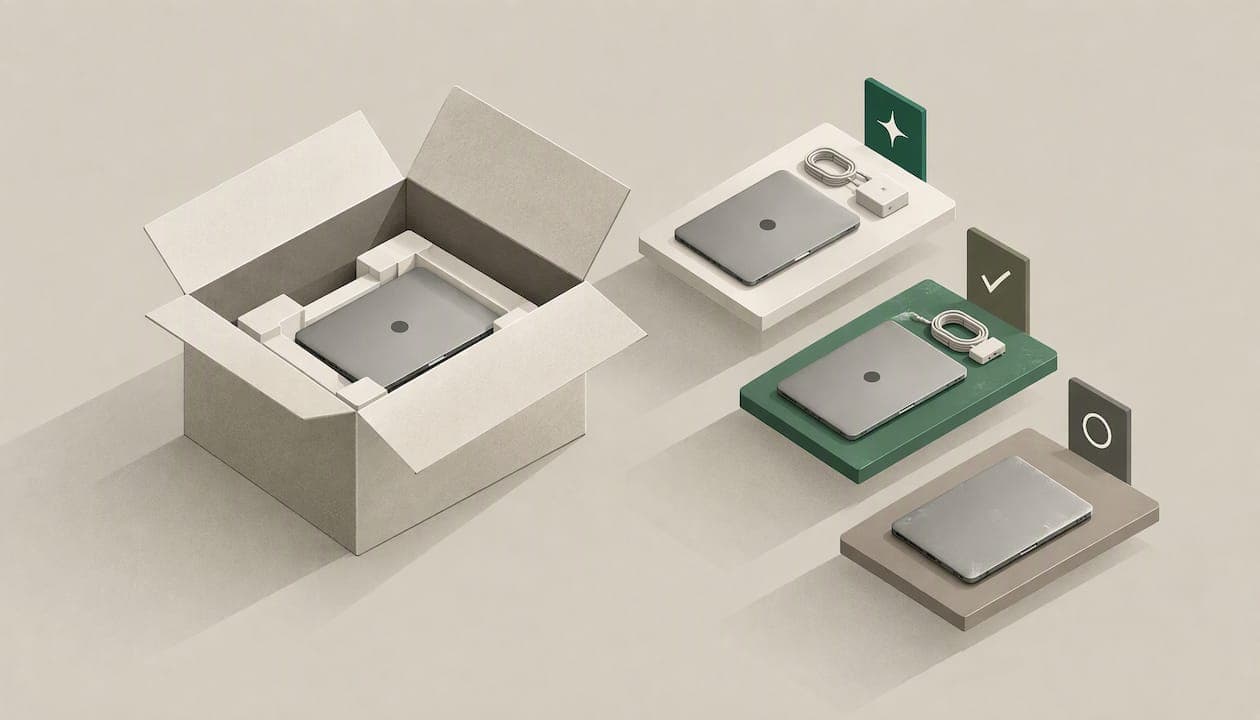
An open box price is the price of an item whose packaging has been opened, usually because someone returned it or a store used it as a display. Retailers set it below new, but there is no standard discount. The fair figure depends on condition, accessories, warranty and what the same model is actually selling for right now. This guide shows you how to work that out, whether you are buying or reselling.
TL;DR
- Open box is not one grade. It covers anything from a sealed-quality return to a floor model with cosmetic wear, so price it by condition, not by the label.
- The warranty and return terms are part of the price. An open box item with the full manufacturer warranty is worth more than the same item sold as-is.
- Compare against recent sold prices, not asking prices. Asking prices show what sellers hope for.
- Check the new-in-box price on the same day, because a new item on sale can beat an open box deal.
- For a quick check, PricexPoint shows sold, asking and new prices with links to the listings behind them.
Table of Contents
- What an open box price actually is
- How big is the discount?
- Five factors that move an open box price
- How to estimate the open box value of a specific item
- Pricing open box items if you are the seller
- What to check before you call a price fair
- Our perspective
- Check an open box price in seconds
- FAQ
- Sources
What an open box price actually is
An open-box item has had its packaging opened and may be unused or lightly used. It is typically a returned product or floor model that the retailer inspected before resale. The open box price is the markdown the seller applies to reflect that history.
That definition hides a lot of variety. Micro Center says its open-box products are returns, demos or store displays that were inspected, tested and repackaged. It adds that they may show minor cosmetic wear and, unless noted otherwise, include a warranty. A different retailer may sell the same word with different testing, different accessories and different return rules.
Open box vs. new, used and refurbished
The four conditions sit on a ladder, and each rung carries a different price logic.
| Condition | What it usually means | What drives the price |
|---|---|---|
| New | Sealed, never opened | Retail price, promotions, model age |
| Open box | Opened, often returned or a display unit, typically barely used | Cosmetic state, missing parts, warranty, retailer testing |
| Refurbished | Repaired or restored toward like-new | Quality of the repair, replaced parts, warranty length |
| Used | Previously owned and operated | Wear, age, usage history, no seller guarantee |
The difference between the middle two matters. According to DealNews, refurbished goods tend to be damaged goods repaired toward like-new condition, while open-box goods are generally returned and put back on shelves. Back Market makes the same split: open-box items are returned after being unboxed but typically barely used, refurbished items go through professional restoration, and used items have been owned and operated.
How big is the discount?
There is no universal percentage, and anyone quoting one is describing a single retailer's system. Retailers that grade open box items usually tie the markdown to the grade. A pristine return with every accessory sits close to the new price. A unit with scratches or a missing charger sits much lower.
Research on online marketplaces shows why a flat rule fails. In an eBay study of laptop listings, condition significantly affected prices, but the gap between new and open-box laptops was not statistically significant. Put simply, once an open box item is in near-new shape, buyers on that platform treated it almost like new. A study of three iPod types on eBay found a similar ordering: remanufactured items sold at a discount to new and at a premium to used.
Two lessons follow. First, the open box discount is thinnest when the item is truly like new. Second, the discount grows quickly as condition details slip, so those details deserve real attention.

Five factors that move an open box price
1. Cosmetic condition
Look at the photos for scratches, dents, scuffs and screen marks. A mark on the back of a wall-mounted TV costs you nothing in use. The same mark on a phone screen costs you every day. Price the flaw by where it sits and how often you will see it.
2. Accessories and packaging
Charger, cables, remote, stand, manuals, original box. Each missing piece has a replacement cost you can look up. A missing proprietary charger can take a noticeable bite out of the savings, while a missing generic cable barely matters. Resellers also know that an original box helps an item sell, so a unit without one will usually fetch a bit less when you pass it on.
3. Warranty
This is the biggest swing factor. Best Buy notes that open-box products often come with the same manufacturer warranty as a new product, but the words "in many cases" are doing work there. Confirm it per item. eBay's Certified Open Box program, for example, advertises a one-year warranty and 30-day free returns on qualifying listings. An uncovered open box unit is closer to a used one, and its price should reflect that.
If you want to see why this matters in practice, think about a peripheral such as a low-profile mechanical keyboard. Small hardware like that lives or dies on switch and port reliability, so a seller's return window is worth more to you than an extra $10 off.
4. Retailer testing and return policy
DealNews advises buyers to check how thoroughly the retailer tested the item, whether it is sold as-is, and whether returns apply. A tested item with a 30-day return is a low-risk purchase. A final-sale item with no test notes is a gamble, and the price should be lower to match.
5. Model age and market timing
Prices follow the market for the model, not just the item. A study of used Dell computers found that prices fell because their technical characteristics lagged new machines, not because of physical wear. For open box, that means a spotless unit of last year's model still loses value when its successor launches. Always check whether a newer generation is out or about to be.
How to estimate the open box value of a specific item
Here is a repeatable method. It works whether you are deciding what to pay or what to ask.
- Identify the exact model. Use the full model number, not the product family. Two laptops with the same name can differ in storage, memory or processor, and the price gap can be large.
- Find the current new price. Check a few retailers on the same day, including any active sale. This is your ceiling.
- Pull recent sold prices for the same model. Look at completed sales in used and like-new condition. Ignore asking prices for now.
- Remove the outliers. One unusually high sale can mislead. We cover that in our guide on why one high sale can mislead you.
- Adjust for condition and extras. Subtract replacement cost for missing accessories. Add a premium for a transferable warranty or a clean return policy.
- Set a range, not a point. A fair open box price is a band, such as "between the best like-new sale and the median used sale", with the warranty deciding where in the band you land.
For a broader walkthrough of the method, see how to calculate resale value of almost anything.
Sold prices vs. asking prices
Asking prices tell you what sellers want. Sold prices tell you what buyers paid. The two diverge more than most people expect, especially on overpriced listings that sit for weeks.
Use asking prices as a signal about competition and sold prices as the evidence for value. If asking prices sit far above sold prices, the market is crowded with hopeful sellers and you should anchor to the sold figure. If asking and sold prices are close, the market is healthy and tight. A tool like PricexPoint puts sold, asking and new listings side by side, so you can see the spread at a glance.
A worked example
Suppose you see an open box budget Chromebook listed at $180, and the new price today is $230. Your steps:
- New price: $230, so the listed discount is $50, or about 22%.
- Recent sold prices for the same model in used, good condition: say they cluster near $140 to $160.
- The open box unit includes the charger, a 30-day return and the manufacturer warranty.
In that scenario, $180 is a fair price, because you pay a premium over used for the warranty and the near-new state, and still save over new. If the same listing had no charger and no returns, you would negotiate toward the top of the used band instead. The figures here are illustrative, not market data. You can check real numbers for a similar model on this Lenovo IdeaPad Slim 3 Chromebook sold-price page.
Pricing open box items if you are the seller
Resellers face the mirror image of the buyer's problem. You hold an item that is opened but barely used, and you need a price that moves it without giving away margin.
Accurate condition descriptions matter here. Researchers studying secondary markets argue that detailed, accurate condition descriptions are essential for aligning price with how buyers perceive the item. In practice:
- Photograph every flaw and list every accessory.
- State the warranty status plainly, including whether it transfers.
- Say whether it was tested, and how.
- Price against sold listings in the matching condition, not against new.
The category changes the math. Consoles, tablets, bikes and PC parts each have their own depreciation rhythm. Our guides on console resale pricing, tablet resale value, bicycle resale pricing and pricing PC parts from sold checks go category by category.
Keeping your valuation current
An open box valuation goes stale. A new model launch, a holiday sale or a flood of similar listings can shift the market within weeks. Re-check before you list and again if the item has not sold after a couple of weeks. Look for three triggers: a successor model announced, the new price dropping, or sold prices trending down across several recent sales. If you hold inventory, saving scan history and exporting it lets you compare today's figures with last month's.
What to check before you call a price fair
A price that looks fair in one place may not be in another. Before you decide, check these:
- Marketplace fees and shipping. A $200 sale on a platform with fees nets less than $200. A buyer paying shipping pays more than the sticker. Compare totals, not headlines.
- Taxes. Sales tax in the US varies by state, and prices elsewhere may already include VAT or similar taxes.
- Currency. If you compare listings from other countries, convert to one currency and add import costs where they apply.
- Region-specific versions. Electronics sold in other regions may use different plugs, power ratings or warranty coverage. A manufacturer warranty may not apply outside the country of sale.
- Platform programs. Certified or graded programs usually add warranty and returns that plain listings lack, so the same unit is worth different amounts in each place.
The client base for this guide is worldwide, so treat every number above as belonging to the market it came from. Programs, return windows and tax rules named here are US examples.
Our perspective
We built PricexPoint because "open box" is a label, not a price. Two items with that label can differ by a charger, a warranty and a scratch, and that is real money. The only trustworthy way to value either one is to look at what comparable items actually sold for.

That is why we link every estimate to the sold listings behind it, name the marketplaces we pull from, and decline to show a figure without evidence. We also let you correct the item identification, because a wrong model number is the most common reason a price comes out wrong. Asking prices and new prices are useful context, but the sold figure is the anchor, and a single outlier should never set your number.
Our advice to a buyer: treat the warranty as part of the price and walk away from vague "open box" listings that give you no condition detail. Our advice to a seller: describe the item the way you would want it described to you, and price to the sold evidence, not to hope.
— PricexPoint
Check an open box price in seconds
If you are pricing one item or a whole stack, PricexPoint identifies it from a photo or a name and shows sold, asking and new prices with links to the sources. Plans are Basic at $4.99 per month, Pro at $9.99 per month and Power at $24.99 per month. If you prefer to pay per lookup, token packs cost $5.99 for 100 tokens, $12.99 for 300 tokens or $34.99 for 1000 tokens, all one-off. You can see the details on the pricing page, or browse real sold prices by item first. For a sense of what a sold-price page looks like, try the Nintendo Switch OLED or the Beats Solo 4.
FAQ
What is an open box price?
It is the reduced price a seller puts on an item whose packaging has been opened, usually a customer return or a display model. The size of the discount depends on condition, included accessories and warranty. It is not a fixed percentage.
Is open box worth buying?
Often, yes, when the item is tested, complete and covered by a warranty and a return window. The value falls when the unit is sold as-is or is missing parts. Compare the price with both the current new price and recent used sales before you commit.
Is Best Buy open box cheaper than new?
It is generally priced below new, and Best Buy says many of these products carry the same manufacturer warranty as new ones. But a new item on sale can undercut an open box listing, so check the new price the same day.
How do I know if an open box price is fair?
Find the exact model, then compare the open box price with the new price and with recent sold prices in used and like-new condition. A fair price falls between those two, closer to new when the warranty and accessories are complete. Asking prices alone are not a reliable guide.
Sources
- What Is 'Open-Box' and Should You Buy It? (DealNews)
- What does it mean when an item is open box? (Back Market)
- Clearance Deals (Micro Center)
- The Best Deals on Open Box Items at Best Buy
- eBay Certified Open Box
- Statistical analysis of eBay laptop listings (JDMDC, 2025)
- Market prices of remanufactured, used and new items (ScienceDirect, 2016)
- Estimating computer depreciation using online auction data (Taylor & Francis, 2011)