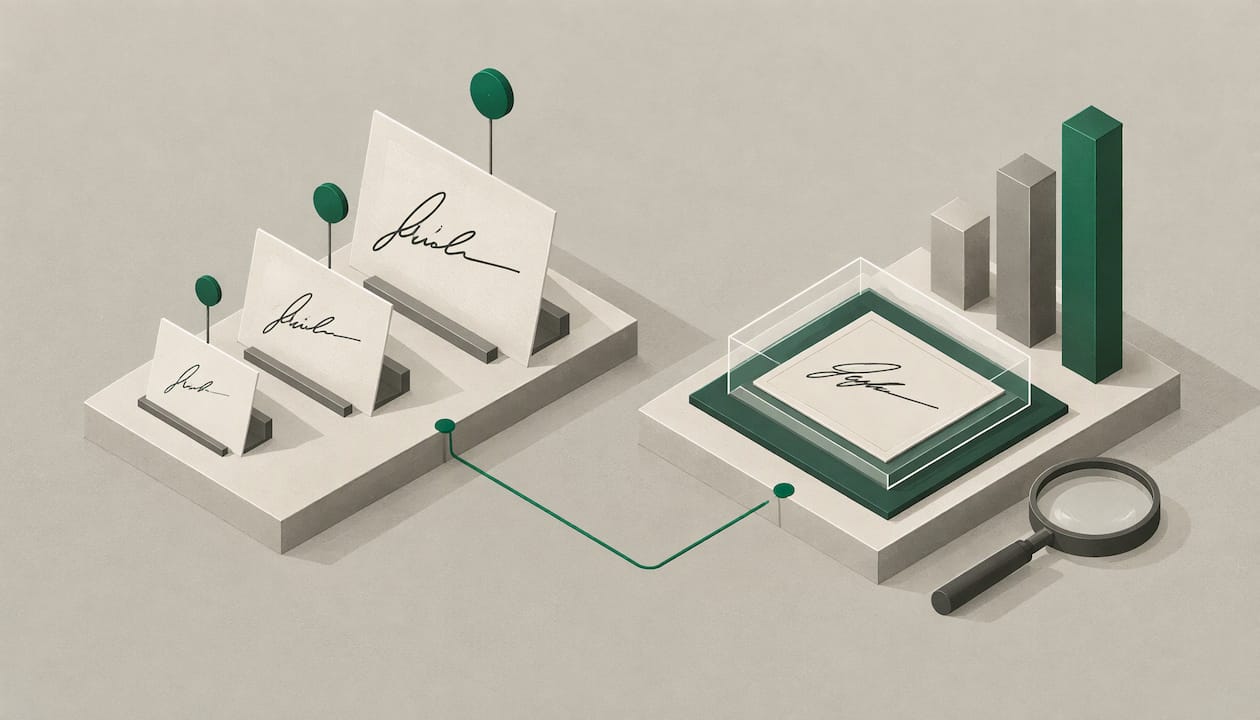
The most reliable way to price an autograph is to find completed sales of the same signer, on the same kind of item, in similar condition, and ignore what sellers are asking. Asking prices are wishes. Sold prices are evidence. PricexPoint is built around that rule: you snap a photo or type the item name, and the app returns sold, asking and new listings from several marketplaces, with links to the sales behind each figure, so you can check every comparison yourself.
This guide shows how to run that research for an autograph, what moves the number up or down, and how to turn a pile of comps into a price you can list or pay with confidence.
TL;DR
- Price from completed sales, not asking prices. A listing at $5,000 does not make an autograph worth $5,000.
- Match comps on five things: signer, what was signed, condition of the signature and item, inscription, and authentication.
- Authentication can change a price dramatically, so compare authenticated items only with authenticated items.
- Subtract fees before you decide. Dealers, auction houses and marketplaces each take a different cut.
- Save your comps and the links behind them, so the price you set can be explained and revisited later.
Table of Contents
- Why two autographs by the same person can sell for very different prices
- Step 1: Identify exactly what you have
- Step 2: Pull sold prices, then set asking prices aside
- Step 3: Narrow the comps until they truly match
- Step 4: Treat authentication as part of the price
- Step 5: Convert the price into what you actually keep
- Step 6: Price many items at once and keep a record
- Reading the wider market
- What a useful value guide should contain
- Perspective
- Start pricing your autographs
- FAQ
- Sources
Why two autographs by the same person can sell for very different prices
An autograph's value depends on the person, but also on what was signed, its condition, how available it is and the trends that shape supply and demand. That is why a single "value guide" number is rarely useful. A guide can tell you what matters. Only sales tell you what it is worth.
Academic work backs this up. A hedonic pricing study of 1,151 autographed artefacts (a method that isolates how each feature adds to or subtracts from price) found significant price effects from whether the signer was alive or dead, their sphere of fame, nationality, age and the nature of the item. The same study noted that for autographs without a photograph, the signer's star quality and place in history drive the price. Only when the signature is on a photograph do details such as background or age start to matter.
The practical lesson: the signer is the starting point, and every other factor adjusts it.
The factors to record for every autograph
| Factor | What to note | Why it moves the price |
|---|---|---|
| Signer | Exact name, era, field (film, TV, sport, politics) | Demand differs by sphere of fame, and the study above found differences between film-only, TV-only and film-and-TV fame |
| Item signed | Photo, index card, book, program, letter, memorabilia | Signed photos tend to sell higher than programs or books because people like to frame and display them |
| Signature quality | Clear, bold, complete | A clear, readable signature is worth more; a blurry one can be hard to authenticate and may have little value |
| Rarity | How many exist, how freely the signer signed | A generous signer's autographs can become less valuable as supply grows |
| Condition | Fading, creases, stains, framing damage | Matters most when supply is ample |
| Inscription | "To Mike, best wishes" or a plain signature | Personalization narrows the pool of buyers |
| Authentication | Third-party certificate, letter, provenance | Can separate a $250 item from a $2,900 one |
Rarity can outweigh almost everything
Supply is the factor that surprises newcomers. One dealer's illustration: two signers of the Declaration of Independence had equal historical demand, yet one signer's autograph is worth well over $100,000 and the other's about $500, because only about 50 of the first are known to exist against hundreds or thousands of the second. The same piece explains that a poor-condition document from the scarce signer could still be worth close to $100,000, while a similar one from the common signer might fetch around $200.
For most modern signers, the question is the same in miniature: is this signer's autograph scarce, or is it everywhere? Your comps will answer that. If you find dozens of sold examples every month, you are pricing a common item. If you find three in two years, you are pricing a scarce one, and each comp counts for more.
Step 1: Identify exactly what you have
Bad identification ruins pricing before it starts. Write down:
- The signer's full name, and the name of any item connected to them (a movie poster, a team jersey, a book title).
- The type and size of the item signed.
- Any inscription, date or dedication.
- Any certificate number, sticker or holder from an authentication company.
Photograph the signature and the whole item in good light, front and back. In PricexPoint you can start from a photo or from a typed name. The app identifies the item, and you can verify and correct that identification before it prices anything, which matters for autographs, where a wrong signer or wrong item type sends the whole search in the wrong direction.
Step 2: Pull sold prices, then set asking prices aside
This is the step that decides whether your price is real. AARP's guide to autograph value puts it plainly: an eBay listing at $5,000 does not mean the autograph is worth $5,000, and in most cases you are better off looking at realized prices, which show what someone actually paid. Realized prices come from auction house results and completed marketplace sales.
A second reason to distrust asking prices: an item that has sat at the same published price for years is evidence that the price is not right, not that the item is valuable.
Asking prices still have one use. They show how much supply is competing with you. If sold prices cluster around $60 and twelve active listings sit at $120, you know sellers are optimistic and that your item will have to compete with whatever sells, not whatever is listed. Our guide on sold price versus asking price walks through reading the two side by side.
In PricexPoint, sold, asking and new listings appear separately, so you do not have to sort them by hand. The app filters out unreliable listings, and every figure links to the sales source behind it, so you can open the comp and check that it matches your item.
Step 3: Narrow the comps until they truly match
A comp is only useful if it looks like your item. Work through these filters in order:
- Same signer. No exceptions. Similar-name signers and secondary signers on a group item are not the same.
- Same item type. A signed photo is not a signed index card. Compare photos to photos.
- Same authentication status. Compare certified items with certified items, and uncertified with uncertified.
- Similar condition and signature quality. A bold signature on a clean 8x10 is a different product than a faded one on a creased page.
- Similar inscription. A personalized item often sells for less than the same item with a plain signature, so match like with like.
- Recent sales. A signer whose profile has changed, through a new film, a death, a Hall of Fame vote or an anniversary, can move quickly. A 2024 study of Polish autograph auctions over seven years found relationships between prices and the signer's popularity, the time a document was created and even the Covid-19 pandemic, so timing is part of the price.
Aim for three to six solid comps rather than dozens of loose ones. If fewer than three match, widen one filter at a time (usually date range first) and note that the estimate is less certain.
A worked example
Say you have a signed 8x10 photo of a mid-career actor, clear signature, no inscription, with a third-party certificate. The numbers below are made up to show the method.
You find five sold comps of signed 8x10 photos with certificates and clear signatures: $55, $60, $62, $70 and $85. The $85 sale was a rare movie-still photo, so you set it aside. The remaining four sit between $55 and $70, with a middle around $61. Active asking prices run $95 to $150, which tells you sellers are hoping for more than buyers are paying.

A sensible listing price is near the top of the sold range, around $65 to $70, if you can wait, or near the middle if you want to sell quickly. You can explain that to a buyer, because every number has a sale behind it.
Step 4: Treat authentication as part of the price
Authentication is the single biggest swing factor after the signer. The market for sports and celebrity memorabilia has a counterfeit problem: the academic study cited above reports that the US State Department estimated in 2000 that more than 50% of a roughly $1 billion annual US market, and possibly as much as 90%, was counterfeit goods. Buyers know this, so they pay for confidence.
One reported example: an unauthenticated Babe Ruth signature might sell for $250, while the same autograph with a major authenticator's endorsement jumps to $2,900. Treat that as an illustration of the direction and scale, not a rule for every signer.
What this means for your research:
- When you pull comps, separate certified sales from uncertified ones. Averaging them together gives a number that fits neither.
- Check provenance. A documented chain back to the signer, especially with a good story, adds appeal.
- If you are buying, a price far below certified comps for the same signer is a reason to look harder at the signature, not a bargain by default.
PricexPoint prices items from the sales data; it does not replace an authenticator's opinion on whether a signature is genuine. Use the comps to learn what the market pays for certified and uncertified versions, then decide whether certification is worth the cost for your item.
Step 5: Convert the price into what you actually keep
A comp tells you what a buyer paid. It does not tell you what the seller kept. AARP reports that a dealer's offer is typically 33 to 45 percent below what they expect to resell it for, that an auction house commission is typically 20 to 30 percent, and that eBay charges a minimum 10 percent fee on the final price.
On a $100 autograph, that works out to:
| Route | Typical cost | What you keep on $100 |
|---|---|---|
| Dealer buyout | 33% to 45% below resale value | About $55 to $67 |
| Auction house | 20% to 30% commission | About $70 to $80 |
| eBay-style marketplace | At least 10% of final price | About $90 or less |
These are minimum or typical figures from one source and exclude shipping, insurance and certification costs. Run your own numbers with the actual fee schedule of the route you pick.
For buyers the reverse applies: if a seller's price sits well above the recent sold range, you are paying for their optimism.

Step 6: Price many items at once and keep a record
One autograph is a research task. Fifty from an estate, a convention haul or an inventory is a project. PricexPoint supports bulk pricing through CSV upload or multi-item photos, saves your scan history, and lets you export it. That gives you a dated record of what each item was worth when you checked, which is useful if you sell over several weeks, insure a collection, or track value changes in a business.
If you collect more than autographs, the same method works across categories. We have written it up for collectibles generally, trading cards and antiques.
Reading the wider market
Zoom-out numbers are context, not prices. One market research firm estimates the global autograph collectibles market at USD 4.2 billion in 2024, projected to reach USD 6.5 billion by 2030, a compound annual growth rate of 6.5%. A growing market does not lift every signer. Your item's price still depends on its own sales, which is why the comp-by-comp method stays the foundation, and why checking again before a big sale is worth the few minutes.
What a useful value guide should contain
If you are building a value estimate for yourself, a client or an insurer, it should include:
- The signer, item, condition, inscription and authentication details you matched on.
- Three to six completed sales, each with a date and a link to the sale.
- The range and the middle of those sales, not a single figure.
- A note on current asking prices, labeled as supply rather than value.
- The fees for the route you plan to sell through.
- The date of the research, so the reader knows how fresh it is.
An estimate without links to sales is an opinion. One with them can be checked.
Perspective
We built PricexPoint around one belief: a price is only worth stating when you can point to the sales behind it. Autographs show why. The same signer can appear at $60 in one sale and $600 in another, and the difference is hidden in details such as the item, the inscription and the certificate.
That is why our estimates link to actual sold listings from several marketplaces and name every data source. We do not give a figure without supporting evidence, and we let you verify and correct how the item was identified, because a wrong identification produces a confident wrong price.
For resellers, that means pricing quickly without guessing. For collectors and buyers, it means a fair-price check you can show to someone else. For businesses tracking value, saved scan history and exports turn one-off lookups into a record.
PricexPoint
Start pricing your autographs
PricexPoint has a free tier, so you can run your first lookups before paying anything. Plans are Basic at $4.99 per month, Pro at $9.99 per month and Power at $24.99 per month. If you would rather not subscribe, token packs are a one-off purchase: 100 tokens for $5.99, 300 tokens for $12.99 or 1000 tokens for $34.99. See the full details on the pricing page.
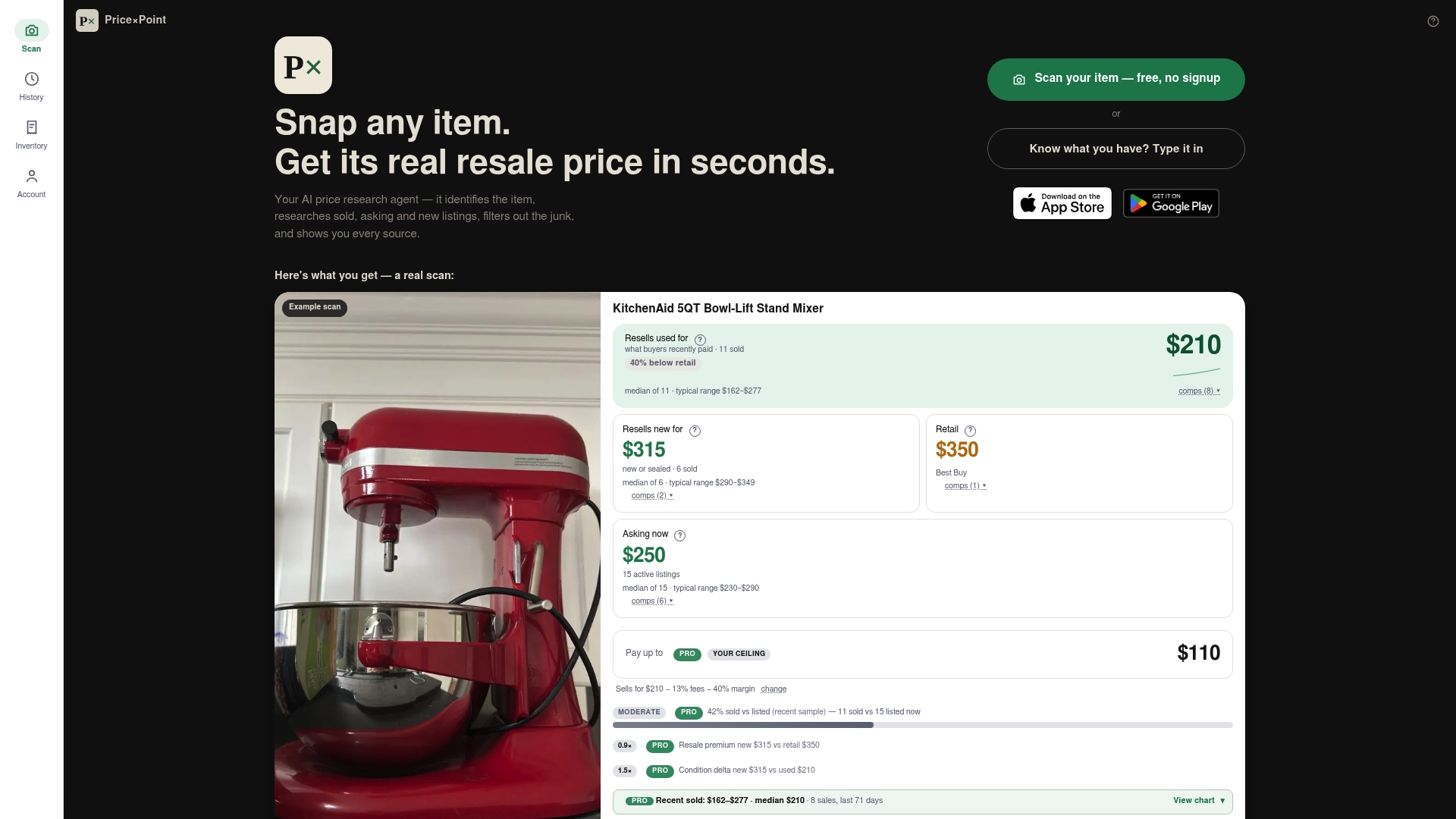
To see what sold-price data looks like before you start, browse real sold prices for used items, or read how an AI app answers what something is worth.
FAQ
How do I find out what my autograph is worth?
Identify the signer, the item and any certificate, then look up completed sales of matching items. Use the middle of three to six close matches as your estimate, and deduct fees for the route you plan to sell through. Do not use asking prices as value.
Is an autograph value guide enough to set a price?
A guide is useful for learning which factors matter: signer, item, condition, rarity and authentication. It is not a substitute for recent sales of your exact item. Use the guide to decide which comps match, then price from the sales.
Does authentication really change the price?
Often, yes. One reported case has an unauthenticated Babe Ruth signature near $250 and an authenticated one near $2,900. Compare certified items only with certified items so your estimate reflects what buyers pay for the version you have.
Why do sold prices differ so much from listings?
Sellers set asking prices on hope, and some listings sit unsold for years. Sold prices show what a buyer paid. When the two diverge, the sold range is the realistic one, and the gap tells you how crowded and optimistic the market is.
Sources
- Rising stars, superstars and dying stars: hedonic explorations of autograph prices (O'Doherty, 2006)
- How Much Money are Famous Autographs Worth? (AARP)
- Most Valuable Autographs (Investopedia)
- The Impact of Supply and Demand on Value (Raab Collection)
- What Are the Factors that Determine Autograph Values? (Tamino Autographs)
- Autograph Value: How to Find It (Tamino Autographs)
- Price formation of autographs of famous persons at auctions (2024)
- How Self-Appointed Experts Rule the Autograph Industry (Dallas Observer)
- Autograph Collectibles Market Size (Strategic Market Research)