
Price your prints by covering the per-print cost, adding a profit margin, then layering on an edition scarcity premium, and finally checking that number against real sold-listing data. For small open-edition prints, $10 to $50 is a common range, while signed limited editions often start higher once materials and scarcity are factored in. This guide walks through each part of that math so you land on a number you can defend.
TL;DR:
- Include printing, packaging, proofs, and included framing in the cost floor; spreading setup expenses across the edition means $60 over 20 prints adds $3 each.
- A $4 open edition poster can list for $8 to $12, while limited editions may justify two to three times cost plus a scarcity premium.
- Set and publish the edition cap before sales begin, keep Artist Proofs near 10% of the run, and never enlarge it after a sale.
- Compare realized prices for prints with similar size, format, and edition counts; asking prices show sellers’ hopes, while completed sales show what buyers paid.
- Sell framing separately, and explain paper, ink, and lightfastness; collectors may value archival materials, while gift buyers often prioritize a lower price.
Table of Contents
- 1. Calculate your per-print production cost
- 2. Edition size, scarcity, and signing: how supply choices change price
- 3. How size, format, and finish shift typical price bands
- 4. Materials and archival quality: when to charge a premium
- 5. Step-by-step pricing method: a repeatable workflow
- 6. Validate prices with sold-listing market data
- 7. How to set a markup or profit margin
- 8. How to factor in trends and seasonality in art print pricing
- Why pricing is a long-term career lever
- How PriceXPoint helps you check comps and refine print prices
- FAQ
- Sources
1. Calculate your per-print production cost
Your per-print cost is the floor you should never price below, and it has more pieces than most artists first assume.
- Printing and paper or canvas: the base substrate and ink run cost per unit.
- Inks and proofs: test prints and color calibration runs, especially for a new image.
- Packaging and shipping: mailers, rigid sleeves, tubes, and postage if you cover it.
- Framing: only when the listed price includes a frame, not a separate upsell.
- Setup and photography: scanning, color correction, and any plate or file prep.
Direct costs are easy to track per unit. Indirect costs like a professional scan or initial color proofing are one-time expenses, so you spread them across the whole edition. A small edition of 20 prints with $60 in one-time setup costs adds $3 to each print's floor. A larger run absorbs setup costs over more units, reducing per-print cost, which is one reason larger editions can carry lower per-unit prices while still turning a profit.
2. Edition size, scarcity, and signing: how supply choices change price
Edition size is a supply decision, and supply decisions move price. An open edition has no cap and typically sells at lower, more accessible prices because buyers know more copies exist. A limited edition caps the run at a fixed number, and that cap is what lets you charge more per unit.
- Set the edition size before your first sale and state it publicly on the print or its listing.
- Keep Artist Proofs to roughly 10% of the edition, a cap widely treated as standard practitioner guidance for preserving edition integrity.
- Never increase an edition size after it has started selling: doing so breaks the scarcity promise buyers paid for and can undercut resale value.
- Add signatures and numbering for limited editions since both signal authenticity and typically justify a meaningful price step up from an unsigned, open print.
Pro Tip: Write your edition size and AP count directly on the certificate of authenticity so every buyer sees the same scarcity commitment.
3. How size, format, and finish shift typical price bands
Format changes both your cost floor and what buyers expect to pay. A basic poster paper print costs the least to produce and typically sells lowest, while giclée paper, canvas, and photographic paper each carry their own cost and perceived value.
- Poster paper prints often sell at a lower price range for small open editions.
- Giclée paper prints usually command more due to pigment ink quality and archival paper stock.
- Canvas prints carry higher material and stretching costs, which typically pushes retail price up accordingly.
- Framing is best sold as a separate line item or upsell rather than baked into the base print price, since not every buyer wants it.
Signed limited editions commonly start meaningfully higher than their open-edition counterparts in the same format, though your own reputation and market demand will shift where exactly that starting point lands.
4. Materials and archival quality: when to charge a premium
Archival materials cost more to produce, and that cost is worth passing on to the right buyer. Acid-free paper, pigment-based inks rather than dye-based, and museum-grade mounting board all add to your per-print floor but also extend the print's expected lifespan significantly.
- Collectors and gallery buyers typically expect and will pay for archival quality since longevity matters to their purchase.
- Casual gift buyers often prioritize price over material specs and may not value the archival premium the same way.
- Include a short materials note with each listing: paper type, ink type, and expected lightfastness.
- Add basic care instructions so buyers understand what they're protecting by paying more.
Documenting these details in plain language helps a buyer see exactly why an archival giclée costs more than a standard poster print.
5. Step-by-step pricing method: a repeatable workflow
Pricing is not a one-time decision, it's a workflow you repeat as each edition sells and new data comes in; understanding commercial photography pricing can also shed light on how format and size influence your pricing decisions.
- Compute your per-print cost using the floor math from the production cost section above.
- Set your profit margin: a common starting point is doubling or tripling your cost floor, depending on your market position.
- Add an edition premium: smaller editions justify a higher multiplier since scarcity concentrates buyer demand.
- Check sold comps: compare your proposed price against realized sale prices for similar format and edition size work.
- Document and adjust: record what sold, note buyer response, and raise prices as your edition sells down and supply tightens.
Example one: a small poster print costs $4 to produce. Doubling that for margin gives $8, and since it's an open edition there's no scarcity premium, so $8 to $12 is a reasonable listed price.
Example two: an archival giclée print costs $18 to produce in an edition of 25. Tripling for margin gives $54, and a scarcity premium for a small edition might add another $20 to $40, landing the price in the $75 to $95 range, well above the $5 to $15 range that only fits small, low-cost poster runs.

Smaller edition sizes often correlate with higher realized prices, because scarcity concentrates buyer demand even as overall print market volume grows.
List at your calculated price, track what actually sells, and refine using real sales data rather than guesswork. Our guide on a step-by-step pricing playbook walks through a similar iterative approach for marketplace sellers.
6. Validate prices with sold-listing market data
An asking price tells you what a seller hopes to get. A sold price tells you what a buyer actually paid, which makes realized sales the stronger signal for setting your own number.
- Compare sold prices for work matching your format, size, and edition size as closely as possible.
- Note how often similar prints resell: frequent resale activity tends to support more predictable, stable pricing.
- Experts recommend using realized sales and resale frequency to validate pricing rather than relying on asking prices alone.
We pull sold, asking, and new listing data across multiple marketplaces and surface evidence-backed price estimates with links to original sales, giving you a fast way to run this comparison for your own prints or research what similar work has realized.
7. How to set a markup or profit margin
Markup formulas give you a repeatable starting point instead of guessing a number that feels right. The simplest version is cost-plus pricing: take your per-print floor and multiply it by a fixed factor, commonly two to three times cost for prints sold directly to collectors.
A lower multiplier, often 1.5 to 2 times cost, fits volume-focused open editions where you're optimizing for more units sold at accessible prices. A higher multiplier, sometimes three times cost or more, fits limited editions where scarcity and your reputation already support a premium.
Margin should also reflect your sales channel. Selling direct through your own site or at a fair keeps the full margin in your pocket, while a gallery or publisher arrangement changes the math substantially. Publisher-artist split models sometimes pay artists only a fraction, commonly around 10%, until the publisher recoups production costs, after which the split improves. If a publisher is covering your printing and framing costs upfront, your listed price needs to account for that recoupment schedule, not just your own production math.
Whichever formula you choose, write it down and apply it consistently across your catalog. A buyer comparing two prints from your shop at wildly different markups, with no clear reason like size or edition size, will notice the inconsistency and may hesitate on both.

8. How to factor in trends and seasonality in art print pricing
Demand for prints shifts throughout the year, and pricing that ignores this leaves money on the table or stalls sales. Art fair season, gift-giving months leading into the winter holidays, and graduation season each tend to lift demand for accessible, giftable formats like small open-edition prints.
Trend sensitivity also varies by subject matter and style. A print tied to a current cultural moment or a popular palette may see a temporary demand spike, which can support a short-term price increase or a limited-run release timed to that window. Once the moment passes, that same image may need to settle back toward its baseline price to keep selling at a steady pace.
Longer-term market trends matter too. New buyers have been entering the print market at the lower end, which has expanded transaction volume in prints priced under $50,000 and made the segment more resilient overall. That broader trend supports steady, incremental pricing increases for artists building a consistent body of work rather than one-off price spikes tied to a single sale.
Rather than reacting to every seasonal swing, track which months and subjects consistently perform well for your own catalog and adjust release timing and pricing around that pattern, using sold-comp data to confirm the trend is real rather than a one-off.
Why pricing is a long-term career lever
Consistent editioning, clear documentation, and measured price increases build collector trust over time. Every sale you record becomes evidence for your next price, so treat your sales history as an asset you're building, not a side note.
— PricexPoint
How PriceXPoint helps you check comps and refine print prices
Running the math on cost, margin, and scarcity gets you close, but confirming it against real sales removes the guesswork. We analyze sold, asking, and new listings across multiple marketplaces and return evidence-backed price estimates with links back to the original sales, so you can see exactly what similar prints have realized before you commit to a number.
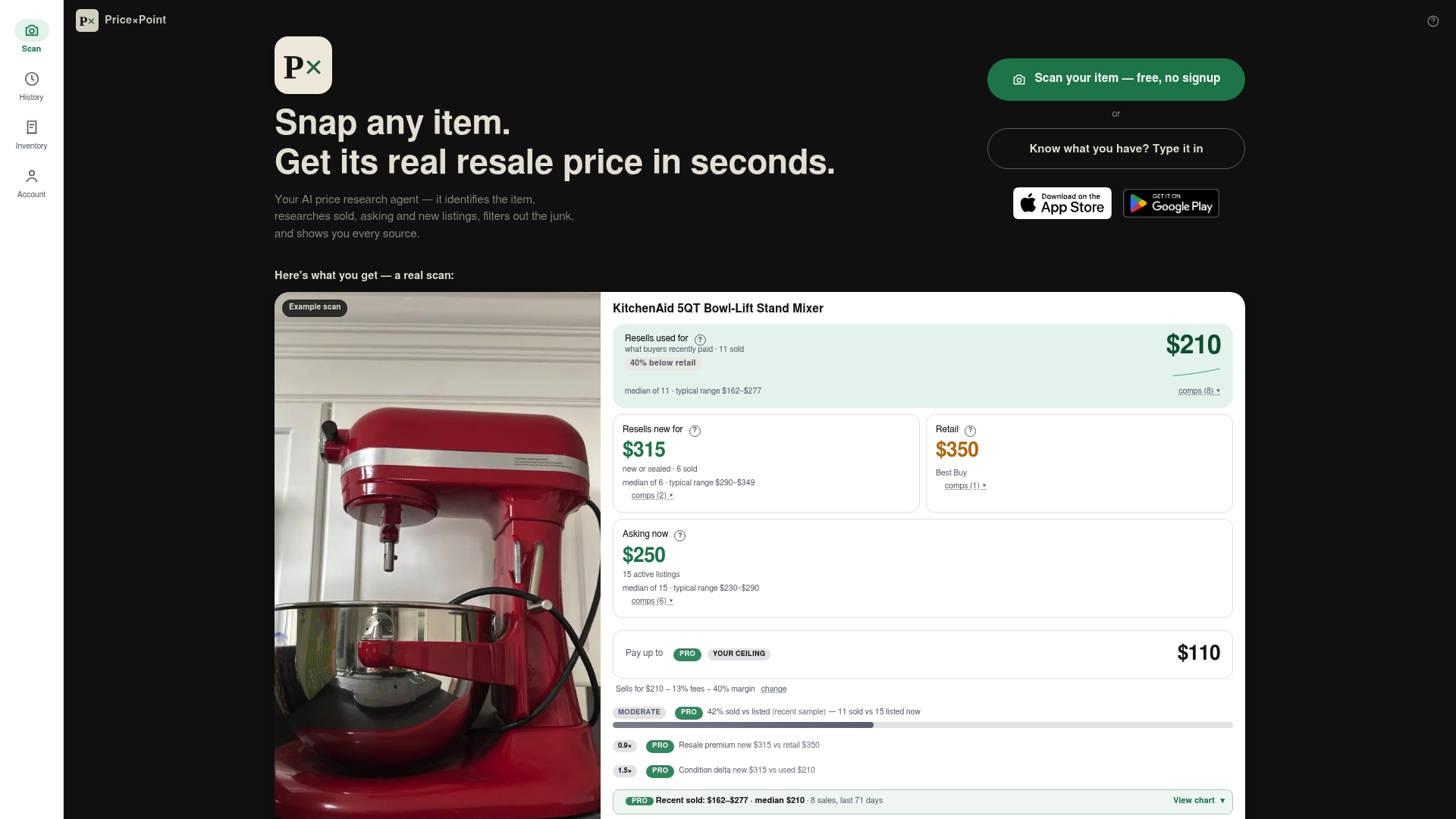
Snap a photo or enter a print's details to get a quick read on comparable sales, or visit our pricing page to see the Basic, Pro, and Power plans and start validating your own print prices today.
FAQ
What is the 70/30 rule in art?
Splits vary by gallery and arrangement, so it's worth confirming the specific terms before listing work through a third party.
How can I calculate the price of an art print?
Start by totaling your per-print production costs, including printing, materials, and packaging, to establish a floor price. Add a profit margin, commonly two to three times that cost, then layer on an edition scarcity premium for limited runs, and check the result against realized sold prices for similar work.
What is the average price for an 8x10 art print?
Small open-edition prints in common sizes like 8x10 often fall in the $10 to $50 range, depending on paper quality and whether the print is signed. Signed limited editions in the same size typically start higher due to scarcity and archival materials.
How much does art printing cost?
Printing costs vary by substrate and ink type, with poster paper the least expensive and archival giclée or canvas prints costing more per unit due to higher-grade materials. One-time costs like scanning or color proofing get spread across the whole edition, so larger runs typically carry a lower per-unit printing cost.
How does edition size affect what I should charge?
Smaller editions tend to support higher per-print prices because limited supply concentrates buyer demand, while open editions rely on higher volume at lower individual prices. Capping Artist Proofs at around 10% of the edition and never expanding the run afterward helps protect that scarcity value over time.
Sources
- IFPDA | How Gen Z and Prints Are Reshaping the Art Market’s Future | OBSERVER – IFPDA
- Inside the Business of Prints, Multiples and Editions | Observer
- Should you buy limited edition prints in 2026? — Maddox Gallery
- A guide to understanding print editions, techniques and APs — Artsy