
A good reseller pricing strategy comes down to three numbers: the lowest price you can accept, the price buyers have actually paid for the same item, and the price you list at to get from one to the other. Most mistakes come from skipping the second number and guessing from active listings. PriceXPoint exists for that step: snap a photo or type an item name, and you see sold, asking and new prices from several marketplaces, with links to the listings behind them.
This guide walks through the whole routine for resellers, collectors, casual sellers and buyers checking whether a second-hand price is fair.
TL;DR
- Start with a floor price: your item cost, fees, shipping and the profit you want, worked backward to a minimum.
- Anchor the list price on sold listings, not asking prices. Asking prices show hopes; sold prices show what buyers paid.
- Pick a list price strategy on purpose: a firm precise price, a round negotiable price, or a high start with scheduled drops.
- Review unsold items on a schedule. Research on used-car dealers shows most price changes after listing are cuts, so plan for them.
- Price in bulk when you can. Checking items one at a time is where most sourcing trips lose their time.
Table of Contents
- Start with the price you cannot go below
- Anchor on sold prices, not asking prices
- Choose a list price strategy on purpose
- Adjust as the item ages
- Match the strategy to where you sell
- Price in bulk and track what changes
- Try it on your next item
- Our view on reseller pricing
- FAQ
- Sources
Start with the price you cannot go below
Before you look at any market, know your floor. The floor is the lowest price at which the sale still does what you need it to do. Skipping it is how a reseller ends up with a sell-through rate of 90% and a bank balance that does not move.
The University of Maine Extension states three principles that fit resale well: a price should cover your total costs plus a reasonable profit, stay competitive with similar products, and fall within what your target market will pay. It also makes the point that the goal is the largest total profit, not the largest sales volume. Matching a competitor can still lose money if your costs are higher than theirs.
For a reseller, "total costs" means more than what you paid at the thrift store:
- The purchase price, including tax.
- Marketplace selling fees and payment processing fees.
- Shipping you pay, packing materials and any returns you absorb.
- Your own cost of sourcing, such as gas or storage, if you track it.
Two terms are worth keeping straight. Markup is profit as a percentage of what the item cost you. Margin is profit as a percentage of what it sold for. The Australian government's business agency, Business Victoria, defines markup as sales minus cost of goods, divided by cost of goods, times 100. Its worked example takes a $31.20 cost and a 66.67% markup to a $52 minimum price. The formula is the same wherever you sell.
A worked example
Say you buy a vintage camera for $12. You assume about 15% in total fees and expect to pay $5 shipping. You want at least $10 profit.
- Costs before fees: $12 + $5 = $17.
- Add the profit target: $17 + $10 = $27.
- Fees come out of the sale price, so divide by 0.85: $27 ÷ 0.85 = $31.76.
Your floor is about $31.76. If it sells for $40, you keep $40 − $6.00 in fees − $5 shipping − $12 cost = $17. That is a markup of about 142% on cost and a margin of 42.5% on the sale price. The 15% fee rate here is a placeholder, so swap in your marketplace's current fee schedule.
The floor tells you which items to skip. If the sold data say the camera moves at $25, you leave it on the shelf, however nice it looks.
Anchor on sold prices, not asking prices
The most common pricing error in resale is reading active listings as market value. An asking price is a wish. Some items sit for months at a price nobody will pay, and they still look like "comps" on a results page.

Sold listings are the price buyers accepted. Our own guide on sold price versus asking price goes through why the two diverge. For pricing, use asking prices to see your competition and sold prices to set your number.
When you review sold data, filter before you average:
- Match the exact item. Model, edition, size, color and variant can move the price by multiples.
- Match the condition. A "for parts" sale does not price a working unit.
- Match the format. Auction results, best-offer accepted prices and fixed-price sales behave differently.
- Throw out outliers. One shill-bid sale or one lot sold with extras can pull an average badly.
- Look at the date. Collectibles and electronics move fast; a sale from two years ago may be stale.
- Look at volume. Ten sales in a month tells you far more than one.
Doing this by hand across several marketplaces is slow. PriceXPoint identifies the item from a photo or name, pulls sold, asking and new prices from multiple marketplaces, filters out unreliable listings and links to the sales sources so you can see where each figure came from. You can verify and correct the item identification too, which matters because a wrong model number gives you a confident wrong price. For a look at what this data looks like in practice, see the real sold prices for a Canon T50.
If you are comparing options for this kind of research, our guide to reselling apps covers what to look for, and the one on apps that price your item for you explains how to read what they show.
Why the data is worth the effort
Resale data are valuable even to the companies that make the products. A peer-reviewed study in Management Science on product drops found that building resale data collection and analysis into pricing raised a firm's profit by 8.8%. That study is about brands, not individual sellers, but the logic is the same at any size: the secondary market tells you what the item is worth, and ignoring it leaves money behind.
A Harvard Business School working paper on used cars makes a related point for one-off items. Used-car dealers who learned about item-specific demand while selling gained about $203 per car from that learning, and an initial assessment added a further $139 per car, against net profit of roughly $1,150 per car. Unique goods reward sellers who gather information before and during the sale.

Choose a list price strategy on purpose
Once you have a floor and a sold range, the list price is a decision about speed and margin. Three approaches cover most resale situations.
| Approach | How it works | Fits when |
|---|---|---|
| Market price | List at the middle of the recent sold range | Common items with steady demand and many comps |
| Premium start | List near the top of the sold range, then step down on a schedule | Rare or well-conditioned items where a patient buyer may exist |
| Quick turn | List at the low end of the sold range, or at a round number | Cash-flow needs, seasonal items, items that age badly |
The general small-business names you will see on competing pages (cost-plus, value-based, skimming, penetration) map onto these. Cost-plus is your floor calculation. Value-based pricing is the sold-range anchor. Skimming is the premium start. For one-off secondhand goods, the sold range does the heavy lifting, because no two items are quite identical and buyers compare against what similar ones went for.
Does the .99 trick work for resale?
It depends on the buyer. A 2025 survey study of 200 shoppers at a Nigerian supermarket found that charm pricing, prices ending in .99 or .95, raised perceived affordability and perceived value. That was a retail shelf setting, though, and secondhand negotiation works differently.
A Microsoft Research working paper on eBay-style negotiation offers a more useful read for resellers. Items listed at round numbers received offers 5% to 8% lower, but those offers arrived 6 to 11 days sooner, and the items were 3% to 5% more likely to sell. The authors read a round price as a signal that the seller is willing to deal, and a precise price as a signal of firmness.
So you can use the ending deliberately:
- Want a fast sale and expect offers? List at a round number and accept a fair offer.
- Hold a firm position on a scarce item? List at a precise figure, such as $187, that sits on your research.
Adjust as the item ages
A list price is a starting position. Items that do not sell are telling you something, and the data on how sellers respond are consistent.
The Harvard Business School used-car paper found that about 30% of cars at the studied CarMax store had their listing price changed at least once, and 92.1% of all price changes were decreases. The authors attribute this to the way unsold items reveal weaker demand over time, not to inventory swings. For you, that means an unsold item is evidence, and a scheduled price review is part of the strategy rather than a sign of a bad first guess.
A simple schedule for most resale categories:
- Days 1 to 14: hold your list price. Watch views and saves, not just sales.
- Days 15 to 30: if there are views but no offers, recheck the sold range. If sold prices moved, follow them.
- Day 30 onward: cut in steps no smaller than your marketplace's rounding makes visible, and stop at the floor you calculated at the start.
- At the floor: relist, bundle or move the item to another marketplace instead of selling at a loss.
Inventory matters too. A 2026 working paper by Mingao Xie of Georgetown University, using transaction-level data from a used-book platform, found that dynamic pricing tied to inventory levels raised profits by 0.86% to 12.14% over static pricing, with larger gains when demand or supply shifted. It also found demand reacted to price much more strongly than supply did. The practical reading: price changes move buyers, so use them with a reason. If you hold several of the same item, price the first against the market and let stock level guide later cuts. Teams that manage many SKUs sometimes build inventory-aware pricing systems to track this; a solo reseller can do it with a spreadsheet and a weekly review.
Bundling without cutting prices blindly
Before you discount an item that is slow, consider whether it sells better as part of a set. Our piece on bundle pricing and attach rates shows how to check whether buyers add a second item before you give away margin.
Match the strategy to where you sell
The floor and the sold range stay the same, but the venue changes the math.
- Fee-heavy marketplaces: your floor rises with fees, so re-run the calculation for each venue.
- Local sales: with no shipping or marketplace fee, you can price lower and still keep more. Our guide to Facebook Marketplace pricing walks through it.
- Handmade and craft platforms: buyers compare differently there; see the Etsy pricing playbook.
- Electronics: values fall quickly and condition matters a lot; the guide on where to sell used electronics shows what items go for.
- At the thrift store, before you buy: work backward from the sold range to a maximum buy price. Our thrift store pricing steps cover this.
Price in bulk and track what changes
Pricing is where resellers spend the most unpaid time. A haul of 60 items checked one by one eats an afternoon. PriceXPoint supports bulk pricing through a CSV file or multi-item photos, and it saves your scan history with export options, so you can come back to an earlier price check and compare it with today's sold data. For businesses tracking how item values move, that history is the record.
AI pricing tools are useful because they remove the slow part of the research, but the principle stays the same as with manual research: the figure is only as good as the evidence behind it. See this overview of AI tools in ecommerce for the wider picture. In PriceXPoint, every estimate links to the sold listings it rests on, and the app does not give a figure without supporting evidence.
For buyers, the same data work in reverse. If a seller asks $90 for something whose recent sold listings cluster around $55, you have a fair offer and the evidence to explain it.
Try it on your next item
If you price items regularly, the cheapest way to improve your margins is to replace guesses with sold data. PriceXPoint has a free tier. Paid plans are Basic at $4.99 per month, Pro at $9.99 per month and Power at $24.99 per month. If you prefer not to subscribe, token packs are a one-time purchase: 100 tokens for $5.99, 300 tokens for $12.99 and 1000 tokens for $34.99. You can compare them on the pricing page.
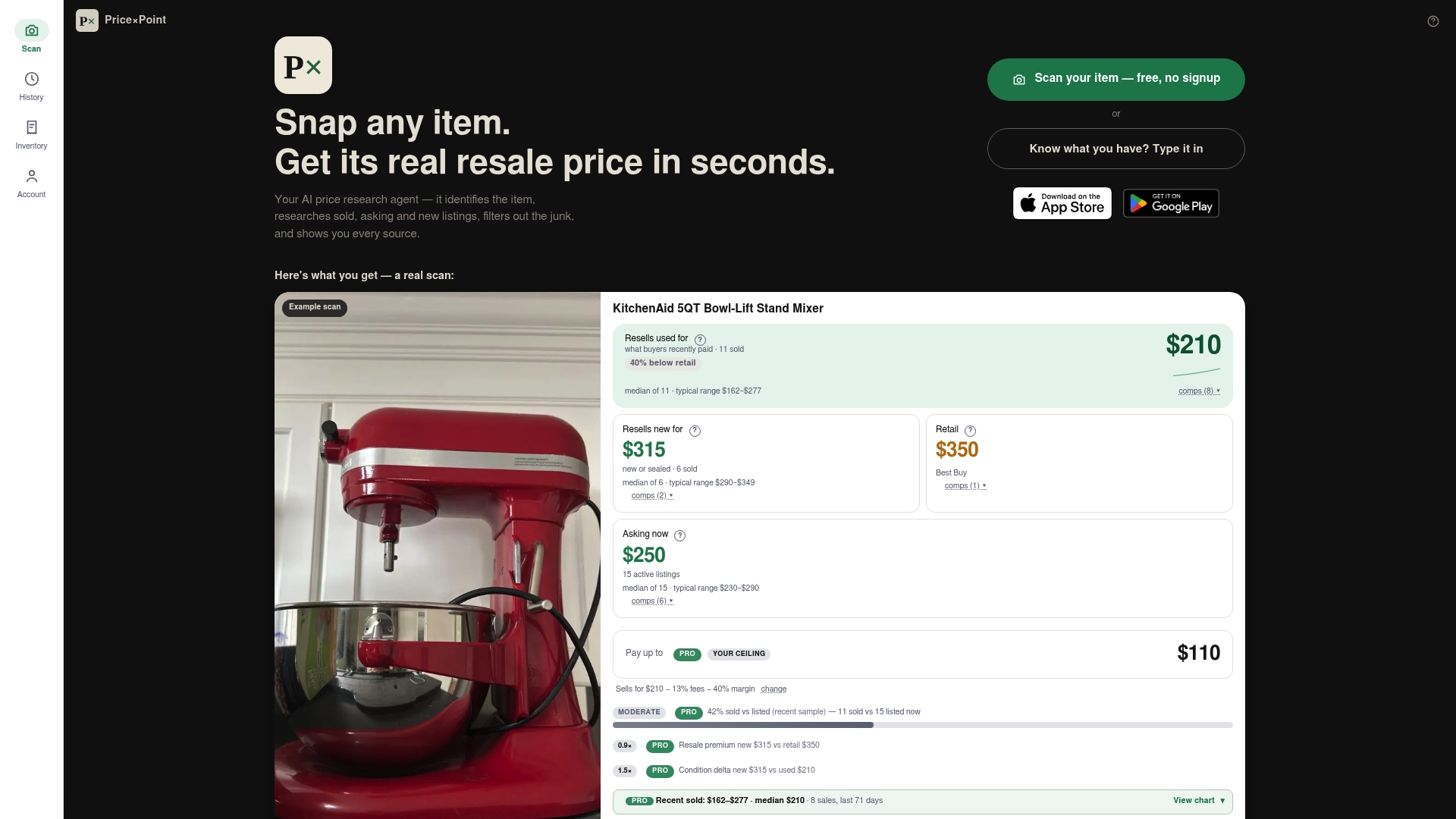
To see what a result looks like before you scan anything, browse what used items sell for, which lists real sold prices.
Our view on reseller pricing
We think pricing should be an argument you can show, not a feeling you have. A price that rests on sold listings can be explained to a buyer, checked by you next month and adjusted when the market moves.
That is why we built PriceXPoint to name every data source, link each estimate to actual sold listings from several marketplaces, and refuse to give a figure without supporting evidence. We also let you verify and correct the item identification, because the most careful research still fails if the item is wrong.
Our advice to every reseller is the same: know your floor, read the sold range, choose your list price deliberately, and review it on a schedule. The tool should take away the hours of searching, so your time goes to sourcing and selling.
PricexPoint
FAQ
How do I set my selling price to make a profit?
Add your purchase cost, shipping and expected fees, then add the profit you want. Divide by one minus your fee rate to get the minimum price. Then compare that floor with recent sold listings for the same item and condition: if the market pays more, list higher; if it pays less, skip the item.
What is the best pricing strategy for a reseller?
There is no single best one, but the most reliable starting point is the middle of the recent sold range for an exact match. Use a premium start for rare items you can wait on, and a round, negotiable price when you need a fast sale.
How often should I lower the price on an unsold item?
Hold for the first two weeks while you watch views and offers, then review against current sold data. After that, step the price down on a regular schedule and stop at your floor. Used-car research shows that price cuts are the normal pattern for items that stay unsold.
Is it better to price against sold or active listings?
Use sold listings to set your price, because they show what buyers actually paid. Use active listings only to see who you are competing with and how many similar items are available right now.
Sources
- Calculate your breakeven point, margin and markup, Business Victoria
- Intertemporal Pricing with Resellers, Management Science
- Learning, Harvard Business School working paper
- The Dealer's Problem: Two-Sided Pricing and Inventory, Georgetown University working paper
- Negotiation, Microsoft Research working paper
- Charm pricing study, BW Academic Journal 2025