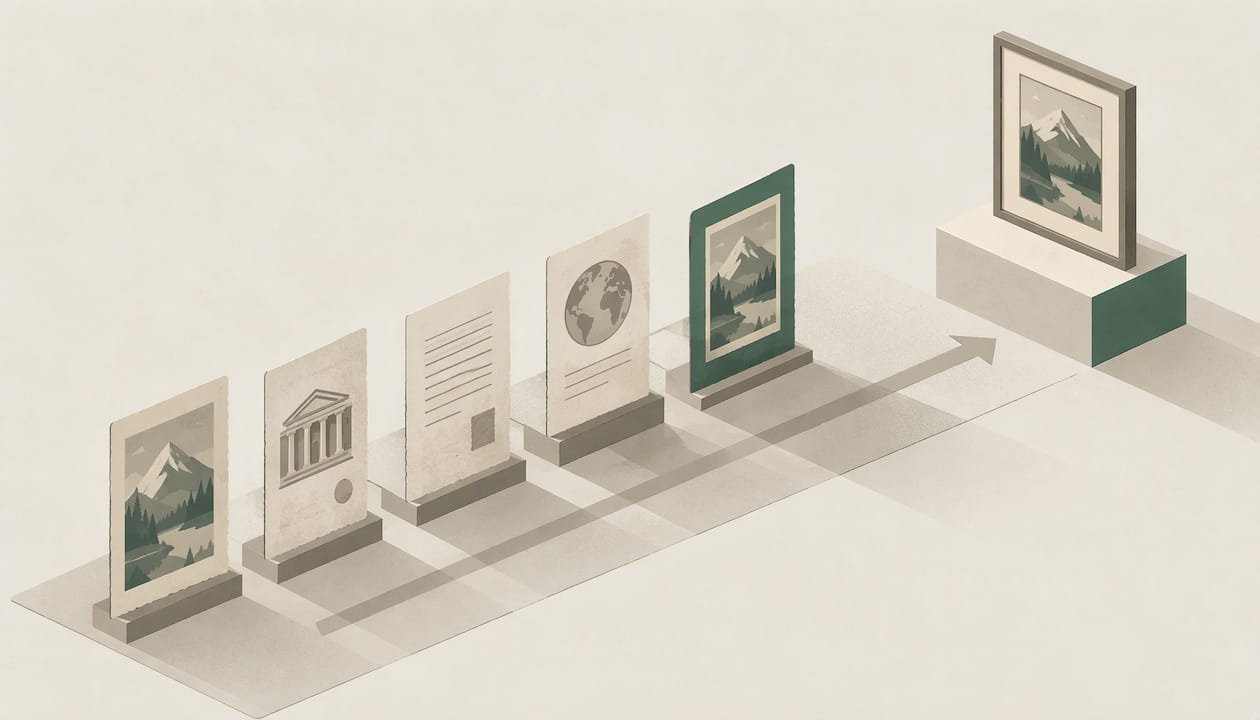
Provenance pricing means adjusting a vintage poster's price for its documented history: who owned it, where it came from and what paperwork backs the story. Start with sold comparables for the same poster in the same condition. Then move the price up or down depending on how strong the history is. For many posters the adjustment is modest. For rare, signed or exhibited pieces it can be the biggest factor in the price.
This guide shows how to read a poster's history, which records matter, and how to fold all of it into a price you can defend. It also covers what to do when no recent sales exist. If you want a poster value guide you can use today, the steps below work whether you are buying, selling or just curious.
TL;DR
- Provenance is the documented, or credibly explained, history of a poster. Strong history is continuous and backed by paper, but a gap is not automatically a red flag.
- Price the poster first on identity, version, size and condition using completed sales. Treat provenance as an adjustment on top of that base.
- Asking prices are offers. Sold prices show what buyers actually paid, so build your range from those.
- When few comparable sales exist, widen the search in a set order and give a range instead of a single number.
- Keep every sold comp link and every provenance document in one file, so your price can be checked by the next buyer.
Table of Contents
- What provenance means for a vintage poster
- How much provenance actually moves the price
- The records that support a poster's history
- Price the poster before you price its history
- Compare sold prices with asking prices
- A worked example: adjusting for provenance
- What to do when there are few comparable sales
- Perspective: why we think price evidence beats price opinions
- Put it into practice with PriceXPoint
- A checklist before you set the price
- FAQ
- Sources
What provenance means for a vintage poster
Provenance is the chain of ownership and handling behind an object. One practical guide to poster provenance checks describes the strongest version as continuous and supported by paperwork, and it adds that a gap is not automatically a problem. That nuance matters for posters in particular. They began life as commercial advertising, not fine art sold with formal certificates, so many perfectly genuine examples have no paper trail at all.
The same guide suggests thinking of provenance as a scale rather than a yes-or-no question. A poster consigned directly from a named former cinema employee, with period photographs and a dated receipt, sits near the strong end. A poster pulled from a house clearance with no ownership details sits near the weak end. Most posters land somewhere between the two.

That is why you should price provenance as a spectrum. A poster with no history is not worthless, and a poster with a good story is not automatically worth a fortune. The story has to be specific, plausible and consistent with the physical poster.
How much provenance actually moves the price
The honest answer is that it depends on the category.
In movie posters, one Sotheby's piece on what makes a movie poster collectable says provenance is not hugely important for them. Signatures, though, can add a lot of value, especially from people who rarely sign. Its example is a To Kill a Mockingbird poster signed by Gregory Peck from a well-known collection.
For fine-art-style posters, the picture is different. Names, exhibitions and earlier owners can matter more, and the more a piece is priced like art, the more the paper trail counts. Another dealer guide notes that posters that were part of prestigious collections or exhibited in important museums can command higher prices, and that certificates from reputable dealers or auction houses can raise buyer confidence.
You will also find sites quoting neat percentage premiums for provenance. Treat those as marketing, not market data. The only number that counts is what comparable posters with comparable history actually sold for.
The records that support a poster's history
When you are buying, ask when and where the poster was acquired and from whom. When you are selling, gather the following before you list. These are the kinds of records the provenance guide points to:
- Invoices and receipts from dealers or earlier sales
- Auction catalogue entries that show the same poster
- Collection inventories and estate records
- Photographs that show the poster in a place or at a time that fits the story
Other trade sources add studio or printer documentation, gallery records and exhibition history to the list. CV Treasures calls provenance a strong indicator of authenticity and names these record types.
Then test the story:
- Is it specific? Names, places and dates beat vague claims like "from an old collection."
- Is it plausible? A poster said to come from a cinema should look like one: fold lines, studio stamps, the right size for its release.
- Is it consistent with the object? A claimed 1960s history on a sheet with modern printing characteristics fails at once.
- Can anything be checked independently? A catalogue entry or a dated receipt is worth far more than a verbal account.
One caution from the other side of the debate. A collector's guide to authentic posters points out that the trade existed long before certification became common, so missing documents do not prove forgery. It also says authentication records from reputable sources are indispensable when serious money is involved. Both are true, and your price should reflect the stakes.
Price the poster before you price its history
Provenance sits on top of a base value. Get the base right first.
Identity and version
One title can exist in many forms: different countries, release types, sizes and reprints. Pin down the exact version before you look at any prices. A French release and a US one-sheet of the same film are different products with different buyers.
Condition
Condition can swing a poster's value dramatically. The Poster House's guide to assessing condition says condition can be the difference between a poster worth $20,000 and one worth $200. Its example is a Mucha poster that sells for $25,000 to $35,000 at auction in perfect condition but was seen in such poor shape that it could not be valued above $500.
Movie posters can be more forgiving. Sotheby's notes that these were often machine-folded and stamped, so condition becomes a real issue mainly when a poster is faded or badly torn.
Rarity, subject and demand
Age alone does not set value. A vintage poster guide lists artist, subject, rarity, period, condition, provenance, graphic quality, historical importance and collector demand as the factors that combine. Provenance is one item on that list, not the whole list.
Compare sold prices with asking prices
Asking prices tell you what sellers hope for. Sold prices tell you what buyers paid. A price guide aimed at poster collectors makes this distinction central: it says a good guide must separate actual sale results from asking prices, and should also show condition, the age of the information and the type of sale.
A simple workflow:
- Find completed sales of the same version, size and similar condition.
- Note the date, the venue and whether the sale was an auction house or an online auction.
- Drop the very highest and lowest results if you have enough data. The same guide advises collecting numerous results, removing the extremes and averaging the rest, and warns that relying on one result is little better than a dealer picking a number.
- Use current asking prices only as a read on market mood.
- Adjust for fees, shipping and how fast you need to sell.
If you are choosing a selling format, our breakdown of auction versus Buy It Now shows how format affects the price you get.
Why the same poster sells for different prices
Expect spread. The same price-guide article explains that two eager bidders can push a poster far above its normal value, while a later sale with no interested bidders can land far lower. It also says online auctions lack the catalogue and promotion of a traditional auction house sale, so the same item can sell for vastly different prices on the same day. Location matters too: a title can be worth more in one city or country because local demand is stronger.
Long-run thinking helps. A piece by René Grohnert on how posters are valued says the market value of a poster comes from supply and demand, and that watching price development over a long period gives the best sense of its average value.
Markets also move. Sotheby's notes that many movie posters have risen more than tenfold in 20 years. A sale from several years ago is a history lesson, not today's price.
A worked example: adjusting for provenance

Here is an illustrative walk-through. The figures are invented to show the method and are not market data.
Say you hold a US one-sheet for a mid-tier 1970s film, folded as issued, with light edge wear. You find five completed sales of the same version in similar condition at $180, $210, $220, $240 and $400.
- Drop the $180 and $400 outliers. The remaining three average about $223.
- That is your base. Without any documents, a range of roughly $200 to $240 is defensible.
- Now add provenance. You can show a dated receipt from a dealer and a photo of the poster in a former theater lobby. That moves you toward the top of the range, or slightly above it if comparable documented examples have sold higher. The documents earn a bit of extra confidence from buyers. They do not transform the poster into a different price class.
- Suppose instead the poster were signed by someone whose signature is rarely seen. You would then search for sales of signed examples specifically. They are a separate comp set.
The lesson: provenance changes which comps are relevant. It rarely works as a flat percentage bolted onto a price.
What to do when there are few comparable sales
Thin markets are normal for rare posters. When recent comps are scarce, widen the search in a careful order. One poster price guide recommends this sequence:
- Same title, same release type, same size
- Same title, same release type, different but related format
- Same title, similar era and condition
- Comparable titles or performers with similar collector demand
For truly rare pieces, professional valuers go further. A valuation article citing the Uniform Standards of Professional Appraisal Practice describes expanding the method when comps fall short: look at replacement cost, analogous markets and expert opinion, and report a value range rather than a single figure.
An art-market research piece makes a related point. It treats thin comps as context rather than a pricing engine, triangulating from similar artists and from dealer and gallery intelligence, and it flags a survivorship problem: auction databases miss lots that failed to sell. So a database showing only high prices may be hiding the posters nobody bought.
If the piece is valuable, hire a qualified appraiser. For everything else, a transparent range with your assumptions written down is the professional standard to copy.
Perspective: why we think price evidence beats price opinions
We built PriceXPoint around one belief: a price without evidence is just an opinion. Provenance conversations are full of confident numbers and thin proof, and buyers and sellers both pay for that.
Our approach is to tie every estimate to actual sold listings from several marketplaces and to name every data source. We refuse to show a figure without supporting evidence. You can open the sales behind a number, check them against your poster, and correct the item identification if the app got it wrong. That last step matters for posters, where the version, size and release type decide which comps apply.
For provenance, that means you can price the base poster on real sold data, then make your documented-history adjustment with your eyes open. Your paperwork explains the gap between your poster and the comps. It should not replace the comps.
PricexPoint
Put it into practice with PriceXPoint
PriceXPoint is an AI price research agent. Snap a photo of a poster or type its name, and the app pulls sold, asking and new listings across multiple marketplaces, filters out unreliable listings and links to the sales behind the estimate. For a poster seller, that means a defensible base price in seconds, which you can then adjust for your documents.
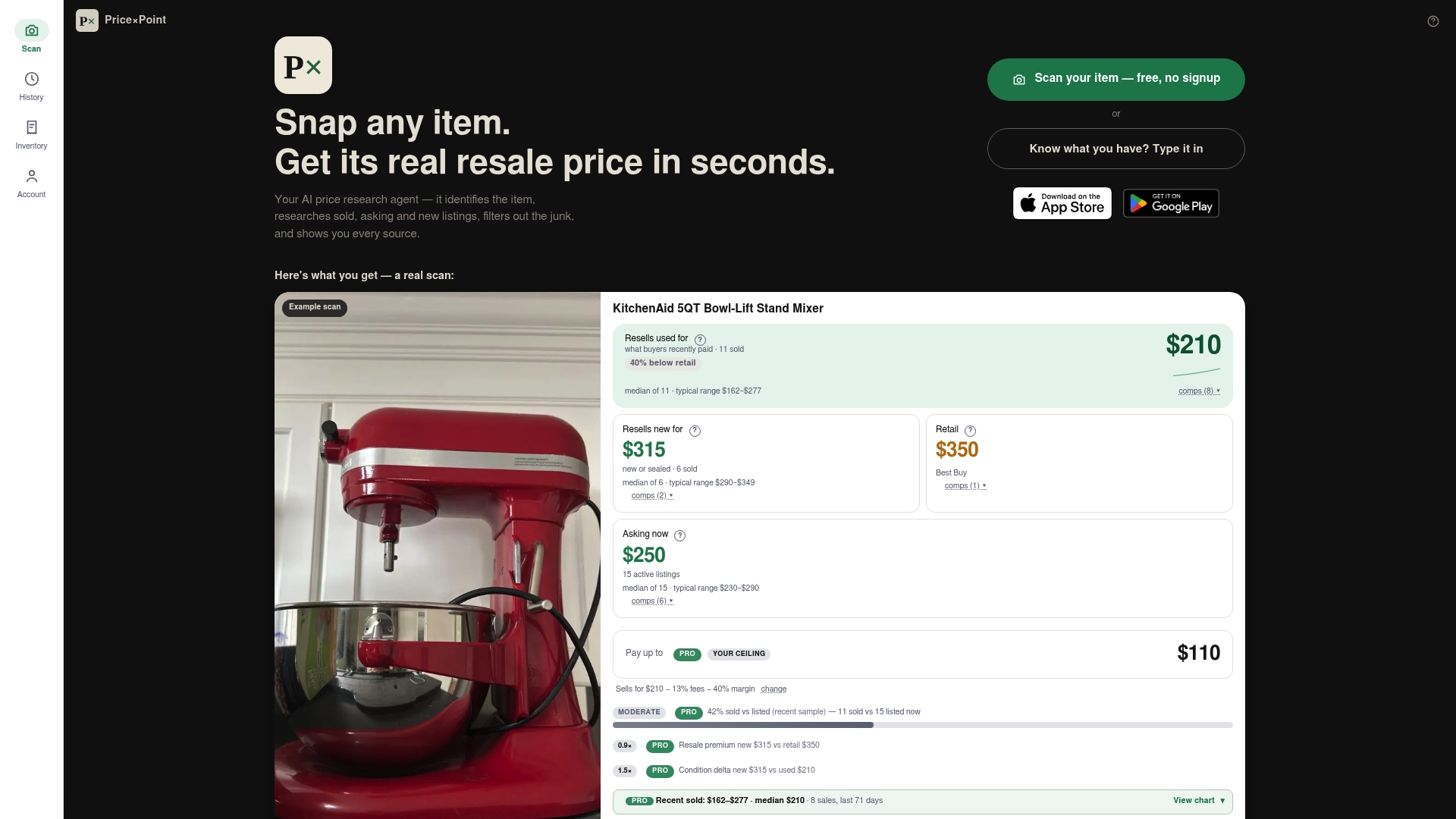
If you are clearing out a collection, bulk pricing works from a CSV or from photos with several items, and scan history can be saved and exported, so your comps stay attached to each item. There is a free tier to start. Paid plans are Basic at $4.99 per month, Pro at $9.99 per month and Power at $24.99 per month, and token packs are also available: 100 tokens for $5.99, 300 for $12.99 and 1000 for $34.99, all one-off. See the details on the PriceXPoint pricing page, or browse real sold prices for used items first.
Other categories follow the same logic. Our guides on pricing collectibles with real sold prices and pricing antiques from sold prices show the steps in detail.
A checklist before you set the price
- Confirm the exact version, size and release type.
- Grade condition honestly, with photos of folds, tears, fading and restoration.
- Collect three to six completed sales of the same version, and keep the links.
- Separate signed or documented examples from plain ones when you compare.
- Write down the provenance you can prove, and mark what is only a family story.
- Set a range, then choose a point inside it based on fees, shipping and how fast you want to sell.
- Recheck the comps when you relist, since poster markets can move.
FAQ
Does provenance always increase a poster's value?
No. Its weight depends on the category and the poster. For many movie posters, Sotheby's says provenance is not hugely important, while signatures can add a lot. For art-style posters and pieces with exhibition history, documentation counts for more.
Is a poster with no provenance fake or worthless?
Not necessarily. Posters were commercial advertising, and the trade operated long before certification was common. Missing paperwork means you rely more on the physical evidence and on sold comps, and for expensive pieces it makes sense to seek expert authentication.
What documents count as proof of provenance?
Dated receipts and dealer invoices, auction catalogue entries, collection inventories, estate records and period photographs all help. The stronger the record, the more specific and independently checkable it is. A named source with a dated receipt beats a general story.
How do I price a vintage poster with no recent sales?
Widen the search in order: same title and release in a related format, same title from a similar era and condition, then comparable titles with similar demand. Present the result as a range and note your assumptions. For rare, high-value pieces, ask a qualified appraiser.
Should I use asking prices or sold prices?
Use sold prices as your anchor. Asking prices show what sellers hope for and can hint at market mood, but only completed sales show what buyers paid.
Sources
- A Practical Guide to Poster Provenance Checks
- What Makes a Movie Poster Collectable, Sotheby's
- Valuing Vintage Posters, Posters + Prints
- How to Verify Vintage Poster Authenticity, CV Treasures
- How to Identify Authentic Vintage Posters
- Price Your Poster: Pro Tips on Assessing Condition, Poster House
- Original Vintage Posters Guide
- How to use Price Guides
- No Two Values are the Same, Austrian Posters
- When Comparable Sales Don't Exist
- Comparable Sales Analysis for Art, Masterworks