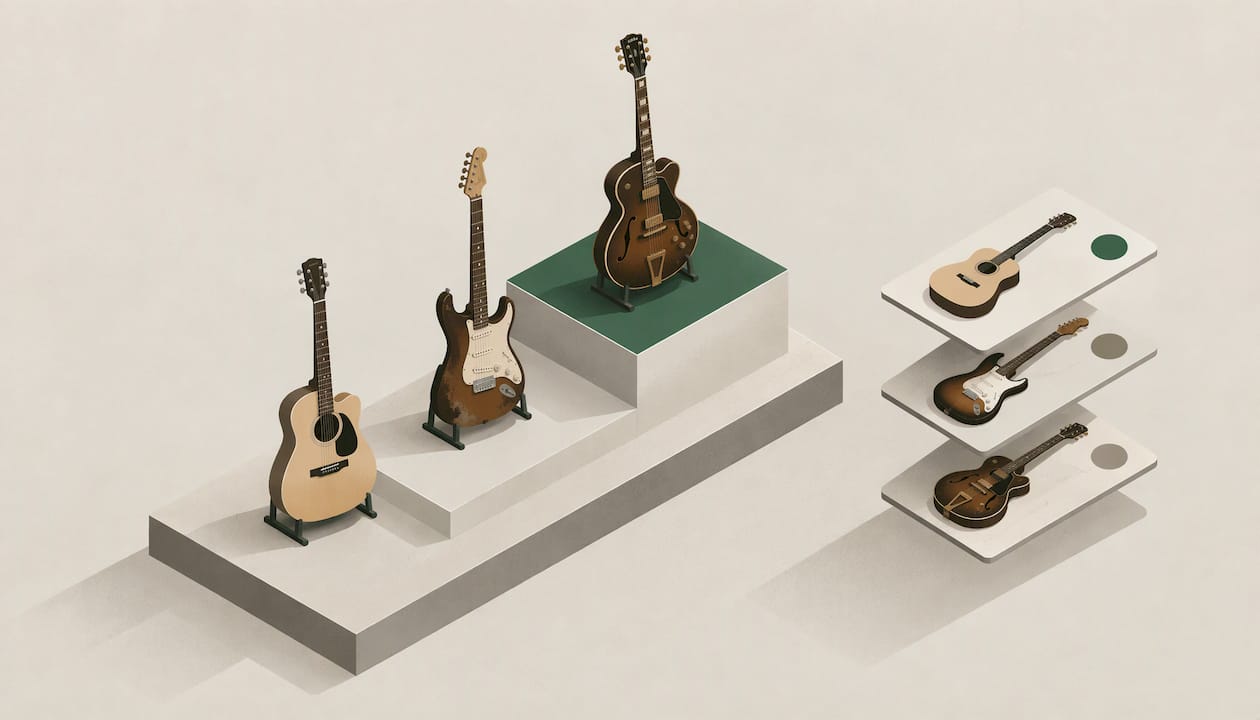
The fair price of a musical instrument is what comparable instruments in the same condition have actually sold for, not what they are listed for. Typical new prices give you the ballpark, and sold listings give you the number. This guide covers both: the ranges for guitars, keyboards, drums and orchestral instruments, then a repeatable way to price a used one, whether you are selling a Strat from the closet or hunting for a bargain clarinet.
TL;DR
- Most guitars fall between $150 and $1,500 new, and US average selling prices in 2023 were $745 for acoustic and $780 for electric guitars.
- Brand, model, condition, age, rarity and included accessories move a used price far more than the instrument type does.
- A common used rule of thumb starts at one half to two thirds of the new price, then adjusts for condition and demand.
- Asking prices show hope, sold prices show the market. Always anchor on sold listings for the exact model.
- PriceXPoint looks up an instrument from a photo or name and links each estimate to the sold listings behind it.
Table of Contents
- What instruments typically cost new
- What makes one instrument worth more than another
- How to price a used instrument, step by step
- A worked example: a used student guitar
- Pricing different types of instrument
- Why guesswork costs money
- Price your instrument from real sales
- FAQ
- Sources
What instruments typically cost new
Start with a new-price baseline, because every used price is a fraction of it. Ranges vary widely by instrument, and by what "entry level" means in that family.
Guitars
NAMM, the music products trade association, reports that in the United States acoustic guitars averaged $745 per unit and electric guitars $780 in 2023, up 8.0% and 9.9% on the year. Those are averages across every tier, so a single beginner guitar will sit well below them.
A 2026 guitar price guide breaks the tiers down like this:
| Tier | Typical new price |
|---|---|
| Basic beginner | $100–$200 |
| Student / intermediate | $200–$500 |
| Higher-quality intermediate / performance | $500–$1,000 |
| Professional / premium | $1,000–$3,000 |
| Custom, vintage, boutique, collectible | $3,000+ |
For electrics specifically, Guitar Chalk puts most models in the $600–$900 range, with a Fender Player Stratocaster around $650. Entry-level guitars have stayed in the $200–$300 range for decades, while American-made Fenders, Gibsons and Martins start at $1,000–$2,000 and climb from there.
Keyboards and pianos
The spread here is enormous. One 2026 popularity list puts piano and keyboard entry costs from $100 for a Casio up to $175,000 for a Steinway. In the US, NAMM's figures show a top-quality digital piano at about $1,200 against $6,500 for an entry-level vertical acoustic piano. If you are pricing a keyboard, work out first which category it belongs to: portable, stage, digital piano or acoustic. They behave like different markets.
Drums and percussion
Starter kits generally run $300 to $600, including mesh electronic kits. NAMM notes that electronic kits from as little as $200 are eroding acoustic kit sales. That matters for resale: a technology-based instrument ages differently from a wooden one, and cheap new electronics pull used prices down. Accessories follow their own logic too. Even sticks have price tiers, as this look at signature drumsticks versus standard ones shows.
Orchestral and band instruments
Student violins run roughly $150–$500, and student saxophones $800–$1,500, the highest entry cost on that same list. A student sax therefore holds far more resale value in absolute dollars than a student violin, though the percentage lost to depreciation can be similar.
Outside the US, levels differ. Average e-commerce prices in Japan are a very different scale from US retail, so a foreign figure is no guide to a US sale. Compare against the market you are selling into.
What makes one instrument worth more than another
Two guitars that look alike can sit $1,000 apart. The usual drivers:
- Materials and construction. Solid woods and hand work cost more than laminates and machine production. American-made guitars with solid rosewood, mahogany, spruce and maple, built more by hand, cost far more than entry-level ones.
- Hardware, pickups and electronics. The Tune Luma guide lists these alongside fretwork and setup quality. A professional setup costs $50–$150, which matters when you compare a well-set-up instrument with one that needs work.
- Brand and model. A 2025 look at the used-gear market found the Les Paul, Strat and Tele remain the top used-gear models, driven by demand for classic models and brands. High demand means faster sales and firmer prices.
- Model year and production run. Guitar Chalk lists model year and limited production runs as price factors. A special edition can outsell a standard model of the same spec.
- Condition and included accessories. Case, strap, original box, papers and spare parts all change what a buyer will pay. Wear, refinishing and repairs lower it.
The practical lesson: the exact model name, year and condition matter more than the category. "Used electric guitar" is not a pricing unit. "2019 Player Stratocaster, minor finish wear, with gig bag" is.
How to price a used instrument, step by step
1. Identify the exact instrument
Find the brand, model, year or serial range, finish and country of manufacture. Many instruments carry this on the headstock, a neck plate, a label inside the body or the back panel. Mistaken identification is the most common reason a price is wrong: a Japan-made model and a Mexico-made model of the same name can sell at quite different levels. PriceXPoint identifies items from a photo or a name, and lets you verify and correct the identification so the lookup matches your exact instrument.
2. Get a new-price anchor
Find what the model sold for new. This gives you a ceiling. A woodwind repair specialist offers a rule of thumb: start a used instrument at one half to two thirds of its new price. A $2,000 instrument starts at $1,000 to $1,350, leaning higher for fine condition and strong demand, lower for condition issues, heavy supply or weak demand. Treat it as a starting guess, not an answer. Discontinued, vintage and limited models break the rule in both directions.
3. Check sold prices, not just asking prices
This is the step that decides the outcome. An asking price is what one seller hopes for. A sold price is what a buyer paid. Listings that sit for months at high prices drag any average upward, and they never show up as transactions. Our guide to sold price versus asking price explains why the two diverge and which to trust.
To do this by hand, search your exact model on marketplaces, filter for sold or completed listings, and note the last several sales in similar condition. Ignore outliers: the one sale at triple the average is usually a rare variant, a bundle or a mislabeled listing. PriceXPoint does this research across multiple marketplaces and shows sold, asking and new listings side by side, filtering out misleading data and linking to the sales sources so you can see where each figure comes from.

4. Adjust for condition and extras
Grade the instrument honestly: cosmetic wear, fret wear, cracks, electronics that crackle, sticky valves, pads that leak. Then adjust against your sold comparables. A comparable sold in excellent condition with a hard case is not your price if yours has dings and no case. Photograph flaws clearly, because buyers discount unknowns more than known flaws.
5. Set a price with room to move
If you sell and expect offers, list slightly above your target, but within the range sold listings show. If you buy, use the same sold range to judge whether an asking price is fair, and to make an offer you can justify with evidence.
A worked example: a used student guitar
Say you are selling an electric guitar you bought new for $650, such as a Fender Player Stratocaster in the range Guitar Chalk gives for that model. The one-half to two-thirds rule gives a starting range of roughly $325 to $433. That is the anchor.
Now check sold listings for the same model and year. Suppose recent sales for similar guitars cluster toward the upper end of that range when a case is included, and lower when there are scratches or a worn fretboard. You price yours by where its condition and extras sit in that cluster. If your guitar has had a professional setup, mention it: setup work costs $50–$150, and it makes an instrument ready to play. The figures here are an illustration of the method, not a quote for any specific guitar.

Pricing different types of instrument
Guitars and basses. Highest liquidity. Popular models sell quickly, so sold data is plentiful and reliable. Pay close attention to year, country and finish.
Keyboards and digital pianos. Technology ages fast. Models a few generations old can lose value quickly, while an acoustic piano has a different problem: size and moving costs limit buyers, so local pickup shapes price.
Drums. Sell kits as a set or piece by piece depending on completeness. Cymbals often carry more value than the shells, and brand and line decide how much.
Band and orchestral instruments. Condition is dominant. A clarinet or saxophone that needs pads, or a violin with an open seam, trades at a repair-adjusted price. A student model in playable condition is the easiest to compare, since thousands of the same model sell.
Vintage and collectible instruments. Here, serial numbers, originality of parts and provenance carry the price, and the ranges above stop applying. The Tune Luma guide places custom, vintage, boutique and collectible instruments above $3,000. Collectors should rely on documented sold prices for the exact year and spec, and note any replaced parts.
Why guesswork costs money
Price too high and your listing sits unseen. Price too low and you leave money with the buyer. Buyers face the mirror problem: without sold data, a $900 asking price may look reasonable and still be $200 above what the model sells for. A listing price is a claim. A sold price is evidence.
If you price many items, such as a shop clearing consignment stock or a reseller flipping gear, the same method has to scale. PriceXPoint supports bulk pricing through CSV or multi-item photos, and saves your scan history with export options, so you can come back to a price later and see how the value of an instrument moved. For a broader look at which tools do this and how they differ, see our guide to the best apps to find out what something is worth, or how to calculate resale value of almost anything.
Our view on pricing instruments
Instruments are hard to price because every one is a little different: the year, the finish, the repairs, the case. Category averages hide all of that. We built PriceXPoint around one rule: a price estimate should be tied to sold listings, and we do not give a figure without evidence behind it.
That is why we name every data source and let you verify and correct the identification of your item. If the app has the wrong model, the number is wrong, and we would rather you fix the model than trust a guess.
For a guitar, a clarinet or a drum kit, the question is always the same: what did this exact thing sell for recently? We think you should be able to see the answer, and the sales behind it, in seconds.
PricexPoint
Price your instrument from real sales
Photograph the instrument or type its name, and PriceXPoint returns sold, asking and new listings across multiple marketplaces, with links to the sales behind them. There is a free tier to start. Paid plans are Basic at $4.99 per month, Pro at $9.99 per month and Power at $24.99 per month, and one-off token packs cost $5.99 for 100 tokens, $12.99 for 300 and $34.99 for 1,000. See all plans and token packs.
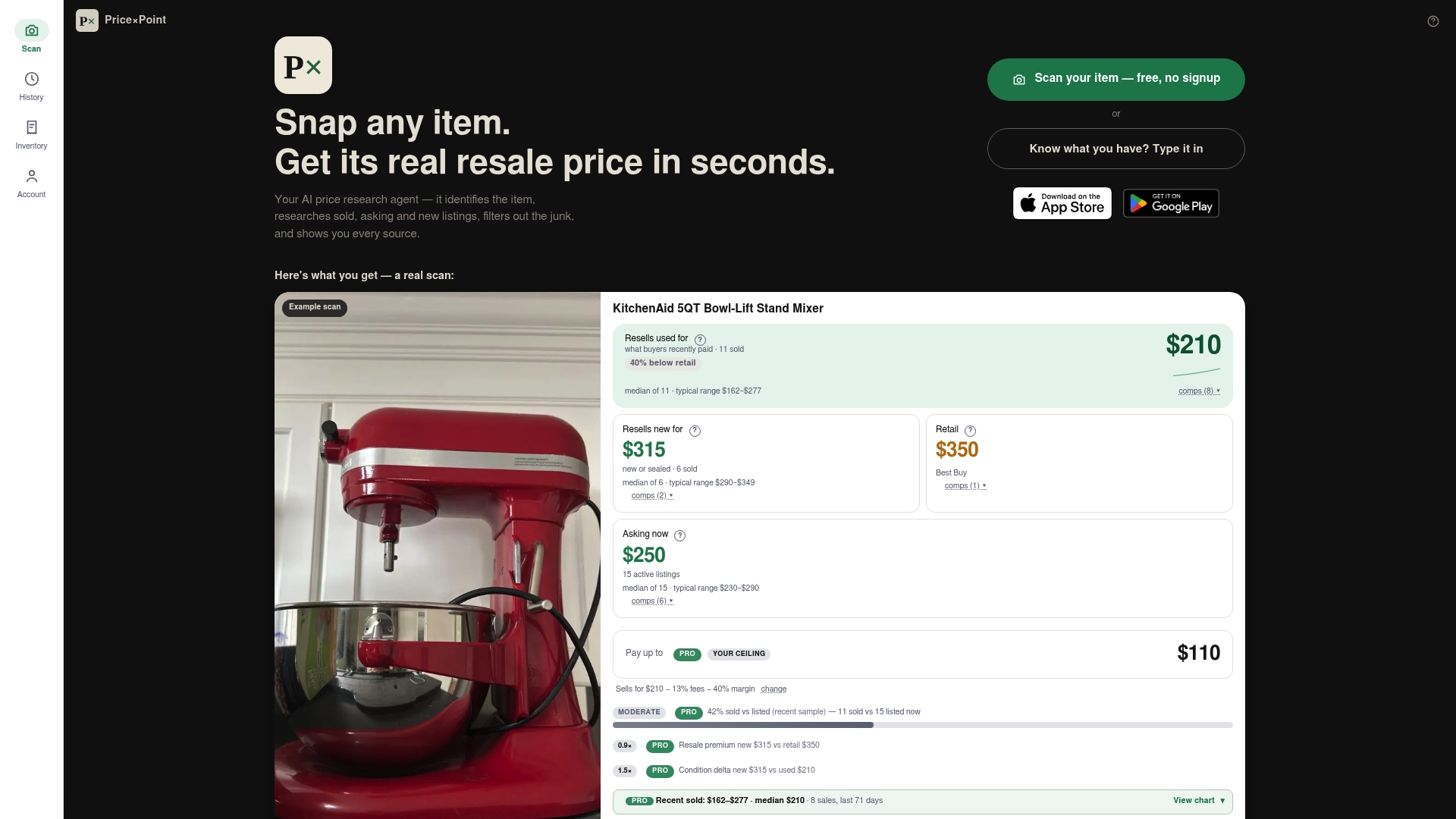
If you sell often, a plan suits a steady flow of items, while a token pack covers an occasional clear-out. You can read our guide to selling apps that price for you to see what to expect from tools in this space.
FAQ
What is a normal price for a guitar?
Most new guitars land between $150 and $1,500, according to a 2026 price guide. Beginner models run $100–$200, student models $200–$500, and professional guitars $1,000–$3,000. In the US, 2023 average selling prices were $745 for acoustics and $780 for electrics.
How do I price a used instrument fairly?
Identify the exact model and year, then look up what comparable instruments actually sold for in similar condition. A common starting point is one half to two thirds of the new price, adjusted up or down for condition and demand. Sold listings should overrule any rule of thumb.
Why do asking prices differ so much from what instruments sell for?
Asking prices reflect what sellers hope for, and unsold listings stay online at prices nobody pays. Sold prices record real transactions. Comparing the two on the same model shows how far a listing sits from the market.
Does condition change the price a lot?
Yes. Wear, repairs and missing accessories move prices, and a case or original packaging can add to them. Grade your instrument against sold examples in the same condition, not against the best-looking listing you can find.
Do electronic instruments hold their value like acoustic ones?
Usually less well, because technology improves and new entry-level models get cheaper. NAMM notes that electronic drum kits from as little as $200 are eroding acoustic kit sales. Check sold prices for your exact model and generation.
Sources
- NAMM Global Report 2024 (2023 data)
- How Much For A Guitar: 2026 Price Guide
- Why Are Guitars So Expensive, and Are They Worth It?
- How much do electric guitars usually cost?
- Top 10 Most Popular Musical Instruments, 2026
- Trends behind the used guitar gear market, Guitar World
- Pricing Used Instruments