
There is no single minimum profit margin that fits every reseller, but there is a practical floor: about 20% net after every fee, shipping charge and return allowance. Below that, one refund or one slow month can erase the profit from several sales. Higher-priced items can live near that floor. Cheap items usually need a much higher percentage. The only margin that counts is the one you calculate from a real sold price before you buy, and that is where most resellers go wrong.
This guide gives you the ranges, the formula, a worked price-floor example and the rules of thumb for deciding whether an item is worth buying. If you want the sold prices behind that calculation in seconds, PriceXPoint pulls them from several marketplaces and links each figure to its source.
TL;DR
- A healthy net margin for most US eBay resellers is 20% to 35% after all fees, shipping and a returns reserve. Treat about 20% as a working floor.
- Margin is profit divided by selling price. Markup is profit divided by cost. A $40 item sold for $50 is a 20% margin but a 25% markup.
- Cheaper items need bigger percentages: common rules of thumb are 50% under $30, around 30% from $30 to $100, and at least 25% above $100.
- Work backward: add every cost, divide by one minus your target margin and your fee percentages, and you get the lowest price that still pays.
- The price you plug in must be a sold price, not an asking price. Asking prices are what sellers hope for.
Table of Contents
- Why a single "minimum margin" does not exist
- Realistic margin ranges by type of reselling
- Margin versus markup: the mix-up that wrecks pricing
- What counts as a cost
- How to set your price floor, step by step
- Margin is not the whole story: speed and cash
- A quick decision rule before every purchase
- Promo: price from real sales data
- Perspective
- FAQ
- Sources
Why a single "minimum margin" does not exist
Search this topic and you will find numbers from 10% to 85%. They disagree because they measure different things. Some are gross margins before fees. Some are net. Some come from sellers of $8 thrifted shirts and some from sellers of $900 cameras. Some count only the purchase price as a cost and ignore shipping, supplies and returns.
So the useful question is not "what percentage do others hit?" but "does this margin still pay me after everything that can go wrong?" A margin that cannot absorb marketplace fees, a slow two weeks and a handful of returns is too thin, whether it is 15% or 60%.
That said, you need a number to buy against. The ranges below give you a starting point, and the rest of the article shows how to tighten it for your own category.
Realistic margin ranges by type of reselling
The 2026 eBay benchmarks from ResellMargin break net margins down by how you source. These are net figures, meaning after fees and shipping:
| Reseller type | Typical net margin |
|---|---|
| Thrift and garage-sale flipping | 35% to 60% |
| Vintage and collectibles | 40% to 70% |
| Wholesale and pallet liquidation | 25% to 40% |
| Sneakers and streetwear | 15% to 30% |
| Retail arbitrage (new goods bought at retail) | 10% to 20% |
The same source also splits by category: sports sneakers 20% to 35%, standard categories 20% to 30%, clothing and accessories 15% to 25%, and books and media 10% to 20%. The pattern is easy to read. The cheaper your sourcing is relative to resale value, the more margin you can expect. When you buy at retail and sell at slightly less than retail, margins compress fast.
The full benchmark breakdown also notes that thin margins only work with fast turnover (under 30 days), returns below 3% and carefully tracked costs. If you cannot meet those three conditions, aim higher.

Use value tiers, not one percentage
A flat percentage hides an obvious problem. A 20% margin on a $15 item is $3, which may not cover the time to photograph, list, pack and ship it. A 20% margin on a $300 item is $60. Hostinger's reselling guide lists common minimum-margin rules that resellers apply before buying:
- Items under $30: at least 50%
- Items from $30 to $100: around 30%
- Items over $100: at least 25%
These are rules of thumb rather than laws, but they match how the dollars work. Low-priced items need a high percentage to produce a profit worth the effort. Higher-priced items can run on a lower percentage because the absolute profit is already meaningful.
Margin versus markup: the mix-up that wrecks pricing
"Is a 30% markup the same as a 30% margin?" No, and confusing them is one of the most common ways resellers underprice.
- Margin = (selling price − cost) ÷ selling price × 100
- Markup = (selling price − cost) ÷ cost × 100
Shopify's explanation of markup versus margin uses a clean example: a $40 item sold for $50 earns $10, which is a 20% margin but a 25% markup. Margin is always the smaller number, and it can never reach 100%. Markup can go well past it.
Here is why it matters. Suppose you decide you want a 30% margin and mistakenly add 30% to your cost. A $30 item would be priced at $39, which is only a 23% margin before you subtract a single fee. Always say which one you mean, and when you compare yourself with other sellers, check that their number is a margin and not a markup.
What counts as a cost
The second source of confusion is what goes into "cost." The gap between gross sales and actual profit is everything that leaves your account between the buyer's payment and your pocket. Count all of these:
- Purchase price of the item, including any tax you paid
- Inbound costs: shipping to you, fuel or travel if you drove to source it
- Prep and supplies: cleaning, repair parts, boxes, tape, labels
- Marketplace final value or selling fee, which varies by platform and category
- Payment processing, where it is charged separately
- Outbound shipping you pay, net of anything the buyer pays
- Promoted listing or ad fees
- A returns allowance, a small percentage of revenue set aside for refunds and damaged items
Gross sales is the number the marketplace dashboard shows. Net profit is what remains after all of the above. A reseller who reports "$5,000 in sales this month" and a reseller who reports "$1,100 in profit" may be describing the same month.
Fees differ a lot by platform, so the same item can produce different margins depending on where it sells. Our guide to comparing marketplace fees across eBay, Poshmark and Mercari lays out those differences so you can plug the right percentage into your calculation.
How to set your price floor, step by step
This is the routine that turns a margin target into a buying decision. Do it before you buy, not after.
1. Add up fixed costs
Total the dollar costs that do not change with the sale price: purchase price, inbound shipping, supplies, and the shipping you will pay the carrier.
2. Add up percentage costs
Combine the marketplace fee, payment processing, any ad rate and your returns allowance into one percentage.
3. Divide to find the floor
The formula for the lowest price that hits your target is:
Minimum price = fixed costs ÷ (1 − target margin − percentage fees)
Use decimals. If the target margin plus the fee percentages reach 100%, no price works. This is the same reverse logic Shopify gives for pricing to a target margin (selling price = cost ÷ (1 − target margin)), with fees added to the denominator.
4. Worked example
You find a used item for $30. You expect $8 in shipping and $1 in packaging, so fixed costs are $39. Your combined marketplace, payment and returns percentage is 15%, and you want a 30% margin.
- Denominator: 1 − 0.30 − 0.15 = 0.55
- Minimum price: $39 ÷ 0.55 = $70.91
Check it: 15% of $70.91 is $10.64 in percentage costs. $70.91 − $39 − $10.64 = $21.27 profit, and $21.27 ÷ $70.91 = 30%.
Now compare $70.91 with what the item actually sells for. If sold listings cluster around $85, buy it. If they cluster around $60, pass, or accept a lower target margin only knowingly. The fees in this example are illustrative, so use the current rates for your own platform and category.
5. Compare the floor with real sold prices
This step decides everything, and it is where the evidence matters. A floor of $70.91 is meaningless against a hopeful asking price. Look at what comparable items actually sold for, in similar condition, over a recent window. Our explainer on sold price versus asking price shows why the two numbers can differ widely and which one to trust.
PriceXPoint does this lookup for you. Snap a photo or type the item name, and the app returns sold, asking and new listings across multiple marketplaces, filters out unreliable listings, and links the figures back to the sales they came from. You get the sold range to hold against your floor, with the sources named so you can confirm the data yourself.
Margin is not the whole story: speed and cash
Two items with the same margin can be very different businesses. A $15 profit that arrives in two days is often a better stock decision than a $25 profit that ties up $150 for nine months. Track days to sell alongside margin, and track average net profit per sale. A fast-turning 18% can beat a slow 40%, because you can redeploy the money repeatedly.

Category shapes this too. Electronics tend to be volume businesses where small handling costs per unit decide whether it works, with thinner margins and quicker turns. Collectibles and vintage have pricing room but far fewer transactions to spread your fixed costs across. If you sell electronics, our guide on where to sell used electronics and what they go for covers the realistic price levels. If your goal is faster turnover, pricing used items to sell fast without underpricing shows how to position within the sold range.
A quick decision rule before every purchase
- Estimate the realistic sold price from comparable completed sales, not from asking prices.
- Subtract all fixed and percentage costs.
- Divide profit by sale price to get the margin.
- Check it against your tier: roughly 50% under $30, 30% from $30 to $100, 25% or more above $100, and never below about 20% net.
- Ask how long it will sit. If the answer is months, raise your required margin.
If an item fails step 4, the problem is almost always the buy price, not the sale price. Negotiate it down or leave it.
Promo: price from real sales data
PriceXPoint gives you the sold-price evidence that every calculation above depends on. It identifies items from photos or names, checks sold, asking and new prices across multiple marketplaces, and supports bulk pricing through CSV or multi-item photos. It also saves your scan history with export options, so you can review what you paid against what comparable items sold for.
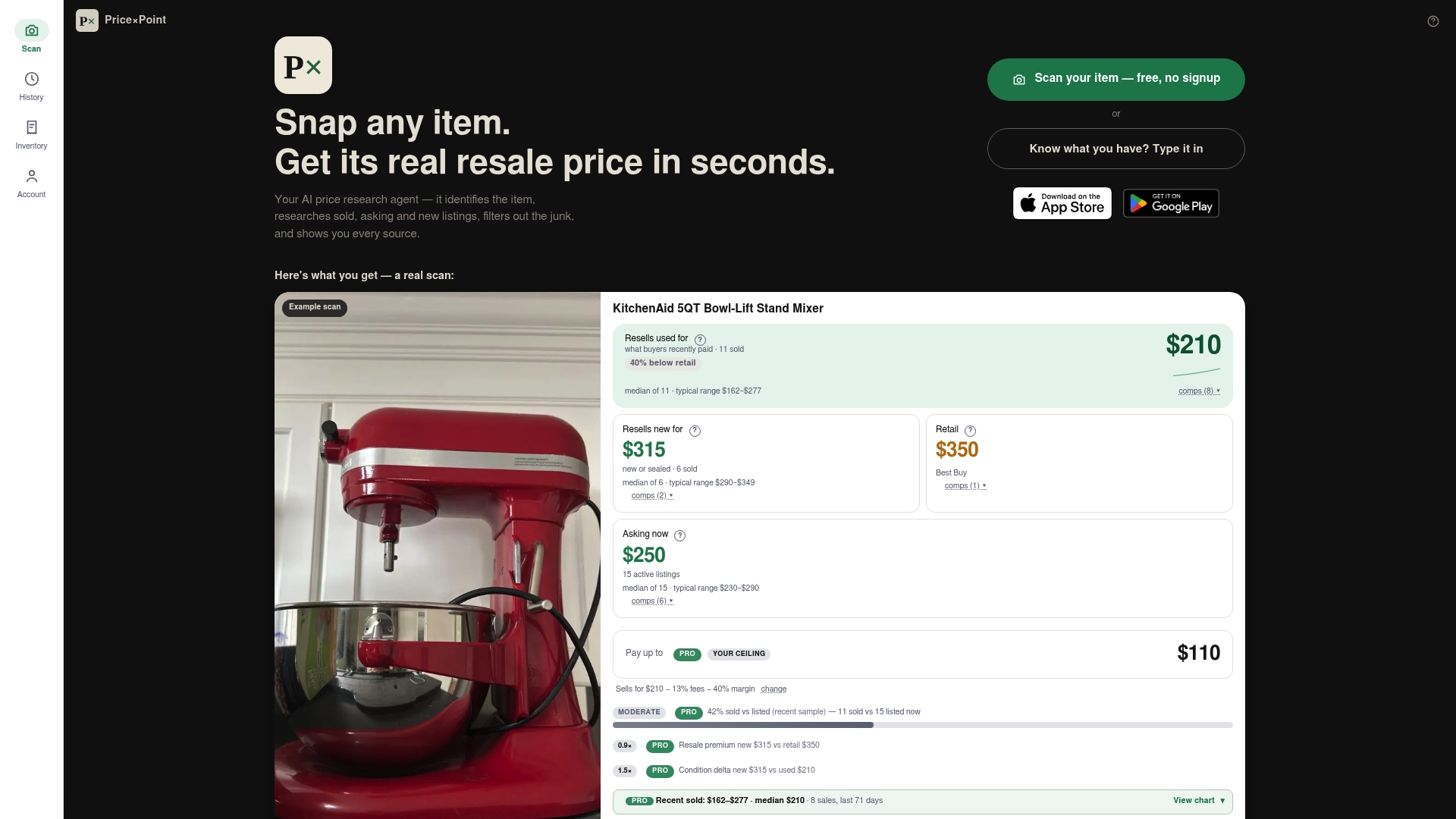
There is a free tier, and paid plans start at $4.99 per month for Basic, with Pro at $9.99 and Power at $24.99 per month. If you prefer to pay as you go, token packs are 100 tokens for $5.99, 300 for $12.99 and 1000 for $34.99, all one-off. See the PriceXPoint plans and token packs to choose what fits your volume.
Perspective
Most margin mistakes we see described by resellers start with the input, not the math. The formula is simple. The number that goes into it, the expected sale price, is where people drift toward optimism, because asking prices are everywhere and sold prices take effort to find.
That is why we built PriceXPoint around sold listings. Our estimates link to actual sales from several marketplaces, we name every data source, and we do not give a figure without evidence behind it. You can also verify and correct the item identification, so the comparison matches the thing in your hands.
A minimum margin only protects you if the sale price behind it is real. Start there, and the percentages take care of themselves.
PricexPoint
FAQ
What is a good profit margin for reselling?
For most US eBay resellers, 20% to 35% net after fees, shipping and returns is considered healthy. Low-cost sourcing such as thrifting can run higher, while retail arbitrage often sits at 10% to 20%. Aim for the upper part of the range on items under $30.
Is a 30% markup the same as a 30% margin?
No. Markup is measured against your cost and margin against your selling price, so a 30% markup works out to only about a 23% margin. Shopify's markup and margin guide shows both formulas side by side.
Can I make $1,000 a month reselling?
It depends on your average profit per item and how many you sell. At an average net profit of $20 per sale, you would need about 50 sales a month. Track net profit per sale and your sell-through speed to see how close you are.
Should I chase high margin or high volume?
Use both measures together. High margin on slow items ties up cash, and high volume on thin margins leaves no buffer for returns. Judge each item by profit per sale, days to sell and the money tied up in unsold stock.
Sources
- ResellMargin: What is a Good Profit Margin on eBay?
- Hostinger: How to make money reselling
- Shopify: Markup vs. Margin