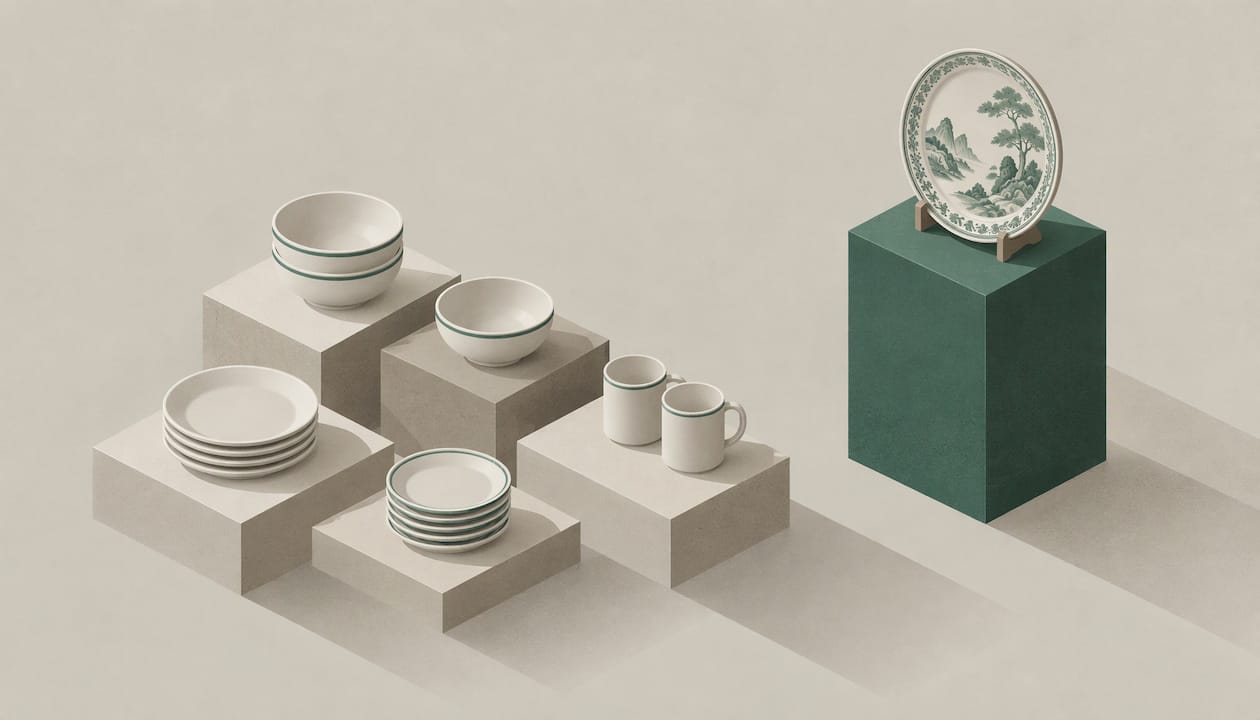
China dinnerware is worth what a buyer has recently paid for the same pattern in the same condition, not what it cost new or what a seller hopes to get. Price it by identifying the maker and pattern, grading condition honestly, and checking sold listings for that exact pattern. Then decide whether the set sells better whole or piece by piece.
TL;DR
- Sold prices beat asking prices. Anchor your number on what identical pieces actually sold for, not on what sellers list them at.
- The standard unit is the five-piece place setting: dinner plate, salad plate, bread plate, cup and saucer. Many everyday patterns bring only about $20 to $40 per setting.
- Condition multiplies value. A small chip on a plate can cut 20 to 25 percent, and a larger one about half.
- Dealers typically pay 25% to 50% of retail, so decide in advance whether you want speed or the best price.
- Incomplete sets often do better sold by the piece, especially in higher-value patterns.
Table of Contents
- What china dinnerware actually sells for
- What drives the price of fine china and bone china
- Identify the piece before you price it
- How to price individual pieces from recent sales
- Pricing a full set versus an incomplete set
- Retail, dealer and private-sale prices are three different numbers
- Keeping your price competitive
- Our perspective
- Price a whole cabinet faster
- FAQ
- Sources
What china dinnerware actually sells for
The shelf prices you see on the first page of Google for "china dinnerware" are new retail prices: a bone china set at $70 to $290, a luxury 12-piece set at $250, a single designer dinner plate at $58 or more. Those are useful for one thing only: they tell you what a buyer could pay for something new. They say very little about what your used set will fetch.
Resale is a different market. According to a slideshow on valuable vintage dishware, a five-piece place setting from Wedgwood may get around $40, Lenox about $25 and Mikasa around $20. At the very top, dealers may pay up to $1,000 for a single Royal Copenhagen Flora Danica dinner plate. The gap between those two ends is the whole story of china pricing: most mass-produced patterns are cheap, and a small number of rare ones are not.

The same pattern can also lose a lot of value over time. One antiques dealer notes that many Noritake patterns from the 1970s to 1990s that retailed for $500 or more now often sell for $50 to $100. If your set was expensive in 1985, that tells you little about 2026.
Typical resale ranges at a glance
| Item | Typical resale range | What moves it |
|---|---|---|
| Five-piece place setting, mass-market maker | About $20 to $40 | Pattern popularity, condition |
| Full older set from a collectible pattern | Hundreds of dollars | Completeness, serving pieces |
| Older Noritake pattern once sold at $500+ | About $50 to $100 | Demand for the pattern today |
| Rare or museum-level plate | Up to $1,000 for a single plate | Maker, rarity, provenance |
The first and fourth rows come from the figures cited above. Treat the middle rows as direction, not as a quote: your pattern's own sold history is the only number that counts.
What drives the price of fine china and bone china
Bone china is porcelain made with bone ash, and it is often thinner, lighter and more translucent than ordinary porcelain or stoneware. It costs more to make, which is why new bone china sets run higher at retail. On the resale market, though, the material matters less than five other things.
- Maker and pattern. A famous name helps, but a pattern that collectors are still hunting for helps more. A common pattern from a respected maker can sell for less than a scarce pattern from a lesser-known one.
- Condition. This is the biggest swing factor, covered in detail below.
- Completeness. Whole services with serving pieces such as a tureen, gravy boat and platter are worth significantly more than the same number of scattered plates.
- Decoration. Intact gold rims, hand-painted details and unworn patterns are valued. Dishwasher-faded gold is not.
- Demand right now. Patterns that people are matching and replacing sell steadily. Patterns nobody is replacing sit.
Price at purchase and professional appraisal values are not the same as what you can reasonably expect to get. A guide to selling china and tableware makes this point directly: what you paid and an appraisal figure are not realistic sale expectations.
Identify the piece before you price it
You cannot price what you cannot name. Spend ten minutes on identification and the rest gets easy.
Read the backstamp
Turn each plate over. Look for a maker's mark, a pattern name or number, a country of origin and sometimes a date code. Photograph it in good light. If a pattern name is missing, note the shape, the border, the colors and any gold or platinum trim. These details are what you will search with.

Check condition in three ways
Condition is not additive. According to one practical value guide, a hairline crack does not subtract a flat amount from a plate: it multiplies the value down, so a $200 plate with a hairline crack ends up around $40. The guide suggests three quick checks:
- Ping test: tap the rim gently with a fingernail. A clear ring suggests it is sound, and a dull thud can mean a hidden crack.
- Rake light: hold the piece at a low angle to a lamp so scratches, crazing and cracks throw shadows.
- Blacklight: a UV light can reveal old repairs that are invisible in daylight.
For insurance and appraisal work, Claims Journal reports that even a small chip on an 8 to 10 inch porcelain plate can cut a piece's value by 20 to 25 percent, a larger chip can cut it by half, and a full break can make it worthless. Grade every piece the way a picky buyer would, and note it in your listing.
Count what you have
Write down how many of each piece you have: dinner plates, salad plates, bread plates, cups, saucers, soup bowls, plus any serving pieces. A buyer replacing a broken plate and a buyer wanting a complete service for eight are two different customers, and your count tells you which one you can serve.
How to price individual pieces from recent sales
This is where most sellers go wrong. They search for the pattern, see asking prices of $60 for a dinner plate, and list at $60. Asking prices show what sellers hope. Sold prices show what buyers paid. For a pattern with plenty of listings, the two can be far apart.
A reliable process takes four steps:
- Search the exact pattern and piece type. "Dinner plate" and "cup and saucer" sell at different prices, so compare like with like.
- Filter to sold listings. Ignore active asking prices for now. Collect three to five recent sales of the same piece in similar condition.
- Discard the outliers. One unusually high sale may be a bidding war or a mislabeled item. One very low sale may be a damaged piece or a lot with missing parts.
- Set your price at the middle of the clean sales. If you want to sell faster, price slightly below the middle. If you can wait, price slightly above and let the listing run.
The approach is the same one we describe in our guide to pricing antiques using sold prices, and it works for any category where the same item changes hands again and again.
It also helps to check your benchmark against more than one source. Whatever tool you use, small errors in a benchmark carry straight through to the final number, which is why online valuation accuracy is worth taking seriously in any category, not only china.
A worked example
Suppose you have a 12-piece set of dinner plates in a discontinued floral pattern, all in good condition. You search the pattern and find that four dinner plates sold recently: one at $9, two at $12 and one at $14. The $9 sale was a plate with visible utensil marks. You discard it, take the middle of the other three at $12, and list yours at $12 to $14 each, or a bundled lot of 12 at a modest discount for the buyer who wants them all. That is a pricing decision grounded in evidence instead of hope.
Pricing a full set versus an incomplete set
The industry's standard unit is the five-piece place setting: dinner plate, salad plate, bread and butter plate, cup and saucer. A service for 12 is therefore 12 of those, plus any serving pieces. If you are comparing with other listings, compare the same unit.
Complete sets
A complete dinner service for 8 or 12 with serving pieces is generally worth more than the same number of individual pieces, because the buyer saves the hunt. Include a clear list of everything in the set, and photograph the serving pieces separately.
Incomplete sets
For incomplete sets there are two ways to price.
- Per-piece pricing: work out what the full set would be worth and divide it across pieces. As one illustration, a seller guide suggests that if a 12-piece set is worth $200, a single dinner plate might sell for $10 to $15. Treat it as a rule of thumb, since plates, cups and serving pieces are not worth equal amounts.
- Selling piecemeal: for sets that are worth more, splitting often pays. One value guide says that in the $300 to $2,000 range, selling by the piece routinely brings 40 to 80 percent more than selling whole. Below that range, the time cost of listing many items often outweighs the gain.
The practical rule: low-value sets sell best as one lot, and high-value sets are worth the effort of splitting. The pieces that go fastest are usually the ones people break most often, such as dinner plates and cups.
Retail, dealer and private-sale prices are three different numbers
Sellers often mix up three prices.
- Retail replacement price: what a dealer asks when selling the piece to someone matching a pattern. It is the highest number and a common benchmark.
- Dealer buy price: what a dealer pays you. The selling guide cited above says sellers can expect 25% to 50% of retail value from dealers, although few pay over 40%.
- Private-sale price: what you get selling directly to a buyer. It usually lands between the two, minus fees and shipping.
The dealer number also depends on stock. The same guide explains that a dealer with plenty of a pattern may offer pennies, while one who has sold out may offer ten times as much. If your first offer is low, ask a second buyer before you accept.
Here is how that looks on a set with a retail replacement value of $400:
| Route | Likely result | Effort |
|---|---|---|
| Sell to a dealer | $100 to $200 (25% to 50%), often nearer $160 at best | Low, fast |
| Sell as a whole set online | Close to market value, less fees and shipping | Medium |
| Sell piece by piece | Can beat the whole-set price if the set is worth over $300 | High |
The percentages come from the dealer guide. The route outcomes are an illustration of how those percentages apply, not a prediction for your set.
Keeping your price competitive
China prices move more slowly than electronics, but they do move. A pattern featured in a design trend can jump, and a flood of estate-sale stock can push it down.
- Re-check before relisting. If a listing has sat for 30 days, look at what sold in that period before cutting your price.
- Read your photos like a buyer. Show the backstamp, any chips and the full pattern. Clear photos support a higher price.
- Track sell-through. If three pieces of the same pattern sold within a week of listing, you probably priced low. If none moved in a month, you probably priced high.
- Use bundles to move slow stock. A lot of six salad plates at a fair total is easier to sell than six single listings.
For general reseller habits that apply to china too, our guide on pricing collectibles with real sold prices walks through the same comps-first routine. If you want to see how a single pattern looks with sold evidence, our Noritake Savannah page shows what a sold-price summary looks like.
Our perspective
We built PricexPoint because china is the kind of category where guessing costs real money. Two plates that look identical can be worth $12 and $120, and the difference sits in a backstamp, a pattern name or a hairline crack.
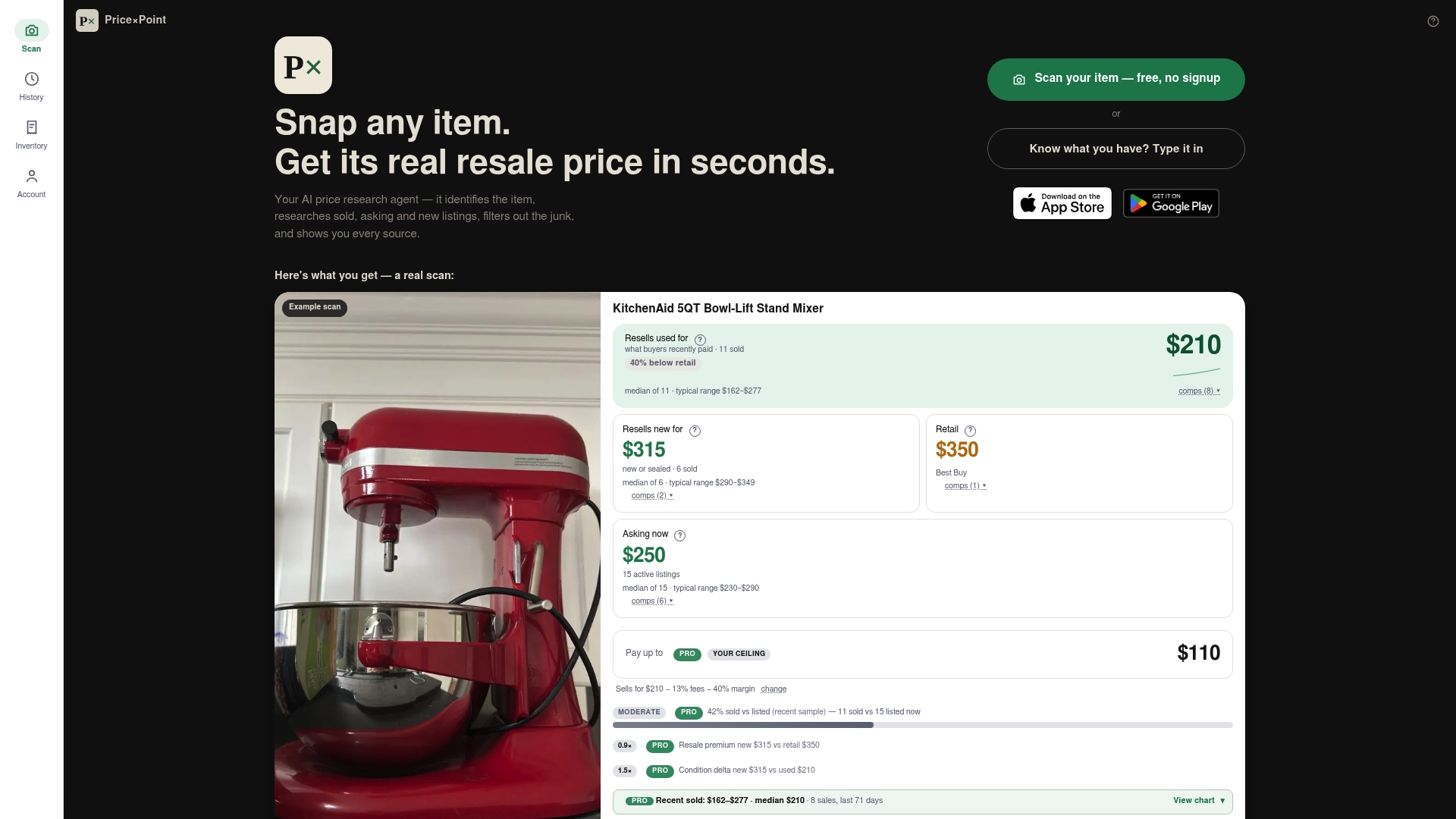
Our view is simple: a price you cannot trace to actual sales is just an opinion. That is why PricexPoint is designed to tie its estimates to sold listings from several marketplaces, name its data sources and link to the sales behind a figure, so you can see the evidence yourself. If an item is misidentified, you can correct it and get a better result.
For china, that means you can photograph a plate or type the pattern name, see what sold, what is currently asked and what the item costs new, and filter out the listings that distort the picture. We would rather give you no number than a number with nothing behind it.
PricexPoint
Price a whole cabinet faster
Pricing one plate by hand is fine. Pricing a cabinet of 80 pieces is a weekend. PricexPoint identifies an item from a photo or a name, then shows sold, asking and new prices across multiple marketplaces with links to the sales. You can price several items at once with multi-item photos or a CSV, and save your scan history with export options.
There is a free tier to try it. Paid plans on our pricing page are Basic at $4.99 per month, Pro at $9.99 per month and Power at $24.99 per month. If you only have one estate to price, token packs are one-off: 100 tokens for $5.99, 300 tokens for $12.99 or 1000 tokens for $34.99. You can also browse what used items sell for on our sold-price pages, or read how AI for resellers fits into a listing workflow.
FAQ
How much is a set of china worth?
It depends on the maker, the pattern, the condition and the completeness. Many mass-market place settings sell for about $20 to $40, while rare patterns can reach hundreds or, for a single plate from a top maker, up to $1,000. The reliable answer for your set is what identical sets sold for recently.
Is bone china worth more than regular porcelain?
New bone china usually costs more at retail because of how it is made. On resale, the maker, pattern, condition and demand matter more than the material alone. A scarce porcelain pattern can outsell a common bone china one.
Should I sell my china as a set or by the piece?
For sets worth roughly $300 to $2,000, selling by the piece often brings 40 to 80 percent more than selling whole. For lower-value sets, one lot usually saves time and sells faster. Sets with serving pieces are worth keeping together when complete.
How much will a dealer pay for my china?
Sellers can generally expect 25% to 50% of retail value from dealers, and few pay more than 40%. Offers vary with each dealer's stock of your pattern, so ask more than one buyer before you accept.
Sources
- 10 Ways to Spot Valuable Vintage Dishware
- How much is my antique china worth? A practical value guide
- The Secrets Behind Selling China and Tableware
- Best Practices for Valuing Fine Porcelain
- Is Fine China Worth Anything in 2026?
- Online watch valuation accuracy