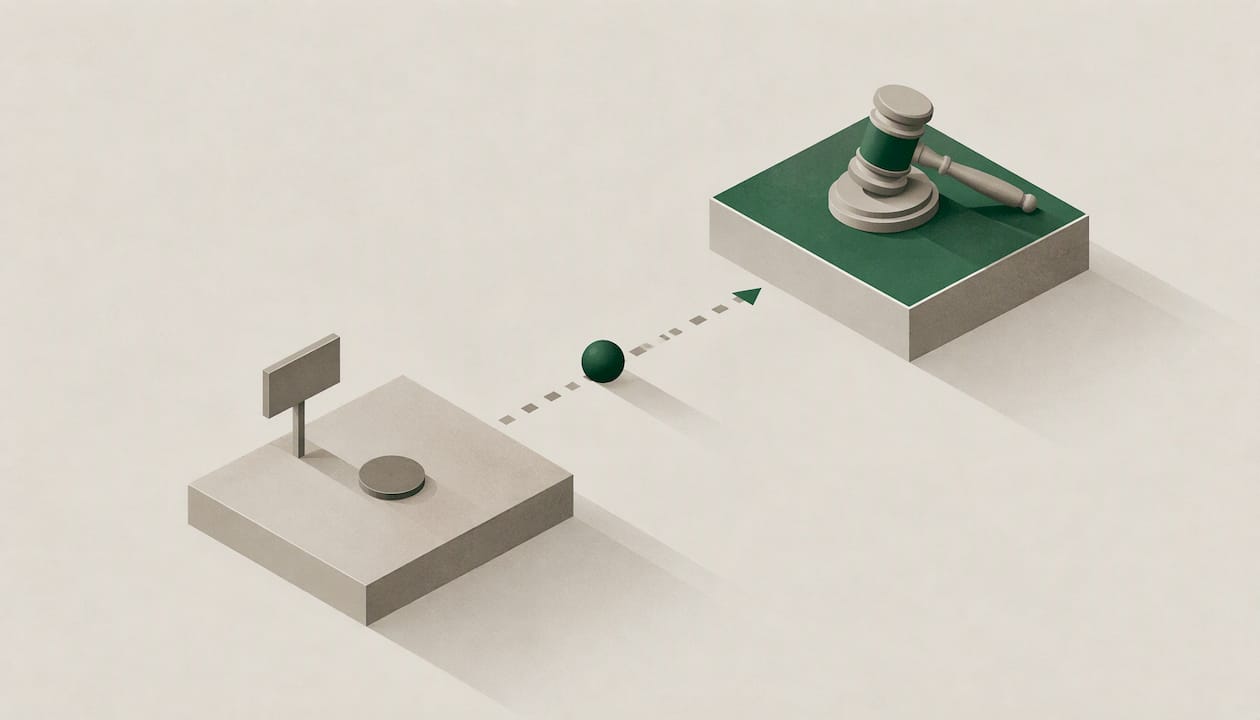
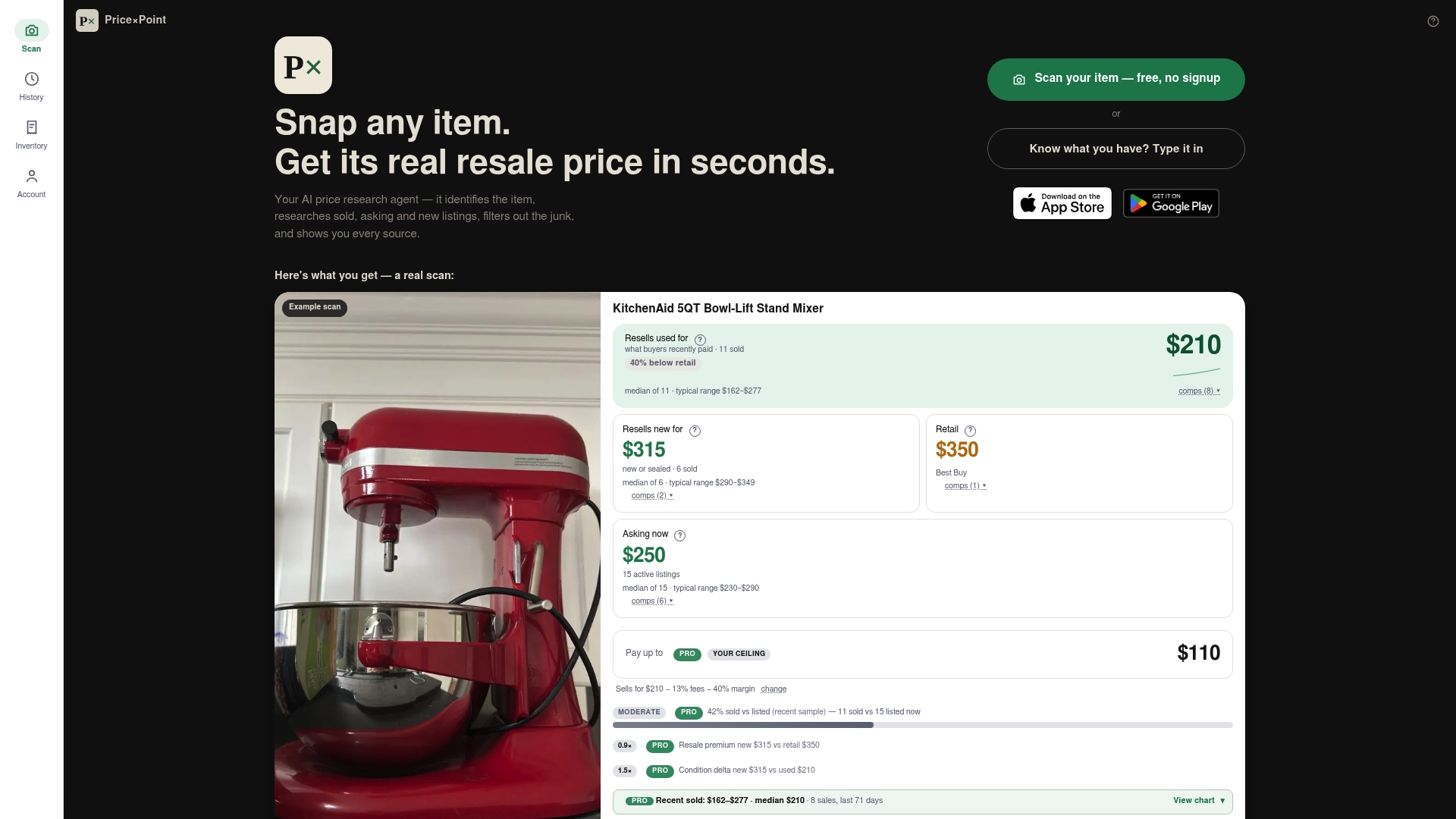
A reserve price is the lowest amount you will accept for an auction item, and the best way to set it is from what comparable items actually sold for, not from what sellers are asking. Pull recent sold prices, find the middle of the closest matches, subtract your costs, and put the reserve at or just under that figure. PriceXPoint pulls sold, asking and new listings from several marketplaces from a photo or an item name, with links to the sales behind each number, so you can build that floor in minutes instead of an evening.
TL;DR
- A reserve price is the hidden or flagged minimum you will accept. The starting bid is the public number where bidding opens. They are two different settings.
- Build the reserve from sold comps that match your item's condition, completeness and venue. Use the middle of the closest matches, not the single best sale.
- Count fees, shipping and prep before you fix the number, because a reserve that ignores costs can leave you with a sale that loses money.
- Research shows a trade-off: reserves protect the price, while lower or no reserves tend to clear more often and attract more bidders.
- On eBay, the reserve fee is charged at listing and is not refunded if the item fails to meet the reserve.
Table of Contents
- What a reserve price is, and what it is not
- Why the reserve matters more than the starting bid
- How to set a reserve price, step by step
- Reserve, public floor or no reserve: what the research shows
- Common reserve mistakes
- What buyers should take from this
- Price the item before you set the floor
- Our view on reserves
- FAQ
- Sources
What a reserve price is, and what it is not
A reserve is the minimum a seller will accept for an item. If bidding ends below it, you are not obliged to sell. Investopedia's definition separates it from the opening bid, which is only the suggested place to start and which the auctioneer may lower if nobody bids.
The starting bid and the reserve are easy to mix up, so keep them apart:
- Starting bid: public, the lowest bid anyone can place. GunBroker's help page notes every auction has one, even at $0.01.
- Reserve price: the least you will accept, usually invisible to bidders.
- Minimum acceptable price: the plain-language name for the reserve, which is what searchers mean by "auction minimum price."
A simple example: you list a vintage camera with a $1 starting bid and a $150 reserve. Bidders can open at $1, but if the top bid stops at $120, you keep the camera. A no-reserve (also called absolute) auction has no floor at all, so the item goes to the highest bidder even if that bid is $40.
Can bidders see the reserve?
It depends on the venue. On eBay, bidders see that a reserve exists and whether it has been met, but not the amount. The listing shows "Reserve not met" until a bid reaches it. After that, the bid is binding on both sides.
Traditional houses work differently. Christie's explains that a reserve is agreed with the auction house in advance and kept confidential throughout the sale. It always sits at or below the published low estimate. Some online platforms go the other way: one UK platform's guide says that in its online auctions the starting price doubles as the reserve and is public, while in live auctions it stays confidential.
The lesson is to read the rules of the platform you sell on before you pick a number.
Why the reserve matters more than the starting bid
The starting bid shapes how many people join. The reserve shapes what you can lose. A low start with a sensible reserve is the standard way to attract bids without selling too cheaply. eBay's help page says the same thing: a reserve lets you set a low starting price and boost interest without the risk of selling below what you think the item is worth.
That protection has a cost, and the research is consistent on it. We cover the evidence below, but the short version is that every time you add a floor, you trade some chance of a sale for a better price if it does sell.
How to set a reserve price, step by step
This is the routine, with where it goes wrong at each step.
Step 1: Identify the item exactly
A reserve built on the wrong model, edition or variant is wrong from the start. Two items that look alike can sell for very different amounts because of a model number, a maker's mark, a color or a year.
Where it goes wrong: you search a generic name and average the results for several different products. Photo identification helps here. In PriceXPoint you snap a photo or type the name, and you can check and correct the identification before the price research runs, so the comps belong to your actual item.
Step 2: Collect sold prices, not asking prices
An asking price is a wish. A sold price is evidence. Motorious's guide to reserves for cars makes the same point for a different category: build the number from completed comparable sales, matched on specifications, originality, documentation, condition and venue.
The approach carries over to almost anything you sell: sneakers, cameras, coins, tools, trading cards, furniture.
Where it goes wrong: unsold listings with hopeful prices drag your estimate up, and a single outlier sale drags it in either direction. Our guide on sold price versus asking price explains why only the first one tells you what buyers paid. PriceXPoint shows sold, asking and new prices side by side, filters out unreliable listings and links each figure to its source sale, so you see which numbers are real.
Step 3: Match condition and completeness honestly
Grade your item against each comp. Is it boxed? Does it have all its parts? Is there wear, a repair, a missing charger, a replaced band? A mint item and a worn one are not the same comp.
Where it goes wrong: you compare your used item to the best-condition sales because those look most attractive. Grade down, not up. Buyers do.
Step 4: Take the middle of the closest matches
Sort your comps by how closely they match, then look at the range and its middle. Motorious warns against anchoring on the single best result, and that advice holds for any category.

For a more formal method, a beginner auctioneer's guide from AuctionWriter uses the median of the last five truly comparable sales as fair market value, then tests reserves between 60% and 90% of that figure. You do not need its full probability model. The useful part is the median and the idea of a stress-test band.
Here is a worked example with made-up numbers:
| Comp | Condition | Sold price |
|---|---|---|
| A | Boxed, complete | $142 |
| B | Complete, no box | $118 |
| C | Complete, minor wear | $112 |
| D | Missing accessory | $95 |
| E | Complete, minor wear | $110 |
Your item is complete with minor wear. The closest matches are B, C and E, so the middle is about $112. The $142 boxed sale is not your comp, and the $95 sale is below it. A reserve between roughly 70% and 90% of $112 puts you between about $78 and $101. Where you land inside that band depends on how badly you need the sale.
Step 5: Subtract your costs
A reserve that ignores fees can turn a successful sale into a loss. List what you will pay: the final value fee, any reserve fee, payment processing, shipping, packaging and the cost of the item to you. The fee math varies by platform, so it helps to compare them before you list. See our comparison of marketplace fees on eBay, Poshmark and Mercari.
On eBay, the reserve is an optional upgrade whose fee is charged when you list and is not refunded if the item doesn't meet the reserve. eBay also notes that for items with a low average selling price, the reserve fee plus the final value fee may be too high to justify. In that case it suggests setting the starting price at the lowest amount you'd accept, with no reserve.
GunBroker follows the same logic. It recommends setting the starting bid at the least you will sell for, and it charges a reserve fee of 2% of the reserve amount, up to $100, at listing.
Step 6: Choose the format
Decide among a hidden reserve, a public reserve (the starting bid doubles as the floor) and no reserve. The next section covers what the evidence says about each.
Step 7: Set the starting bid and write it down
Once the reserve is fixed, pick the starting bid separately. Lower starts draw more watchers. Christie's notes that its bidding usually starts at or below the reserve, which is the same pattern as an eBay-style low start with a reserve above it.
Write your reserve and your reasoning in your notes. Under pressure near the end of an auction, it's tempting to talk yourself down. A written number from a calm moment is harder to argue with.
Reserve, public floor or no reserve: what the research shows
There is no free lunch here. Four studies point in the same direction, with some nuance.
Secret reserves can scare bidders off. In an eBay field experiment on Pokémon cards by Katkar and Lucking-Reiley, only 46% of secret-reserve auctions ended in a sale, versus 70% of public-reserve auctions. Secret reserves drew 0.88 fewer serious bidders per auction and a final price $0.62 lower on average. The authors recommended making the reserve public by using it as the minimum bid.
Hidden reserves can lift price at the cost of clearance. A thesis on online diamond auctions in Australia covered four years of sales. It found a 92.23% clearance rate for unreserved auctions, 88.43% for starting-reserve auctions and 82.23% for hidden-reserve auctions. Hidden reserves achieved the highest prices but the lowest clearance. For sellers with many items, the steadier clearance of starting-price reserves can add up to more revenue over time.

Sellers rarely set the theoretical optimum. A laboratory study in Management Science found that reserve-setting often deviates from the theoretical best, with anticipated regret fitting the data best. In plain terms: sellers fear regret, and that fear moves their number.
Reference prices matter. A Royal Economic Society briefing on work by Rosenkranz and Schmitz suggests that when outside reference prices (past sales of similar items, expert estimates) are high, sellers do better keeping the reserve secret. It also suggests higher reserves when many bidders compete.
What this means for you
| Situation | Format that usually fits |
|---|---|
| Common item, many comps, you want a quick sale | Low starting bid at your true minimum, no separate reserve |
| Item you cannot value with confidence | Reserve, set from a sold-comp range, so you are protected while bidders reveal the price |
| High-value item with strong reference prices | Hidden reserve at the middle of the closest comps |
| Lots of similar items sold over time | Starting-price reserve, for steadier clearance |
Format also depends on the audience. As AuctionMethod's Daniel P. West puts it, absolute auctions create excitement because bidders know they have a real shot, while reserves give sellers peace of mind but can dampen urgency. For a broader look at format choice, see our post on auction versus Buy It Now.
Common reserve mistakes
- Setting it at your hoped-for price. The reserve is your floor, not your target. A reserve at the top of the range means many auctions will end unsold.
- Anchoring on one great sale. One record result is not a market.
- Forgetting fees. A reserve that covers only the item's value can still lose money after fees and shipping.
- Using asking prices as comps. Active listings tell you what sellers want, not what buyers pay.
- Raising the reserve because you are attached to the item. Collectors are especially prone to this. Price the item as if you had never owned it.
- Changing the reserve mid-auction without knowing the rules. On eBay, you can only lower a reserve if no bidder has met it and there are at least 12 hours left, per its help page.
What buyers should take from this
If you are bidding, a "reserve not met" label tells you the seller has a floor above the current bid. It does not tell you the number. Use sold prices for the same item in similar condition to decide what you would pay. If the bid is already above the middle of the sold comps, the reserve is probably not the thing to worry about. Your own ceiling is.
Price the item before you set the floor
The slowest part of reserve pricing is gathering clean comps. PriceXPoint does that research from a photo or an item name. It returns sold, asking and new listings across multiple marketplaces, names each data source, links to the sales behind the figures and gives no price without evidence. You can scan items one by one or use bulk pricing through CSV or multi-item photos, and your scan history is saved with export options, which suits anyone building reserves for a batch of lots.
There is a free tier, and paid plans are Basic at $4.99 per month, Pro at $9.99 per month and Power at $24.99 per month. If you would rather buy lookups as you need them, token packs are 100 tokens for $5.99, 300 for $12.99 and 1000 for $34.99, all one-off. See the details on the PriceXPoint pricing page.
For a worked example of how a short list of sold comps turns into a confident price, read how to price sterling silver using three to five sold comps. The method is the same one you would use for a reserve.
Our view on reserves
Most bad reserves come from the same place: a number picked from a feeling instead of from sales. Sellers look at asking prices, remember the best result they saw, or choose the figure they would like to get. The reserve then either kills the sale or gives away value.
We built PriceXPoint around one rule: a price should be backed by evidence you can check. That means sold listings from several marketplaces, every data source named, and no figure without supporting sales. When you set a reserve, the question is simple: what did the closest matches to my item actually sell for? If the answer is a link you can open, you can set a floor with confidence and defend it when a bid lands just below it.
Identification matters as much as the math. If the item is the wrong model, the whole range is wrong. That is why you can verify and correct what the app identified before you trust the numbers.
Use the sold range to set the floor, then let the auction format do its job.
PricexPoint
FAQ
Do eBay auctions have a reserve price?
Yes, as an optional upgrade on auction-style listings. Bidders see that a reserve exists and whether it has been met, but not the amount. The fee is charged when you list and is not refunded if the item does not reach the reserve, according to eBay's help page.
What is the difference between a starting bid and a reserve price?
The starting bid is the public lowest bid that opens the auction. The reserve is the lowest price the seller will accept, and it is usually hidden. You can have a $1 start with a $500 reserve, or a start that equals the reserve.
How do I choose a reserve for an item I cannot value?
Find recent sold prices for the same item in matching condition, then take the middle of the closest matches. Set the reserve somewhere in the lower part of that range, after subtracting fees and shipping. A photo or name search in PriceXPoint gives you the sold comps with links to each sale.
Do no-reserve auctions do better?
They tend to clear more often. In the Australian diamond-auction thesis, unreserved auctions had the highest clearance rate at 92.23%, though reserves lifted average sale prices. The better choice depends on whether you value the sale or the price more.
Sources
- Understanding Reserve Price in Auctions, Investopedia
- Setting a reserve price, eBay Help
- Reserve prices at auction: everything you need to know, Christie's
- Reserve Prices and Starting Bids, GunBroker Help
- Estimates and starting prices for online auctions, Indy.Auction
- How to Set a Reserve Price When Selling Your Car at Auction, Motorious
- Reserve Price Strategy for Beginner Auctioneers, AuctionWriter
- Everything Auctioneers Need to Know About the Reserve Bid, AuctionMethod
- Public Versus Secret Reserve Prices in eBay Auctions, NBER
- Optimal Capital Preservation Methods for Small/Micro-Sized Auctions, DiVA
- Do Auctioneers Pick Optimal Reserve Prices?, Management Science
- How To Set Reserve Prices In Auctions, Royal Economic Society