
Start with what the same model actually sold for, not what sellers are asking. Then adjust for age, condition, missing parts and brand. Used kitchen appliances usually change hands at roughly 30% to 50% of the original retail price, and the right figure inside that band depends on how old the unit is and whether everything works. This guide walks through the method for fridges, ranges and dishwashers as well as stand mixers, blenders and coffee makers.
TL;DR
- Anchor on the current price of a comparable new model, then apply an age and condition discount. Never use what was paid years ago.
- Expect used appliances to sell for about 30% to 50% of original retail, with newer, near-new units at the top of the range.
- Sold listings beat asking listings. Asking prices show hope, sold prices show what buyers paid.
- Missing parts, weak cooling or broken features cut value fast. Check them before you set a price.
- Recheck the price before you list and again if the item has not sold in a couple of weeks.
Table of Contents
- Start with the new price, then work down
- Age benchmarks for used appliances
- Condition: what moves the price up or down
- Brand, parts and reputation
- Pricing small kitchen appliances
- Pricing major appliances
- Asking prices versus sold prices
- Our perspective on pricing kitchen appliances
- Price your appliances from real sales
- When to update your price
- Buying: how to judge whether a price is fair
- FAQ
- Sources
Start with the new price, then work down
Every reliable method begins with one number: what a comparable new unit costs today. Dimensions Luxury Builders recommends starting with the current new-equivalent retail price, subtracting an age-based depreciation, then adjusting for condition, brand strength and whether smart features still work. Finally, you compare the result against listings for the same model and age.
The reason to use today's price is simple. A mixer bought in 2018 for one price may have been replaced by a newer version at another. Buyers compare your item with what they can buy new this week, so that is the number your price has to sit under.
Here is the sequence in practice:
- Identify the exact model. Read the sticker on the back or inside the door. Model numbers matter: two fridges that look alike can differ by hundreds of dollars.
- Find the current new price of that model or its direct successor.
- Apply the age band from the table below.
- Adjust for condition, missing parts and working features.
- Check sold listings for the same model to confirm your number is realistic.
- Set the asking price slightly above your floor so you have room to negotiate.
Age benchmarks for used appliances
Age is the first discount. The Dimensions Luxury Builders guide gives a benchmark table for kitchen appliance resale as a share of the new-equivalent price:
| Age of appliance | Typical share of new-equivalent price |
|---|---|
| Under 2 years | 60% to 70% |
| 2 to 5 years | 40% to 55% |
| 5 to 8 years | 25% to 40% |
| 8 to 12 years | 10% to 25% |
| Over 12 years | Scrap or parts value |
These are guides, not guarantees. They fit major appliances best. For a premium brand with strong parts support, aim for the upper end of a band. For a discontinued line with hard-to-find parts, aim for the lower end.
Other sources land in a similar area. Consumer Reports notes that older pre-owned appliances can be as much as 75 percent off the original retail price, and that on average buyers can expect about 50 percent off even when the appliance has not been used. A used appliance retailer says units typically sell for 30% to 50% of original retail value, depending on brand, condition and age. Together they give you a sanity check: if your price is far above half of the new price for anything but a near-new unit, expect slow interest.
Condition: what moves the price up or down
Two appliances of the same age can be worth very different amounts. Grade yours honestly before you price it.
- Like new: under a year or two, no marks, all accessories and manual. Price at the top of its age band.
- Good: works perfectly, light scuffs or minor scratches. Price in the middle of the band.
- Fair: works, but dents, stains, worn seals or cosmetic damage are obvious. Price toward the bottom of the band.
- For parts: does not work reliably. Price as parts, and say so clearly in the listing.
Function matters more than looks. A fridge that does not hold temperature, an oven that heats unevenly or a dishwasher that leaks is a different product from one that works. Buyers of major appliances also worry about delivery and installation, so a short note on how it was used, how it was cleaned and whether it has been serviced helps justify a stronger price.
For small appliances, completeness is the big factor. A blender without its lid, a mixer without its beater or a coffee maker without its water tank is not a small discount. Replacement parts can cost a large share of what the unit sells for, so buyers price that in. Photograph every accessory that comes with the item, and include the original box if you have it.

Brand, parts and reputation
Brand reputation affects used prices more than almost any single factor, according to the Dimensions Luxury Builders editorial team. It points to three things that separate strong resale brands from weak ones:
- Parts availability. A wide service network and stocked parts make a brand easier to own.
- Durability. Reliable compressors, motors and control boards hold value better.
- Design consistency. Model lines that stayed visually consistent remain desirable used.
If you are selling, lead with these strengths in your listing. If you are buying, they are the reason a slightly higher price for a known brand can still be the fair one.
Smart features add a wrinkle. A connected fridge or oven is worth more only if the app, Wi-Fi and screen still work. Test them before you list, and say what works.
Pricing small kitchen appliances
The depreciation logic is the same, but small appliances carry more variation because demand is driven by specific, well-known models. A stand mixer, a high-powered blender or a single-serve coffee maker can hold its price far better than a generic toaster, because buyers search for the exact model.
A workable approach for small appliances:
- Look up the exact model and the current new price.
- Start at 30% to 50% of that price if the item is a few years old and in good order, and go lower as it ages.
- Compare with sold prices for the same model. The model-level price matters more than any category average.
- Deduct for missing parts and heavy wear.
Model-level sold prices are where this is easiest to get right. For example, you can see real sold prices for a KitchenAid KSM55 stand mixer, a KitchenAid Pro 5 Plus Series mixer, a Vitamix 5200 blender, a Cuisinart DFP-14BCNY food processor or a Keurig K-Elite coffee maker. Notice how different the numbers are from one model to the next, even though all five are kitchen countertop appliances. That is why a single category rule of thumb is only a starting point.
A broader look at the market shows how wide the range is. Rebuya's open data, as of 7 November 2026, lists 112 small kitchen appliance models with refurbished offers from $24.99 to $4,299.00. A category average hides a huge spread, so price the model, not the category.
Pricing major appliances
For refrigerators, ranges, dishwashers and wall ovens, the new price is high enough that a few percentage points matter. Rebuya's data shows 116 major appliance models with refurbished offers from $135.99 to $5,890.00, a reminder that the type of appliance and the tier of the model do most of the work before age and condition even enter.
The new-price benchmark also varies a lot within a single type. Fridge.com's Appliance Price Index for June 2026 reports a median advertised refrigerator price of $1,255.99 across 680 matched models. Within that, French-door models had a median of $1,999.99, standard refrigerators $1,729.00 and top-freezer models $803.76. If you are pricing a used top-freezer fridge, comparing it with a French-door new price would push your number far too high.

Keep an eye on whether new prices are moving, too. OpenBrand's durable goods index shows appliance prices rose 0.08% month over month in April 2026, with discount depth edging down and discount frequency edging up. Small shifts like these are one reason to refresh your new-price anchor right before you list rather than reusing a number from months ago.
Packages versus single appliances
Retailers sell kitchen suites, typically a fridge, range, dishwasher and microwave in a matching finish, at a bundled price. When you sell used, the logic reverses. Matching sets can appeal to someone furnishing a whole kitchen, but most buyers need one replacement. Price each appliance on its own model, age and condition, and list them separately unless a buyer asks for the set. If you do bundle, make sure the total is not meaningfully above what the individual prices add up to, or buyers will split it anyway.
Asking prices versus sold prices
An asking price is what a seller hopes for. A sold price is what a buyer paid. Many used appliance listings sit unsold at high asking prices for weeks, and they still show up in search results. If you average them, you get a number that is flattering and wrong.
Three habits fix this:
- Filter to sold listings for the same model whenever you can, and note the dates. A sale from last month tells you more than one from two years ago.
- Treat asking prices as a ceiling. Use them to see how much competition you have, not to set your number.
- Throw out the outliers. A listing for parts, a bundle or a mislabeled model can distort the picture.
The same logic applies to buyers. Thrive Global's guide suggests comparing a used price with similar new appliances: a decent-condition, not-ancient appliance listed at about half the new price is likely fair. If the listed price creeps toward the new price, ask why.
Also check the new price itself. A UK spot check by NationalWorld found a refurbished fridge freezer at £749.99 plus £35 delivery, while an independent retailer had it new at £799.99. The article concluded that the refurbished label does not automatically mean cheapest. The lesson travels: before you pay or ask a used price, compare with the current new and open-box price. Our guide to open box pricing covers what a fair number looks like there.
Our perspective on pricing kitchen appliances
We built PriceXPoint because pricing used goods usually comes down to guesswork dressed up as research. With kitchen appliances the guesswork is worse: dozens of near-identical models, accessories that change the value, and listings that never sold.
Our approach is to tie every estimate to evidence. You snap a photo or type a name, and we research sold, asking and new listings across several marketplaces. We filter out misleading listings and link each figure to the sales behind it, so you can see where the number came from.
Identification is where most pricing errors begin, so we let you verify and correct what the app thinks your item is. A KitchenAid mixer in the wrong generation can be a gap of real money. If the evidence is not there, we do not invent a figure.
For resellers with a shelf of appliances, bulk pricing from a CSV or a multi-item photo saves hours, and saved scan history with export gives you a record of what you priced and when.
PricexPoint
Price your appliances from real sales
If you have one mixer to sell, a manual check is fine. If you are clearing a kitchen, flipping appliances or tracking what a collection is worth, doing it item by item gets slow. PriceXPoint identifies the item from a photo or a name, shows sold, asking and new prices across markets, and links to the sales sources so you can verify them.
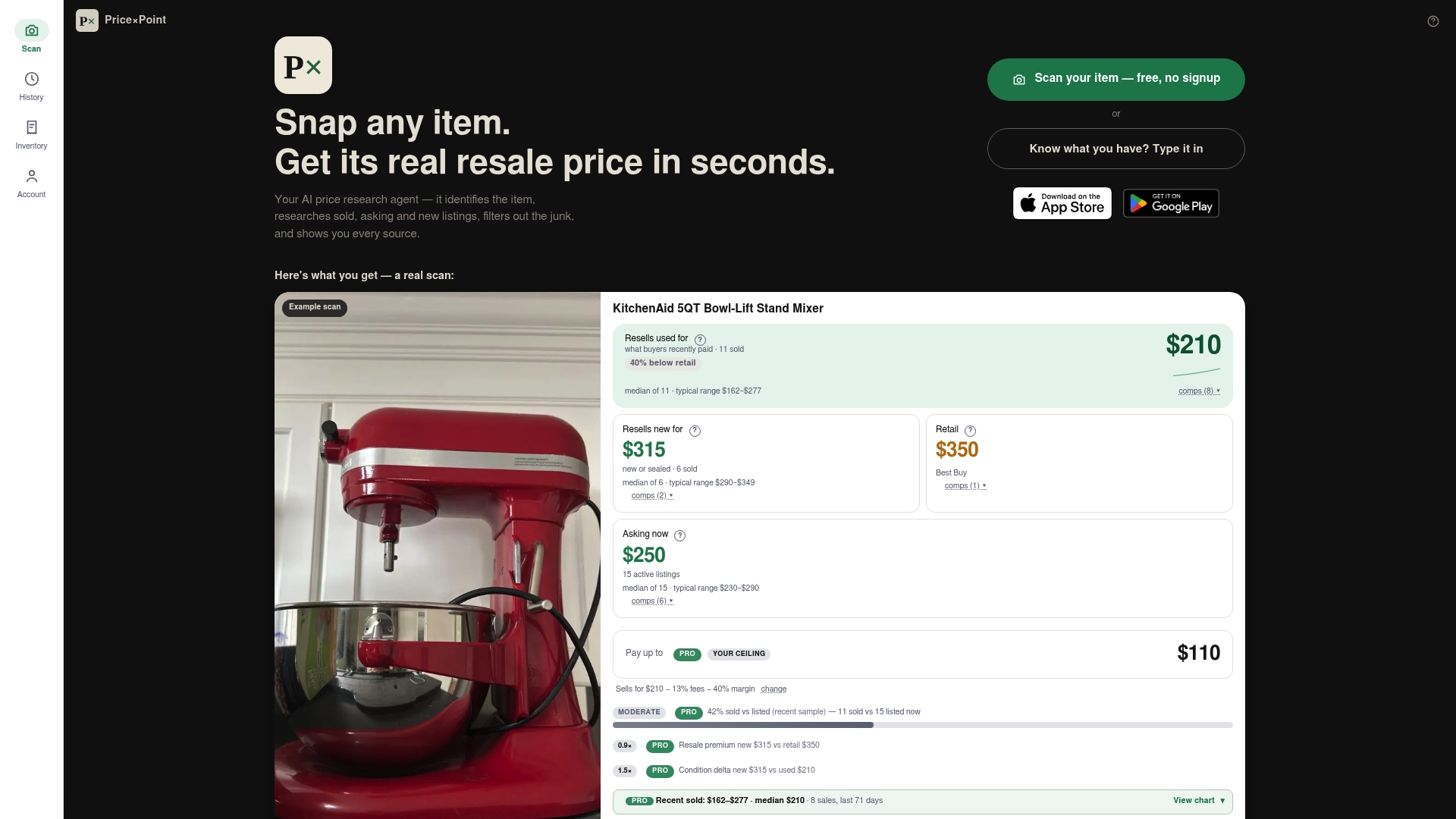
There is a free tier to start. Paid plans are Basic at $4.99 per month, Pro at $9.99 per month and Power at $24.99 per month, and one-off token packs are 100 tokens for $5.99, 300 tokens for $12.99 and 1000 tokens for $34.99. See the current plans and token packs, or browse what used items sell for to see how sold-price pages look. Our guide on AI for resellers shows how sold listings change the way you price.
When to update your price
Markets move. New models launch, retailers run promotions and used supply shifts with the seasons. Retail pricing teams monitor appliance prices several times a day to react to promotions and key sales periods such as Black Friday. A private seller does not need that frequency, but a few checkpoints are sensible:
- Right before you list. Refresh the new-price anchor and the latest sold prices.
- After two weeks without serious inquiries. That usually means the price or the listing needs work. Check photos and description first, then consider a modest cut.
- Around big sale periods. When new appliances are heavily discounted, used buyers compare against those deals, so your price may need to come down.
- For a stock of items, recheck on a regular schedule so older inventory does not drift out of line with the market.
A simple rule when the market is unclear: price slightly below your estimate for faster sales, or at your estimate with room to negotiate if you can wait.
Buying: how to judge whether a price is fair
If you are on the buying side, flip the method. Identify the exact model, find the current new price, and compare the used price to roughly half of it, adjusted for age and condition. Then check recent sold prices for the same model.
Also weigh the warranty. Consumer Reports reports that warranty coverage at used appliance stores ranges from six weeks to six months, including parts and labor, and it recommends buying from a used appliance store or local repair shop, where technicians inspect units and replace worn parts. A slightly higher price with a warranty is often the better value for a major appliance. For a small appliance, check that every accessory is included, because missing parts can quietly erase the savings.
FAQ
How much should I sell a used kitchen appliance for?
Start from the current new price of the same or a comparable model. Most used appliances sell for about 30% to 50% of original retail, with near-new units higher and older units lower. Then confirm against sold prices for the same model.
Does the brand change how I should price it?
Yes. Brands with wide service networks, available parts and a reputation for durable compressors, motors and control boards tend to hold value better. Price toward the upper end of the age band for those, and mention the parts support in your listing.
How do I price a small appliance with missing parts?
Missing parts can cut the price sharply, especially when replacements are expensive. Price it as incomplete, say exactly what is missing, and compare it with sold listings for the same model in similar shape. Selling the missing piece separately is sometimes an option.
Should I sell a kitchen appliance set together?
Usually it is better to price each appliance on its own model, age and condition. Most buyers need one replacement, not a full suite. Offer a bundle discount only if someone wants several pieces.
How often should I recheck my price?
Check right before listing, and again if you get no serious inquiries within about two weeks. Recheck sooner during big sale periods, when new-appliance discounts pull used buyers' expectations down.
Sources
- Should You Buy a Used Appliance? Consumer Reports
- How to Estimate Smart Kitchen Appliance Resale Value, Dimensions Luxury Builders
- 5 Signs a Used Appliance Is Worth Buying, PG Used Appliances
- Rebuya open data: prices and seller terms
- Appliance Price Index, Fridge.com
- OpenBrand CPI: Durable and Personal Goods, April 2026
- How to Determine a Good Price on a Used Home Appliance, Thrive Global
- Remarkit prices checked against AO, AEG and B&Q, NationalWorld
- Price monitoring for household appliances, Price Observatory