
The most reliable way to price a Funko Pop is to find what the exact same figure, in the same condition, recently sold for, then price from those sales instead of from asking prices. Identify the Pop precisely (name, number, variant), pull 3 to 6 recent sold comps, adjust for box condition, and subtract your selling fees. This guide walks through each step and explains how to judge any price checker or value guide you use.
TL;DR
- Sold prices tell you what buyers paid. Asking prices only tell you what sellers hope for.
- Identify the exact Pop first: number, variant, exclusive stickers and chase markings all change the price.
- Box condition can swing the price by a large multiple, so compare like with like.
- Subtract marketplace fees before you decide what a Pop is really worth to you.
- For one Pop, a manual search works. For a shelf or a bulk lot, use a tool that links every estimate to its sales.
Table of Contents
- Why Funko Pop prices vary so much
- Sold prices vs. asking prices
- How to price a Funko Pop, step by step
- Worked example
- Pricing a whole collection
- Reading online value guides and price checkers
- Is grading worth it?
- Pricing mistakes to avoid
- Perspective
- Price Funko Pops faster with PriceXPoint
- FAQ
- Sources
Why Funko Pop prices vary so much
Most Pops are common, and most sell in the low double digits. A small share are scarce, and those can sell for hundreds. Reseller reporting shows the spread: one pair of full-time Funko sellers sold figures ranging from $7 to $1,000 grails, with their highest single sale reaching $2,360. That range is the reason a flat "average Funko Pop price" is useless. You price the figure in your hand, not the brand.
Four things drive the number.
Rarity and variant
Production size, exclusivity and special editions matter most. Chase variants are one example: they carry a gold sticker and, according to one collectibles retailer, Funko typically makes one chase for every six standard figures. Store exclusives, convention exclusives, glow-in-the-dark and flocked versions, and retired ("vaulted") figures often sit above the standard release of the same character.
Watch for look-alikes. The same character can have a regular version, a metallic version and a chase version with the same number. Pricing the wrong one is the most common error we see.
Condition of the box
Collectors usually care as much about the box as the figure. Dents, tears, creases and sun fading all pull the price down. One reseller guide puts a mint-in-box Pop at two to three times the price of the same figure with a damaged box. Treat that as a rough guide, not a rule: the gap is smaller on common figures and larger on sought-after ones.
Out-of-box (OOB) figures sell for much less than boxed ones, and you should never mix OOB and boxed sales in the same comp set.
Demand
Demand follows franchises. A new movie, a show finale or an anniversary can lift a character's Pops for weeks. A franchise that cools can do the opposite. This is why a price from two years ago can mislead you today, and why recent sales matter more than old ones.
Authenticity and extras
A genuine figure with the original box, protector and any exclusive sticker intact is easier to sell and sells for more. Missing stickers or a replacement box reduce buyer confidence.
Sold prices vs. asking prices
An asking price is a wish. A sold price is a fact. A Pop listed at $200 that has sat for six months has not sold for $200, and a lot of live listings are priced hopefully or by sellers who did not check.
A useful pricing set contains three kinds of data, and each answers a different question:
| Data type | What it tells you | How to use it |
|---|---|---|
| Sold listings | What buyers actually paid | Your main anchor for pricing |
| Active (asking) listings | Your current competition | Decide how to position against it |
| New or retail listings | The sealed, current-market price | Context for recent releases |
Sold listings are the anchor. Active listings tell you how crowded the field is. If ten sellers are listing the same Pop at a price above recent sales, pricing at the sold level makes yours the obvious buy.
How to price a Funko Pop, step by step

1. Identify the exact figure
Find the number on the box (for example, #19 or #561), the franchise line on the front, and any stickers. Search by name plus number, not name alone. If you have a photo-ready scan tool, use it, but always confirm that the match is the same number and variant.
2. Pull recent sold listings
On eBay, search for the Pop and tick the sold items filter. According to a seller-research guide, sold listings show what buyers actually paid, which makes them far more useful than live listings for pricing. Look at at least three to six sales from the last few weeks to a few months. Scarce Pops sell rarely, so you may have to stretch the window and say so in your notes.
3. Match condition
Keep only comps that match yours: boxed or not, mint box or worn, sticker present or not. Drop outliers, such as a bundle, a bidding war or a mislabeled listing. Be careful with accepted offers: the listed price can be higher than what the buyer paid, so the displayed figure may overstate the sale.
4. Find the middle
Take the median of your cleaned comps, not the highest sale. If four comps are $18, $20, $21 and $45, your price is about $20, not $26.
5. Subtract fees and shipping
What you keep is what counts. One reseller guide lists about 11% effective on Whatnot (8% commission plus 2.9% and $0.30 processing) against about 13.25% on eBay for collectibles. Fees change, so confirm them on each marketplace's own page before you rely on them. Then subtract shipping, a box protector and packaging.
6. Choose the channel
The same guide suggests a split: a live-selling platform for volume and mid-priced Pops, an auction marketplace for grails, and local marketplaces with no fees for clearing commons. Commons often cost more in fees and shipping than they return online, so bundling them or selling locally can pay better.
7. Set the price, then review
Price at the median for a quick sale, a little above if you can wait. Review in two to four weeks. If nothing has moved, re-check the sold comps before dropping the price.
Worked example
Say you have a boxed Game of Thrones Pop and want to list it. Open its sold-price page, keep only boxed sales from the past few months, and ignore one sale that was bundled with other items. You are left with five sales. You discard the lowest (a damaged box) and the highest (a bidding spike), and the middle three cluster near each other. That cluster is your price range.
Our own pages follow this logic. For example, the sold-price pages for Game of Thrones #49, Ghost #19 and Doctor Doom #561 each show linked sold sales so you can see what went into the estimate. The exact figures change as new sales close, so check the page for the current numbers.
Pricing a whole collection
Checking a handful of Pops by hand is fine. Checking 200 is not. For a collection, the workflow that holds up is:
- Sort by type: commons, mid-tier, and grails. Spend your research time on the last two.
- Price commons in lots, with one flat price per bundle.
- Research each grail individually, with condition notes and photos.
- Save your comps. A price you can trace back to sales is one you can defend to a buyer or an insurer.
- Re-check periodically if you hold stock. Values move.
A spreadsheet works but takes hours. A CSV or multi-item photo workflow in a pricing tool brings that down to minutes, which matters if you are clearing an estate or a store buyout.
Reading online value guides and price checkers
A good Funko price checker or value guide should do five things:
- Base values on completed sales, not asking prices.
- Show the sales behind each value so you can click through and verify them.
- Separate boxed from out-of-box and say what condition the number assumes.
- Show the date range of the sales used.
- Let you correct the identification when the match is wrong.
Be cautious with guides that give a single number with no sales behind it. The reason is simple: a number you cannot trace could be out of date, could cover the wrong variant, or could blend conditions. Some guides are built by matching imported sales to items by hand, which is thorough but slow to update on new releases. Others use automated matching, which is fast but can mix up variants. In either case, spot-check two or three of its values against a sold search before you trust it for a big decision. Condition is the other weak spot: many guides give one price per figure, while real buyers pay different amounts for a mint box and a crushed one.
Where recent transaction chatter helps
Sold listings are not the only evidence. Collector groups on social media often show what Pops are moving at and how fast. Finding the relevant posts in those groups can be time-consuming, and Facebook group lead alerts can flag buyer posts in the groups you choose, so you can see demand as it appears. Treat group prices as supporting evidence and anchor on completed sales.
Is grading worth it?
Grading a Pop means paying a service to authenticate and encase it, and it can raise the price of a high-value figure. But the fee, insured shipping and the wait mean it only makes sense for expensive Pops. One reseller analysis puts the break-even for professional grading around a Pop worth roughly $90 or more ungraded. Verify current grading fees with the grading company before you submit. For a $15 Pop, grading will not pay.
Pricing mistakes to avoid
- Using asking prices as comps. They are optimistic by nature.
- Mixing variants. A chase and a standard version are different products.
- Ignoring the box. Always note condition in the title and photos.
- Using old sales. A two-year-old sale may be unrelated to today's market.
- Forgetting costs. A $12 sale after fees, shipping and supplies can leave very little.
- Anchoring on one outlier. One record sale does not set the market.
Perspective
We built PriceXPoint around one belief: a price is only useful if you can see the sales behind it. Funko Pops are the perfect test. The same figure can be worth very different amounts depending on variant and box, so a bare number is not enough.
That is why our estimates link directly to actual sold listings from several marketplaces, and why we name every data source. We would rather show no figure than show one without evidence. If the app picks the wrong figure from your photo, you can correct the identification and the price follows.
Whether you are a reseller pricing a hundred Pops from a thrift haul, a collector checking what a shelf is worth, or a buyer checking whether a listing is fair, the method is the same: sold comps first, condition second, fees third. We designed the app to make that method fast.
PricexPoint
Price Funko Pops faster with PriceXPoint
If you have more than a few Pops to price, PriceXPoint can do the research for you. Snap a photo or type the name, and you get sold, asking and new listings from multiple marketplaces, with links to the sales behind the estimate. There is a free tier to start, and paid options if you need more lookups: Basic is $4.99 per month, Pro is $9.99 per month and Power is $24.99 per month, or you can buy one-off token packs, 100 tokens for $5.99, 300 for $12.99 and 1000 for $34.99. See the plans and token packs for details.
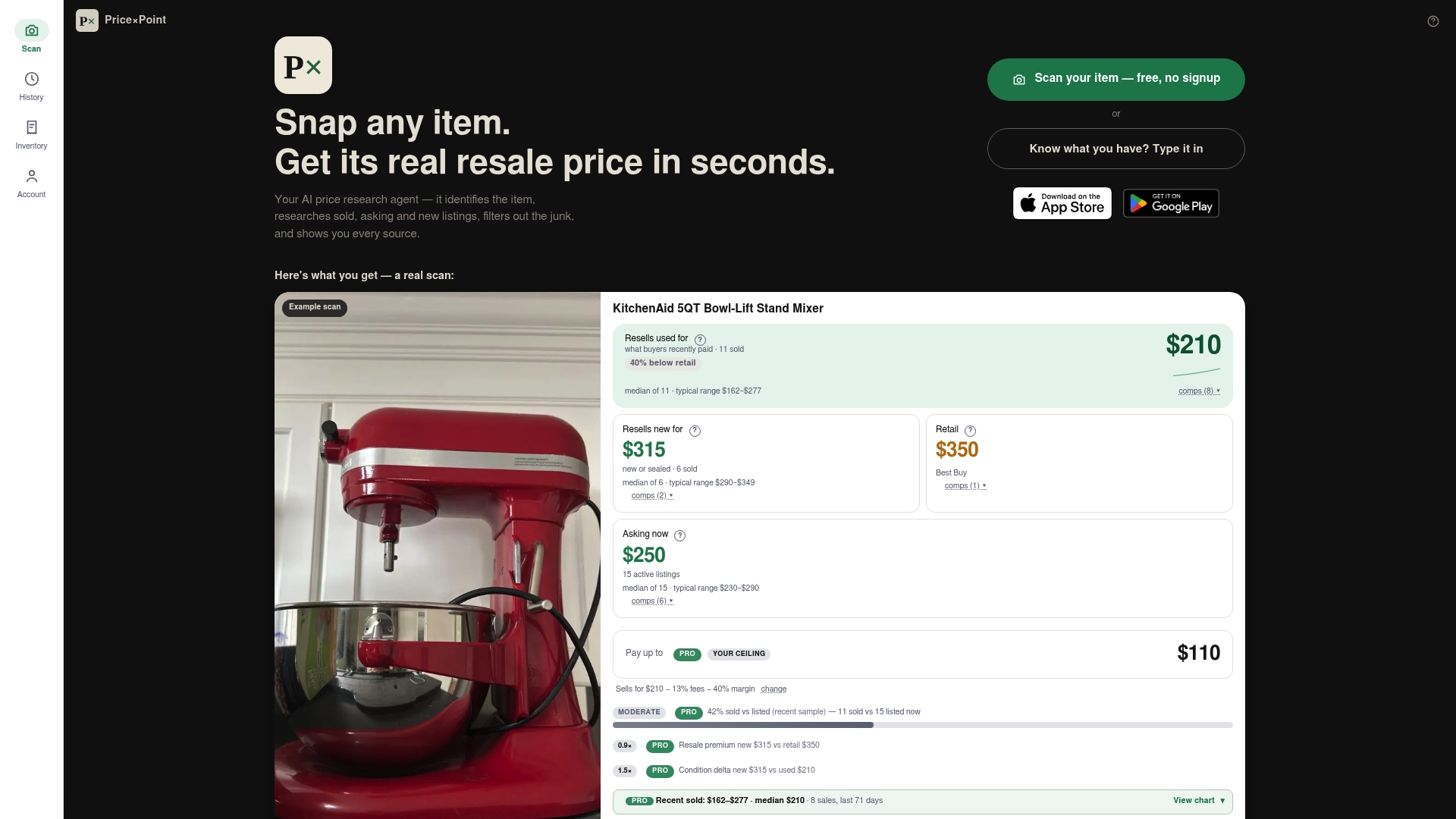
Bulk pricing works through CSV or multi-item photos, and your scan history is saved with export options. Browse real sold prices for many items on our sold-price pages, or read how resellers price collectibles with real sold prices.
FAQ
How much is a typical Funko Pop worth?
Most standard Pops sell in the low double digits, and a minority sell for much more. Rarity, variant and box condition decide where a specific figure lands, so check sold listings for the exact number and version.
How do I check a Funko Pop's value for free?
Search the figure on eBay and filter to sold items, then compare only listings with the same variant and condition as yours. You can also use the free tier of a price-research app, which shows sold comps with links.
Do boxes really matter that much?
Yes. Collectors pay more for a clean, undamaged box, and one reseller guide puts a mint box at two to three times the price of a damaged one. Note box condition in every listing and compare against matching sales.
Should I sell all my Pops on one platform?
Not necessarily. Higher-value Pops usually do best where serious collectors shop, while commons are often better sold in bundles or locally to avoid fees and shipping costs eating the sale price.
Sources
- Funkowhisperer founders topped $350,000 in revenue selling Funko Pops (Business Insider)
- Funko Pop chase variants explained
- How to sell Funko Pops on Whatnot
- How to see sold items on eBay
- Best ways to sell Funko Pops in 2026