
In a resale listing, EUC stands for Excellent Used Condition. Sellers use the acronym to say a pre-owned item is lightly used and in great shape, with virtually no signs of wear. The catch is that no marketplace defines it, so one seller's EUC is another seller's "good". What matters is how much evidence sits behind the label, and what the item has actually sold for in that condition.
This guide explains what EUC means, how it compares with other condition shorthand, what buyers should check and how sellers should use it. It also covers how the label should move a price. (EUC also means electric unicycle in riding circles and end user computing in IT. If you came for either of those, this page is about the resale meaning.)
TL;DR
- EUC means Excellent Used Condition: lightly used, looks great, little to no visible wear.
- It is the seller's opinion. Marketplaces do not define it, so treat it as a claim to check against photos and details.
- Buyers should ask for more pictures and information before paying. Sellers should back the label with close-up photos and honest flaw notes.
- EUC sits just below "like new" and above "good". Items in true EUC usually sell for more than the same item in plain good condition, but the gap depends on the product.
- The most reliable way to price a condition tier is to look at what comparable items actually sold for, not what sellers are asking.
Table of Contents
- What EUC stands for and where you see it
- EUC compared with other condition shorthand
- Why EUC is a seller's opinion, not a standard
- What buyers should check when a listing says EUC
- How sellers should use EUC in a listing
- What EUC does to price
- Finding the real price of an EUC item
- Price your EUC items from real sales
- Our perspective on condition labels
- FAQ
- Sources
What EUC stands for and where you see it
EUC is shorthand from the resale world. You will find it in eBay titles, Poshmark and Mercari listings, Facebook Marketplace posts, Depop descriptions and reseller groups. It tells a buyer at a glance that the item has been used, but taken care of.
Three things are usually implied when a seller writes EUC:
- The item works as intended. Electronics power on and perform, clothing has intact seams and zippers, and so on.
- Wear is minimal. Think a faint mark on the underside of a gadget, or very light pilling on a sweater, not scratches across a screen.
- It has been looked after. Clean, complete with the parts you would expect, and ready to use right away.
The word "used" matters. EUC is not new, and it is not "new without tags". It is a step down from those labels, which is exactly why it often carries a lower price and a bigger need for proof.
EUC compared with other condition shorthand
Reselling has its own vocabulary. These are the abbreviations you will see next to EUC most often, from best condition to most worn:
| Label | Meaning | What to expect |
|---|---|---|
| NWT | New with tags | Never used, original tags attached |
| NWOT | New without tags | Never or barely used, tags removed |
| EUC | Excellent used condition | Used lightly, virtually no visible wear |
| VGUC | Very good used condition | Used, minor wear that is easy to spot up close |
| GUC | Good used condition | Used regularly, visible wear but fully functional |
| Fair or played-with | Heavy wear | Flaws are obvious; priced to match |
Some sellers use VGUC and EUC almost interchangeably, and others skip VGUC entirely. That inconsistency is the main reason to read the whole listing and not only the abbreviation. For a deeper look at how condition grades work across categories, see our item condition grades guide.
Why EUC is a seller's opinion, not a standard
Unlike a manufacturer's grade or a certified refurbisher's rating, EUC has no official definition on the big marketplaces. Most platforms give sellers a short condition dropdown, such as New, Like New, Good and Acceptable, and EUC is something sellers add on top, usually in the title or description.
That has two practical consequences:
- A seller can honestly mean different things by it. Someone who sells one camera a year and someone who lists 40 items a week may judge "excellent" very differently.
- The dropdown is what counts in a dispute. If an item arrives worse than described, the formal condition value and the photos are what a platform looks at. A seller who writes EUC in the title but picks "Good" in the dropdown is describing the item more carefully than one who picks "Like New" and hopes for the best.
So EUC is useful as a quick signal and a search term, but it should never be the only evidence in a listing.
What buyers should check when a listing says EUC
Because the label is subjective, buyers should treat EUC as a starting point and ask for additional information and pictures before finalizing a purchase. A quick routine:
Read the whole listing, not the title
A good EUC listing names specific details: purchase date, how often it was used, what is included. If the description is a single line, that is a reason to ask questions.
Look at the photos for what the seller did not mention
Check corners, edges, screens, soles, cuffs, hinges and any surface that takes friction. Stock photos or a single blurry shot do not support an "excellent" claim. Ask for close-ups of the areas that matter most for that kind of item.
Ask the questions that matter for the category
- Electronics: Does everything power on? What is the battery health? Are the original charger and accessories included?
- Clothing and shoes: Any stains, fading, pilling, odors or stretched areas? Are measurements listed?
- Collectibles and cards: Are there edge, corner or surface flaws, and can you see them in photos?
- Tools and gear: How much was it used, and does it have all its parts?
Check the condition dropdown and return terms
If the formal condition field says "Good" and the title says EUC, the seller is probably being careful. If the item is expensive, confirm the return policy before you pay.
Compare the price with real sold prices
An EUC item priced like a brand-new one is a red flag, and an EUC item priced far below the market may mean there is a problem the seller has not mentioned. The way to tell the difference is to see what similar items in similar condition have actually sold for. Our guide to sold price versus asking price explains why that distinction matters.
How sellers should use EUC in a listing
Used well, EUC helps an item get found and sets an honest expectation. Used loosely, it invites returns and disputes. A practical approach:
Grade the item honestly
Go over the item in good light, the way a skeptical buyer would. If you can find more than a faint, hard-to-see mark, "good" is the safer label. When you are torn between EUC and good, pick good. Being pleasantly surprising is better for your ratings than being corrected by a buyer.
Put EUC in the title, match it in the dropdown
Sellers often include EUC in the title so the item turns up in searches, while choosing the dropdown value that honestly fits the item. On eBay, mobile titles show only a limited number of characters, so lead with the brand, model and key spec and let the condition tag come after.
Back the label with evidence
Best practice is a comprehensive description plus zoomed-in images, with notes on any signs of wear. Concretely:
- Photograph every side, plus the item in use or powered on where it makes sense.
- Show each flaw up close, and describe it by location and size, such as "hairline mark, 1 cm, bottom left corner".
- List what is included: box, charger, manuals, accessories.
- Say when you bought it, and mention that you have the receipt if you do. Stating the purchase date and offering a receipt helps buyers trust the condition you describe.
Do not let the abbreviation replace the description
A title that says "EUC" and a description that says nothing is the pattern that sparks the confused questions seen on reseller forums. Write the sentences out. For more on this, see our tips for selling used items for more.
What EUC does to price
Condition is one of the biggest levers on resale value, but the size of the effect varies by product. For a popular, in-demand item, the gap between excellent and good can be small because buyers are choosing among many options. For collectibles and cosmetic-sensitive goods, a minor flaw can change the price a lot.
Here is an illustration, with made-up round numbers to show the logic. Say the same camera lens has recently sold in three conditions:
| Condition | Recent sold price (illustrative) |
|---|---|
| Like new, boxed | $400 |
| EUC | $350 |
| GUC | $300 |
A seller who prices their EUC lens at $400 is competing with like-new, boxed lenses and will wait longer. A seller who prices a lens with visible scratches as EUC at $350 invites a return. The label is only worth what comparable sold items back up.
That is why condition and price should be set together. Start with sold listings for the same model, filter to the same condition tier, then adjust for completeness: box, accessories, warranty, battery health. If you are unsure how to read the data, our guide to pricing fast without underpricing walks through the logic.

Finding the real price of an EUC item
Google searches and active listings show what sellers hope to get. Sold listings show what buyers paid. When the label is subjective, the difference between those two numbers is the whole game.
PriceXPoint is built for this. You snap a photo of the item or type its name, and the app researches sold, asking and new listings across multiple marketplaces. It filters out unreliable listings and links its price estimates to the actual sales behind them, so you can see which sold items are comparable to yours and check how the condition was described. It also lets you correct the item identification, so a wrongly identified model does not skew your result. You can read more about the approach in our guide to pricing an item from a photo.
If you want to see what real sold data looks like, pages like what a Canon T50 is worth show actual sold prices for a used item.
Price your EUC items from real sales
PriceXPoint has a free tier, so you can try a lookup before you pay anything. Paid options are monthly plans: Basic at $4.99 per month, Pro at $9.99 per month and Power at $24.99 per month. If you prefer not to subscribe, you can buy one-off token packs: 100 tokens for $5.99, 300 tokens for $12.99 or 1000 tokens for $34.99. For a bigger stock of items, bulk pricing works through CSV or multi-item photos, and your scan history is saved with export options.
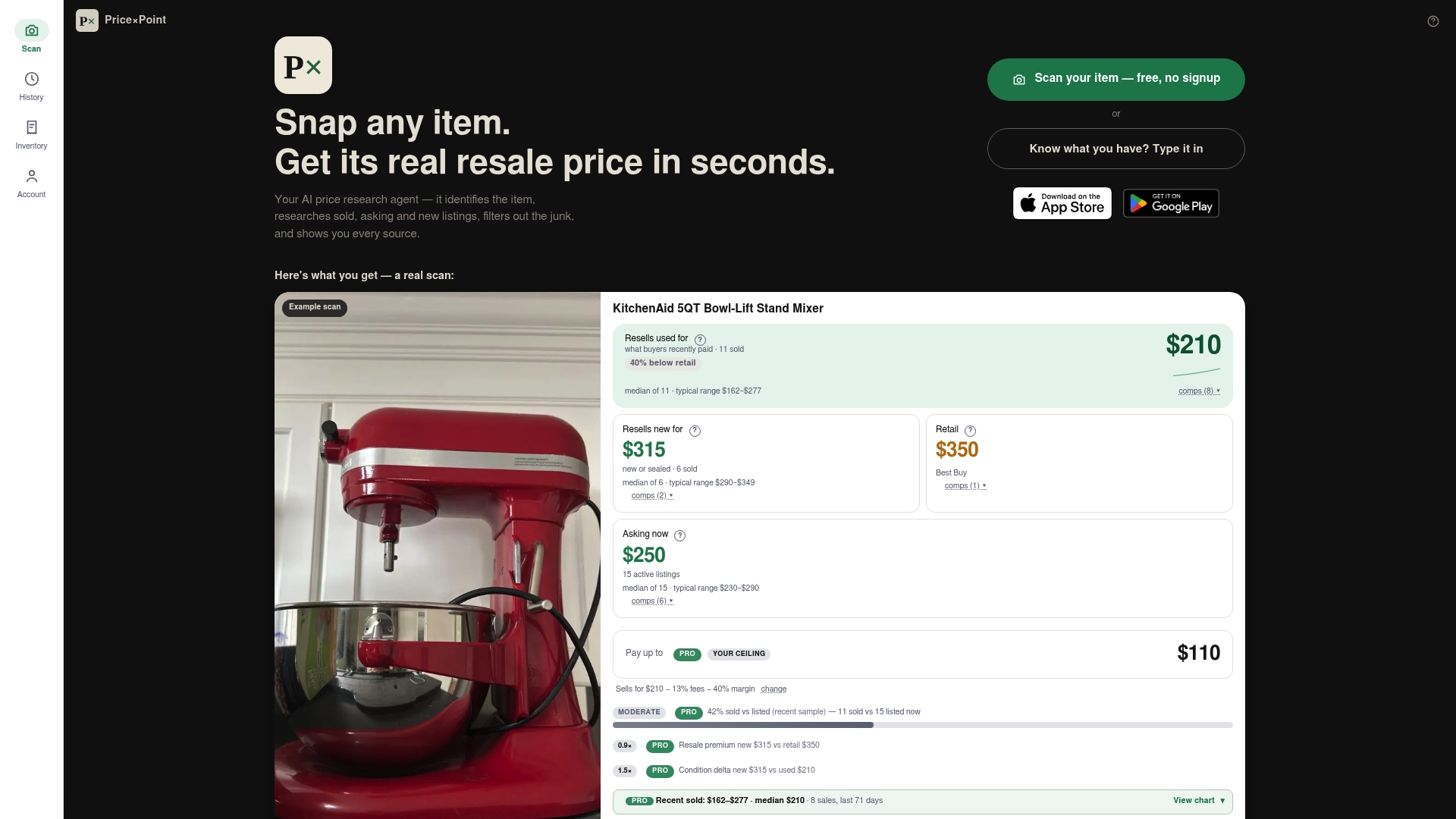
See the plans and token packs on the PriceXPoint pricing page.
Our perspective on condition labels
Condition shorthand exists because listing space is short and buyers scan fast. EUC is a perfectly good signal, but it is only the first half of a pricing decision. The second half is evidence.
We built PriceXPoint around that idea. A price estimate should be tied to actual sold listings, name every source it used and refuse to give a figure without supporting evidence. Condition makes this more important, not less: if two sellers disagree about what "excellent" means, the only neutral reference is what buyers really paid for comparable items.
That is why we let you verify and correct the item identification. A single wrong model number can turn a good price into a bad one, and condition labels cannot fix that. Start with the right item, look at the sales behind the number, then decide what your own EUC item is worth.
PricexPoint
FAQ
What does EUC mean on Poshmark, eBay and other marketplaces?
It means Excellent Used Condition. The seller is saying the item has been used but shows virtually no wear. The marketplace itself does not define the term, so the seller's photos and description are what back it up.
What does EUC mean for selling?
For a seller, EUC is a promise about condition that should match your photos and the condition value you choose in the listing form. Use it only if the item is lightly used and clean, disclose any flaw by location and size, and choose good condition if you are unsure.
Is EUC better than GUC?
Yes. GUC means Good Used Condition, which allows for visible signs of wear. EUC sits above it and implies little or none. Expect EUC items to sell for more than the same item in GUC, though how much more depends on the product.
Is EUC the same as like new?
Not exactly. Like new usually implies the item was barely used or still looks unused, while EUC openly says it was used and looks excellent. In practice the two overlap, which is another reason to rely on photos and the description.
How should I price an item that is EUC?
Look at what the same model has recently sold for in similar condition, not what sellers are asking. Then adjust for what is included, such as the box, accessories or battery health. A lookup in PriceXPoint shows sold prices alongside asking and new listings so you can compare them.