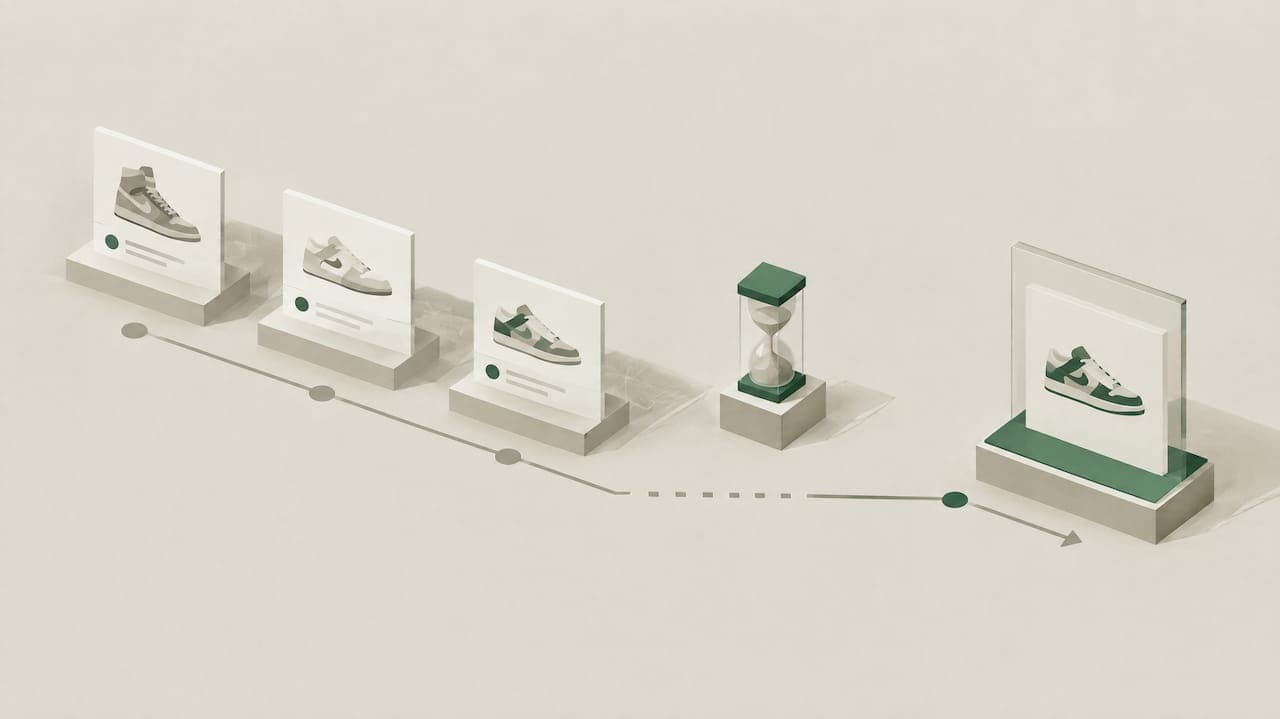
Sneaker prices are volatile rather than steadily rising or falling, with premium and collaboration releases pulling upward while mass-market pairs stay flat or soften during sales windows. The single best action right now is to stop anchoring on asking prices and start checking sold comps for your exact size before you buy or sell. This article walks through the market forces, the retail-versus-resale gap, timing signals, and a pricing checklist you can use today.
TL;DR:
- Checking sold prices within the last 30 to 60 days provides a more accurate market value than relying on asking or listing prices.
- Resale prices fluctuate rapidly after drop events, often peaking within 48 to 72 hours, then dropping as supply increases.
- Size-specific data is critical, as resale prices vary significantly across different shoe sizes, making precise size filtering essential.
- Platform fees, shipping, and payment costs can significantly reduce net profit, so calculate these costs before listing or buying.
- Premium and limited-edition sneakers are more likely to maintain or grow in value over time, unlike mass-market models that tend to depreciate quickly.
Table of Contents
- 1. What drives sneaker prices today
- 2. Retail vs resale: how to read prices and which data matters
- 3. When to buy: practical timing strategies for buyers and collectors
- 4. Pricing checklist for buyers and sellers
- 5. How PriceXPoint's sold-data and filtering improves pricing decisions
- 6. How regional price variations affect what you pay
- 7. How to authenticate sneakers to ensure price accuracy
- 8. Long-term investment potential and price appreciation trends
- 9. Author perspective: priorities for sneaker buyers in 2026
- Check sold prices and calculate net before you buy or sell
- FAQ
- Sources
1. What drives sneaker prices today
Sneaker pricing is no longer just about materials and labor. A handful of structural forces push prices in different directions depending on the tier of shoe you are looking at.
At the top end, premiumization is doing real work. Limited drops, designer collaborations, and tightly controlled distribution give certain lines genuine pricing power, because scarcity is built into the release strategy rather than left to chance. At the bottom and middle of the market, rising input costs and supply-chain pressure nudge retail prices up gradually, while brand storytelling helps justify premium tiers that would otherwise feel overpriced next to a generic running shoe.
Resale demand adds a second, more chaotic layer. Collaborations, athlete endorsements, and social media moments can send a specific colorway's resale price spiking within days, then cooling just as fast once the hype cycle moves on. That volatility is why a shoe's retail tag tells you almost nothing about what it will actually sell for six months later.
The numbers behind this split are notable. The global sneakers market is valued in the hundreds of billions of dollars and is forecast to grow over the coming years, with the premium segment expanding at a notable compound annual growth rate, according to Mordor Intelligence. That gap between overall market growth and premium-segment growth is the clearest signal that collectible and limited-release models will keep facing upward price pressure even if mass-market pairs stay flat.
A few factors to watch when you are trying to understand why a specific pair costs what it does:
- Scarcity from limited production runs or regional-only releases tends to push resale prices well above retail.
- Collaboration partners, whether a designer, artist, or athlete, add a premium that can fade quickly once interest shifts elsewhere.
- Rising material and labor costs show up gradually in retail pricing across entire product lines, not just hyped releases.
- Brand narrative and perceived exclusivity support higher price floors for flagship silhouettes even without a formal limited release.
Understanding which of these forces applies to the specific pair in front of you is the first step before you even look at a number.
2. Retail vs resale: how to read prices and which data matters
Three numbers get thrown around when people talk about sneaker prices, and conflating them is where most pricing mistakes start. Retail price, or MSRP, is simply what the brand or an authorized retailer charges at launch. Asking price is whatever an individual seller lists a pair for on a resale platform. Sold price, specifically the distribution of recent sold prices between the 25th and 75th percentile, is what buyers actually paid.
That last number is the one that matters most, and the gap between it and asking prices is often larger than people expect. Amateur sellers tend to anchor to the highest asking price they see, while professional resellers rely on sold listings because asking prices can often be significantly higher than actual transaction prices, according to SneakerCycle's resale pricing guide. If you are pricing off a listing page instead of completed sales, you are likely working from an inflated baseline.
Size adds another layer of complexity that general market data glosses over. Resale pricing varies notably by shoe size, making it important to check sales for your exact size rather than relying on model-wide averages, according to StockX's data guide to resale. A size 10 in a popular men's silhouette might sell briskly near the median, while a size 7 or a size 13 in the same colorway could sell for notably more or less depending on how thin that size's supply runs. Size and condition together create a distribution of prices, not a single market value, so percentile ranges are more useful than a lone median figure.
A few habits separate reliable pricing from guesswork:
- Pull sold listings from the last 30 to 60 days rather than relying on older data that may not reflect current demand.
- Filter by your exact size and condition grade before comparing prices, since mixing sizes skews the range.
- Watch for stale listings sitting unsold for months; their asking price reflects a seller's hope, not market reality.
- Cross-check more than one platform when possible, since listing behavior varies by audience and fee structure.
Pro Tip: When you see a wide spread between the lowest and highest sold prices for your size, trust the middle of that range (the P25 to P75 band) over any single headline number.
3. When to buy: practical timing strategies for buyers and collectors
Timing a sneaker purchase comes down to reading two separate cycles: the retail release calendar and the resale demand curve that follows it. They rarely move together, and understanding the lag between them is where buyers save the most money.
- Watch the first 48 to 72 hours after a limited drop. Resale prices typically spike immediately after release when demand is highest and supply is still tight, then begin softening as more pairs circulate.
- Track restock announcements closely. A surprise restock from the brand or a major retailer can deflate resale prices within days, so buyers willing to wait often pay far less than early adopters.
- Target end-of-season and holiday sales windows for non-hyped models. Standard retail pairs without collaboration status routinely see markdowns during these periods, making them the cheapest entry point for everyday sneakers.
- Read 30 to 90 day sold-price trends before committing. A shoe trending downward over that window is likely still cooling off; one holding steady or climbing suggests sustained demand rather than a temporary spike.
- Set a target net price before you shop, not after you fall in love with a pair. Decide what you are willing to pay after accounting for shipping and any marketplace fees, then treat that number as a hard ceiling.
The common thread across all five tactics is patience. Sneaker prices, outside of genuinely scarce releases, tend to drift toward a stable band once the initial hype settles, and buyers who wait even a few weeks often see meaningfully better pricing than those who buy on release day.
4. Pricing checklist for buyers and sellers
Whether you are listing a pair or deciding what to offer, the same five-step process keeps you grounded in real numbers instead of guesswork.
- Confirm the exact model, colorway, condition, and size. Small variations, like a slightly different colorway name or a half-size difference, can shift the sold-price range significantly.
- Pull recent sold comps for that exact size and condition. Prioritize listings from the last one to two months and ignore outliers that look unusually high or low.
- Favor the P25 to P75 range over a single average. This band shows you where most real transactions landed, giving a more honest sense of fair value than one headline figure.
- Calculate your net price after fees and shipping. If a pair sells for $150 and platform fees plus shipping run 15%, your net is roughly $127.50, a difference that matters when you are deciding whether a sale is actually worth making.
- Set three price zones before listing. A fast-sale price near the bottom of your comp range moves inventory quickly, a reasonable-market price near the middle balances speed and value, and a hold-for-premium price near the top only makes sense if you can afford to wait.
That fee calculation is not optional. Platform fees, shipping, and payment processing often consume a substantial portion of a sneaker's sale value, so sellers need to subtract these costs to find their true net profit, according to Highsnobiety's roundup of sneaker reselling sites. A listing that looks profitable at face value can quietly lose money once fees are factored in, which is why experienced sellers calculate net before they ever set a listing price rather than after the sale closes.
A simple formula used by experienced resellers captures this: target sale price equals your cost per pair plus desired profit, divided by one minus the platform fee percentage. Running your numbers through that formula before listing removes the guesswork from whether a given price actually works in your favor.

5. How PriceXPoint's sold-data and filtering improves pricing decisions
Every step in the checklist above depends on having clean, current sold data, which is exactly the gap we built PriceXPoint to close. Instead of digging through multiple marketplaces and guessing which listings are stale or inflated, we pull sold, asking, and new listings across markets into one view and link every figure back to its source.
That source-linking matters because it lets you verify a price instead of taking it on faith, which is the same discipline the sold-versus-asking distinction in this article depends on. A few ways this plays out for sneaker pricing specifically:
- We filter out misleading or outdated listings so the price range you see reflects what actually sold, not what sellers hoped to get.
- Size-specific checks are built in, so you can pull comps for your exact size rather than a blended average across the whole size run.
- Net-price calculations become faster when you already have a reliable sold-price range to start from instead of estimating off asking prices.
- Saved scan history lets you track a model over time, useful if you are watching a pair for a buying window or monitoring a watchlist.
The goal is simple: give you a number you can trust before you buy, sell, or decide to wait.
6. How regional price variations affect what you pay
Sneaker prices are not uniform across regions, and the gap can be substantial for globally released models. Import duties, local retail markups, currency fluctuations, and regional demand all shift the price a buyer sees even for an identical pair.
A colorway released simultaneously in multiple countries often sells at different retail prices once local taxes and distribor markups are factored in, and that same gap carries through to resale. A shoe that is common in one region but limited in another will command a higher resale price locally even if sold-price data from a different country shows it trading for less.
This matters most for cross-border buyers. If you are comparing a sold-price range from one marketplace against a listing in your own country, make sure you are comparing apples to apples: same currency, similar import costs, and comparable regional demand. A price that looks like a bargain internationally can lose its advantage once shipping, duties, and currency conversion are added in. When in doubt, weight sold data from sellers and buyers in your own region more heavily than global averages, since that is the market you will actually be transacting in.
7. How to authenticate sneakers to ensure price accuracy
Price accuracy depends entirely on condition and authenticity, since a counterfeit or misrepresented pair throws off any comp you pull. Before trusting a sold-price range or setting your own listing price, confirm a few basics: box label details matching the shoe, stitching quality consistent with the brand's known standards, correct materials and weight, and a verifiable purchase history when available.

Authentication services offered by major resale platforms exist specifically because visual inspection alone is not always reliable, particularly for high-demand collaborations that attract frequent counterfeiting. If you are buying a pair priced well below the sold-comp range you have researched, treat that gap as a warning sign rather than a bargain, since an unusually low price is one of the more common signals of a replica or misrepresented condition.
Condition grading also feeds directly into pricing. A "deadstock" or unworn pair in its original box will sell closer to the top of a sold-price range, while a worn pair with visible creasing or sole wear belongs closer to the bottom. Being honest about condition when pricing your own listing, or skeptical about a seller's condition claims when buying, keeps your price estimate grounded in reality rather than optimism.
8. Long-term investment potential and price appreciation trends
Not every sneaker appreciates, and treating resale sneakers as a guaranteed investment misreads the market. Limited, well-documented collaborations and flagship releases with strong brand narratives have historically held or grown in value, supported by the same premiumization trend driving the broader market forecast referenced earlier in this article. Mass-market pairs, by contrast, typically depreciate from their retail price the moment they are worn, much like a car losing value off the lot.
The premium segment's growth trajectory suggests collectible and limited-release models will keep seeing demand that supports price appreciation over time, but that growth is concentrated in specific tiers rather than spread evenly across the category. A general release running shoe is extremely unlikely to appreciate regardless of brand, while a tightly limited collaboration with strong resale history has a much better shot at holding or increasing in value.
If you are buying with resale value in mind, focus on release scarcity, the strength of the collaboration or athlete tie-in, and historical sold-price trends for similar past releases from the same line. Treat any individual pair as a speculative bet rather than a reliable store of value, and never assume that because one release appreciated, the next one in a similar line will follow the same path.
9. Author perspective: priorities for sneaker buyers in 2026
If you take one thing from this article, let it be this: sold data beats asking prices every time, and fees are not optional math you can skip. My three priorities for anyone pricing sneakers this year are tracking sold comps instead of listings, building platform fees into every decision, and checking size-specific data rather than model-wide averages. For non-hyped pairs in uncertain markets, a conservative rule of thumb is to target the P50 sold price minus your expected platform fee, which keeps you grounded instead of chasing headline numbers.
— PricexPoint
Check sold prices and calculate net before you buy or sell
We built PriceXPoint to answer the exact question this article keeps coming back to: what did this pair actually sell for, in your size, after fees. Snap a photo or enter a model name, and we pull sold, asking, and new listings across marketplaces so you are working from real transactions instead of inflated asks.
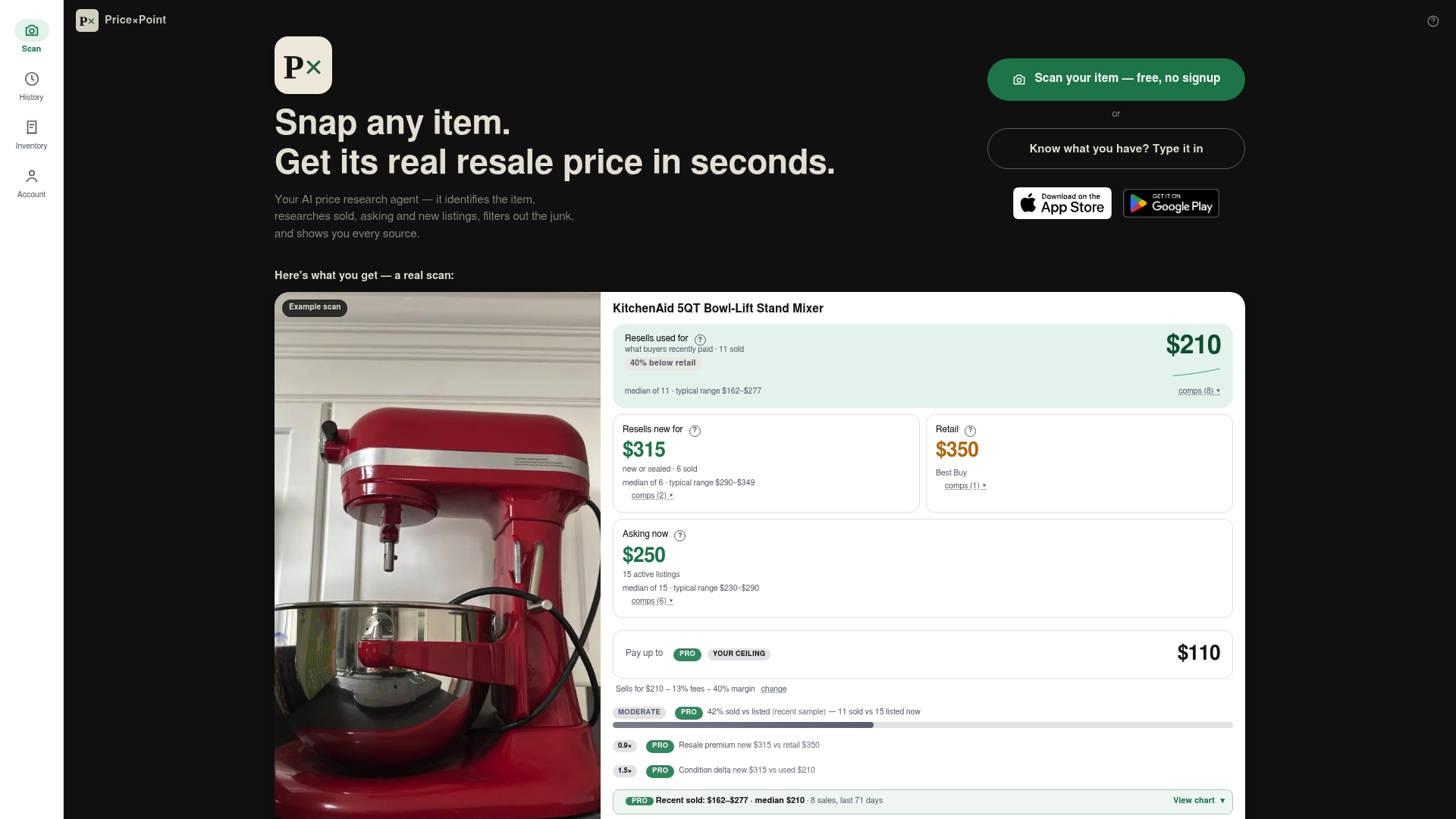
From there, you can:
- Check sold prices for a specific sneaker model and size before you set your own listing price.
- Browse real sold prices across categories when you are comparing more than one item.
- Export your scan history to track a watchlist or compare prices over time.
If data-driven pricing tools are new to you, our pricing page covers every plan, from the Basic tier at $4.99 per month to Pro at $9.99 per month and Power at $24.99 per month, along with one-off token packs starting at $5.99 for 100 tokens if you would rather pay per lookup than subscribe.
FAQ
What are sneakers used for?
Sneakers are athletic and casual footwear originally designed for sports and physical activity, now worn widely as everyday fashion. Many limited and collaboration releases function as collectible items bought primarily for resale value or display rather than regular wear.
What are the top 5 sneaker brands?
The sneaker market is dominated by a handful of global brands with strong retail and resale presence, though exact rankings shift by region and season. Rather than naming a fixed top five, it is more useful to track which brands currently drive the premium segment, since that is where the Mordor Intelligence forecast shows the strongest price growth.
Where can I find affordable sneakers online?
The most affordable sneakers are typically mass-market retail pairs found during end-of-season sales, outlet promotions, and holiday markdowns rather than limited or collaboration releases. Checking sold-price data before buying secondhand also helps you avoid paying resale prices inflated above what pairs are actually trading for.
What is the starting price of sneakers?
Entry-level mass-market sneakers generally start well below premium and collaboration releases, though exact starting prices vary widely by brand, region, and retailer. For an accurate current price on a specific model, checking recent sold listings is more reliable than relying on a single advertised starting price.
How do I know if a sneaker's resale price is fair?
A fair resale price typically falls within the P25 to P75 range of recent sold listings for your exact size and condition, according to StockX's resale data guide. Prices well outside that range, in either direction, are worth double-checking against authentication and condition details before you buy or sell.
Sources
- Sneaker reselling sites roundup — Highsnobiety
- Sneakers Market Size & Share Analysis — Mordor Intelligence
- How to price sneakers for resale — SneakerCycle
- The StockX data guide to resale — StockX