New drivers typically run in the mid to high hundreds, full iron sets commonly fall between several hundred to over a thousand, wedges often cost over a hundred each, and complete beginner sets generally range from low to mid hundreds. Used clubs commonly sell at a significant discount below new prices depending on condition, while genuine collectibles can exceed retail. Before you buy or sell, check real sold listings rather than asking prices to confirm what a club is actually worth in today's market.
TL;DR:
- Drivers are most susceptible to price drops post-release, with used prices often halving compared to retail closeouts, especially after new models launch.
- Buying the outgoing generation of a club right after a refresh can save a substantial amount, often between 20% and 60%, compared to current models.
- Checking actual sold listing prices rather than asking prices or retail listings ensures an accurate valuation, with used clubs typically worth 30% to 60% less than new.
- Custom upgrades rarely increase a club’s resale value, so focus on original configurations unless authenticity or rarity significantly impacts price.
Table of Contents
- Comparing prices across drivers, irons, wedges, and complete sets
- How to price a club: step-by-step checks for sellers and buyers
- Where to buy and where to sell golf clubs
- Real price examples from retail closeouts
- How PriceXPoint checks sold data before you trust a price
- Why model refreshes reshape club pricing every year
- Verify any club's price before you buy or sell
- Sources
- FAQ
Comparing prices across drivers, irons, wedges, and complete sets
Price bands shift a lot depending on the category and whether you are buying new, catching a closeout sale, or shopping used. Drivers carry the highest markup because of adjustability and shaft technology, while wedges and putters hold value differently since design changes less between generations.
Retail closeout pages give a useful window into real sale pricing. GolfDiscount's golf club collection shows modern drivers commonly listed between $249 and $599 on sale, with some clearance models dropping under $150. GolfDirectNow's closeout inventory lists iron sets and full sets showing a wide range of prices depending on model and configuration, commonly between the mid and low thousands, which illustrates how wide the range gets once you factor in brand and year.
| Category | Typical new list price | Common sale/closeout price | Typical used price range |
|---|---|---|---|
| Drivers | $400 to $600 | $249 to $599 | $150 to $300 |
| Iron sets | $800 to $1,314 | $557 to $1,314 | $350 to $800 |
| Wedges | $150 to $200 each | $120 to $150 each | $60 to $120 each |
| Putters | $200 to $350 | $150 to $300 | $75 to $220 |
| Complete beginner sets | $200 to $400 | $150 to $300 | $75 to $200 |
Entry-level clubs use simpler materials and offer forgiveness through larger clubheads, but they rarely include adjustable weighting or premium shaft options. Mid-tier clubs add some adjustability and better feel, usually through improved face materials and refined shaping. Premium tiers bring the most forgiveness per swing speed range, along with custom shaft fitting and multi-material construction that keeps prices firm even on the resale market.
A few current models show how this plays out at retail:
- The Ping G430 shows up often on closeout lists and is built for players who want forgiveness and stability without a steep learning curve.
- The Cobra King line appears frequently in discount inventories, making it a common pick for cost-conscious players chasing performance gear without full retail pricing.
- The TaylorMade SIM2 remains a common reference point in resale searches, since its previous-generation status after newer releases tends to soften used prices.
- The Callaway Paradym represents a newer generation, so its resale prices still track closer to retail than older, superseded models.
- Titleist Vokey wedges hold value unusually well because wedge geometry changes less between releases than driver technology does.
None of this replaces checking actual sold prices for the specific model and condition you care about, since closeout and used prices swing with inventory and season.
How to price a club: step-by-step checks for sellers and buyers
Setting an accurate price, whether you are buying or selling, comes down to a short sequence of checks rather than guesswork.
- Identify the exact model, head design, shaft flex, loft, and year. Small variations, like a Tour versus standard version, change value significantly.
- Assess condition honestly using three tiers: excellent (like-new face and finish, no rust), good (light wear, minor cosmetic marks), and playable (functional but visibly worn, possible face wear).
- Search sold listings, not asking prices, filtered by the same model, condition tier, and your region when possible.
- Adjust for missing extras such as original headcovers, adjustment tools, or documentation, and note any aftermarket grip or shaft swap.
- Calculate expected net proceeds after marketplace or consignment fees before settling on a final number.
Pro Tip: Deduct roughly $10 to $20 for a non-original grip, $5 to $15 for a missing headcover, and up to 15% off for visible shaft damage, since buyers price in the cost of fixing these themselves.
Custom fitting and shaft upgrades often raise a club's original price but rarely transfer that premium to resale, since the next buyer's swing and fitting needs are different. Authentication matters most for older or rare clubs. A hickory-shaft single or a limited head design can swing wildly in value depending on maker and rarity, so getting a knowledgeable second opinion before pricing anything unusual is worth the time.

Where to buy and where to sell golf clubs
The right channel depends on what you're optimizing for: lowest price, speed, guaranteed value, or maximum resale return.
- New retail offers full warranty coverage and the latest technology, but at the highest price point in the category.
- Closeout and discount retailers carry the same current-generation clubs at meaningfully reduced prices once a model year turns over.
- Pre-owned specialists inspect and grade clubs before resale, which adds buyer confidence but usually costs sellers a lower payout than a private sale.
- Marketplaces reach the widest pool of buyers and often net sellers more cash, though trust and shipping logistics vary by platform.
- Auctions can produce upside for rare or collectible clubs where competitive bidding pushes prices above typical resale bands.
- Trade-in programs offer speed and immediate store credit, which the PGA Value Guide frames as a practical way to fund an upgrade, especially when paired with a professional fitting.
Trade-in wins when convenience matters more than maximizing cash, since you avoid photographing, listing, and shipping a club yourself. It loses when the goal is top dollar, since trade-in credit typically runs below what a well-placed marketplace listing would bring. When you do list a club yourself, photograph the face, sole, and shaft clearly, use precise condition language instead of vague terms like "good shape," and always list the exact shaft, loft, and serial number when the club has one.
Real price examples from retail closeouts
Concrete numbers make these ranges easier to apply. Retail closeout excerpts list specific drivers, like TaylorMade SIM2 models and Ping G430 components, at sale prices that show just how much retail discounting affects the category.
| Category | Example listed new price | Example sale/closeout price | Typical used price band |
|---|---|---|---|
| Driver (current generation) | typical new price in the mid hundreds | sale prices generally lower | used prices typically substantially lower |
| Iron set (steel shaft) | new prices often near low thousands | sale prices commonly discounted but variable | used prices commonly lower than sale |
| Wedge (single) | new prices typically over one hundred | sale prices moderately lower | used prices usually below sale range |
| Complete beginner set | new prices generally low to mid hundreds | sale prices somewhat lower | used prices substantially lower |
Retail closeout discounts on drivers and irons commonly run 20% to 60% off original list price, depending on inventory and timing, according to closeout retailer excerpts from GolfDiscount and GolfDirectNow. That range matters most right before and after a new model launch, when retailers need to clear shelf space for the next generation.
Prices swing by region and by what a retailer has in stock at any given moment, so treat every number here as a starting point. The fastest way to confirm a price for your specific market is checking sold listings directly rather than relying on published ranges alone.
How PriceXPoint checks sold data before you trust a price
Asking prices are often aspirational, which is why sold data tells a more honest story. PriceXPoint works by identifying the exact item from a photo or name, then aggregating sold, asking, and new listings across multiple marketplaces before filtering out unreliable or mismatched listings.
- It surfaces a median sold price along with recent sale examples instead of a single, possibly inflated, asking price.
- It shows how far apart asking and sold prices really are for a given model and condition.
- It links every figure back to its source listing so you can verify the data yourself.
Take a used TaylorMade SIM2 iron set as an example. Asking prices on general marketplaces might cluster around $750, but sold data often reveals the actual closing price sits closer to $600 once you filter out overpriced, stale, or mismatched listings. That gap is exactly what a seller needs to know before listing, and what a buyer needs before making an offer. For a look at how sold-price histories work in practice on a completely different category, PriceXPoint's breakdown of a DeWalt DCD771C2 cordless drill's resale value shows the same method applied outside golf equipment.
Why model refreshes reshape club pricing every year
Manufacturers refresh drivers and irons on a predictable cycle, and each new release quietly depresses the previous generation's resale value, often before that older model has actually aged in performance terms. That timing creates a genuine opportunity: buying the outgoing generation right after a refresh often gets you nearly the same performance at a steep discount. If you want the newest technology specifically, buying new makes sense. If you just want strong performance for less money, buying used or during a closeout window right after a launch is usually the smarter move.
— PricexPoint
Verify any club's price before you buy or sell
Guessing at a fair price, whether you're buying secondhand or listing your own set, wastes time and often costs money on both sides of the deal. PriceXPoint identifies a club from a photo or its name and pulls sold, asking, and new listings from multiple marketplaces in one search, so you see a real market range instead of a single seller's guess.
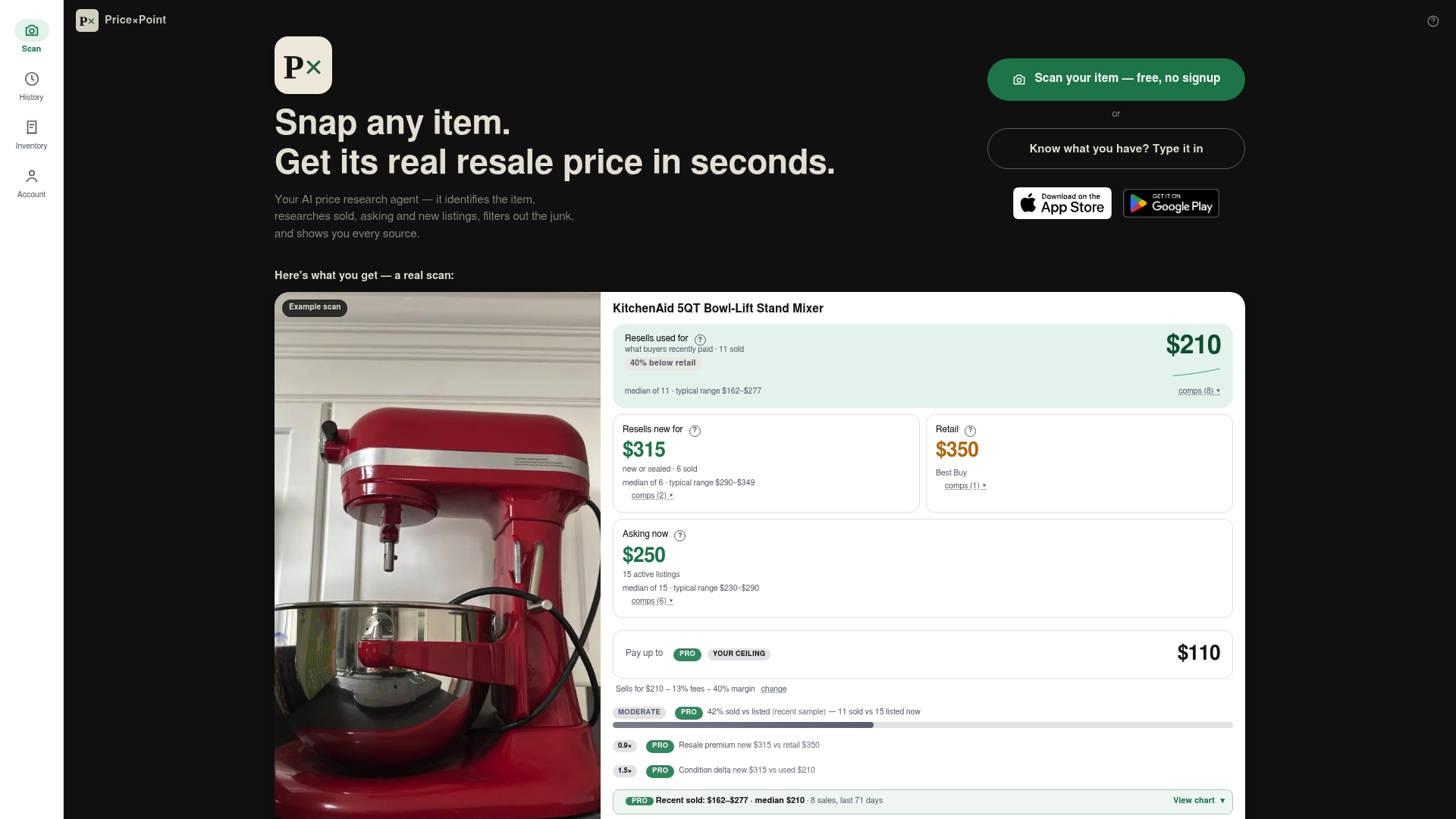
PriceXPoint aggregates listings across multiple marketplaces in a single search, giving you sold, asking, and new prices side by side instead of forcing you to check each platform separately.
Start with a free lookup or compare plans on the PriceXPoint pricing page for the most current details on subscription options. If you would rather explore how sold-price data works before committing, the PriceXPoint worth page walks through real examples across categories.
FAQ
What's a good price for golf clubs?
A good price depends on the category: new drivers commonly run $300 to $600, full iron sets $600 to $1,400, and wedges $120 to $200 each. The best way to confirm you're getting a fair number is checking real sold listings for that exact model and condition rather than relying on the asking price alone.
What are the best value-for-money golf clubs?
Clubs that show up often on closeout inventories, like the Ping G430 and Cobra King lines, tend to offer strong performance at reduced prices once a model year turns over. Checking closeout retailer listings for the current sale price against sold data confirms whether a specific deal is actually worth taking.
What is a good inexpensive set of golf clubs?
Complete beginner sets typically list between $200 and $400 new, with sale and closeout pricing often bringing that down to $150 to $300. Used complete sets in good condition can drop further, commonly into the $75 to $200 range depending on brand and completeness.
How much are good golf clubs worth?
Used golf clubs commonly sell 30% to 60% below their original new price depending on condition, with excellent condition holding the highest resale value. Genuine collectibles or rare models can exceed typical resale ranges, so checking sold listings for that specific club is the most reliable way to know its real worth.