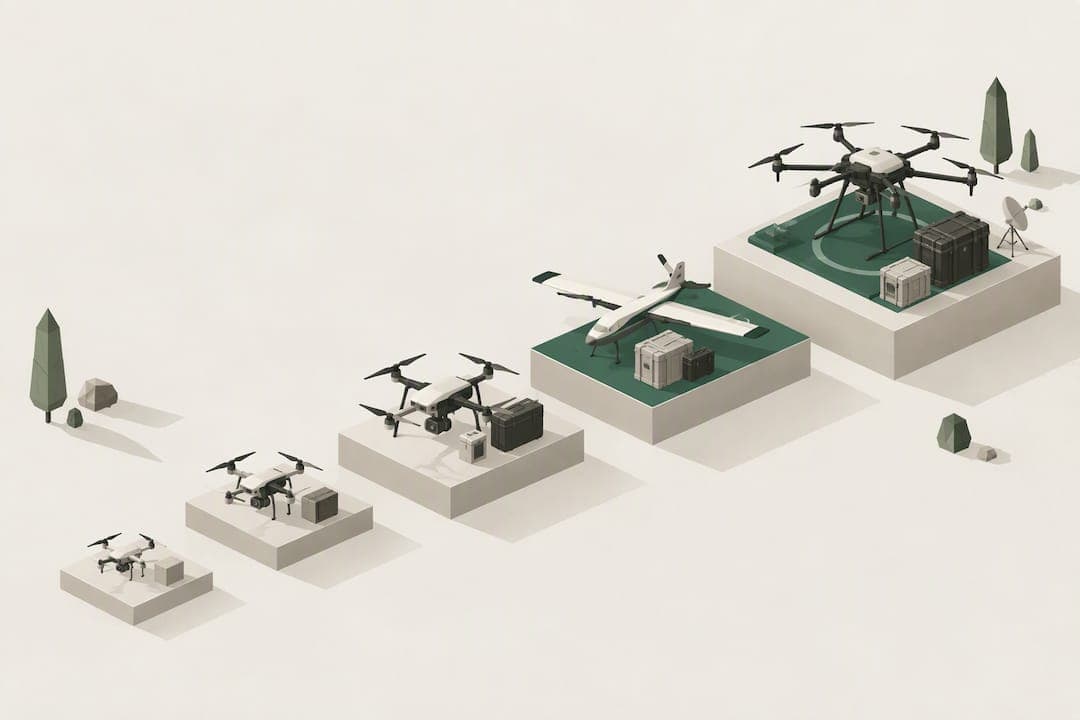
Toy drones start around $30 to $60, beginner camera drones run $150 to $400, and prosumer models with real image quality land between $400 and $2,000. Professional and industrial platforms climb from $2,000 past $30,000 depending on sensors and payloads. The number on the box rarely tells the full story, though. Bundle contents, used-market condition, and registration costs shift the real out-the-door price by hundreds of dollars in either direction.
TL;DR:
- Drones in the $400 to $1,500 range tend to offer the best balance of camera quality and automation features for most consumers, according to testing benchmarks.
- Upgrading from toy drones to beginner camera models adds features like GPS and 4K cameras, with actual costs frequently influenced by bundle contents and accessories.
- Battery replacement, registration fees, and optional accessories such as cases or spare props significantly add to the total ownership cost beyond the initial purchase.
- Professional and enterprise drones carry price tags from $2,000 to over $30,000, mainly driven by advanced sensors like thermal, LiDAR, or high-end payloads.
- When buying used, verified sold prices and condition details provide a more accurate market value than asking prices, preventing overpayment or underselling.
Table of Contents
- How Much Do Drones Cost? Price Comparison by Category
- Drone Prices Explained by Category
- What Actually Drives Drone Prices?
- How to Compare Drone Listings and Spot Real Market Prices
- What Owning a Drone Costs Beyond the Purchase Price
- What Drone Services Typically Cost
- What Most Buyers Actually Need at Their Budget
- Verify Real Drone Prices Before You Buy or Sell
- Sources
- FAQ
How Much Do Drones Cost? Price Comparison by Category
Sorting drones by category is the fastest way to figure out where your budget actually lands you, because the jump from one tier to the next usually buys a specific, nameable upgrade rather than a marginal spec bump.
| Category | Typical price range | Representative models | Best for | Bundle note |
|---|---|---|---|---|
| Toy drones | $30–$100 | Generic mini toy drones | Kids, first flights | Usually sold complete, no add-ons needed |
| Beginner camera drones | $150–$400 | DJI Neo, Potensic Atom 2 | First-time buyers wanting real footage | Fly More combos often add $100–$150 |
| Mini/travel class | $250–$800 | DJI Mini 2, DJI Mini 3, DJI Mini 4 Pro | Travelers avoiding heavier registration classes | Combo kits with extra batteries push toward $800 |
| Value mid-range | $200–$350 | Ruko F11PRO 2, DJI Flip | Budget buyers wanting more than a toy | Controller and case sometimes bundled, sometimes not |
| Prosumer camera drones | $700–$1,500 | DJI Air 3S | Creators needing dual-camera quality | Fly More combos are the default purchase path |
| FPV/immersive drones | $500–$1,300 | DJI Avata 2, DJI Avata 360 | Immersive footage, agile flight | Goggles and motion controller often bundled separately |
| Professional cinema | $8,000–$20,000+ | DJI Inspire 3 | Film production | Lenses and accessories priced separately |
| Enterprise/industrial | $2,000–$30,000+ | Thermal, LiDAR, mapping platforms | Inspection, survey, mapping firms | Payloads sold as modular add-ons |
A few things make that table easier to read correctly:
- Prices reflect aircraft-only or base-combo listings where that's the common purchase path; always check whether a specific listing includes a controller and battery.
- "Best for" is a starting point, not a rule. A DJI Mini 4 Pro suits a working photographer just as well as a hobbyist, since weight class and image quality matter more than the label.
- Ready-to-fly (RTF) pricing includes everything needed to fly out of the box. Aircraft-only listings assume you already own a compatible controller, which is common among buyers upgrading within the same brand ecosystem.
- The gap between the cheapest and most expensive model in a category often comes down to one feature: a bigger sensor, a second camera, or an obstacle-avoidance system.
Popular Mechanics' testing team points to the $400 to $1,500 band as the sweet spot for most consumer pilots, since that range is where camera quality and automation improve sharply without crossing into professional-system pricing. That lines up with where the DJI Air 3S and DJI Mini 4 Pro sit.
Drone Prices Explained by Category
Toy drones: $30 to $100
These are the drones sold in big-box toy aisles, built for indoor flying and short outdoor sessions in calm wind. Cameras, when present, shoot low-resolution video with no gimbal stabilization. Battery life sits around 8 to 10 minutes, and crash resistance is the main design priority over image quality. This tier suits kids, absolute beginners testing whether flying interests them, and gift purchases with no expectation of professional footage.
Beginner camera drones: $150 to $400
Step up here and you get an actual camera worth flying for, usually 2.7K or 4K resolution with basic electronic stabilization rather than a mechanical gimbal. The DJI Neo fits this tier well: compact, genuinely portable, and priced to be a first real camera drone rather than a toy. The Potensic Atom 2 sits in similar territory, aimed at buyers who want 4K footage without paying prosumer prices. Flight time typically runs 15 to 25 minutes, and GPS positioning starts showing up at this price, which matters for stable hovering and return-to-home safety.
Mini and travel-class drones: $250 to $800
This is where weight class becomes the selling point instead of just a spec. The DJI Mini 2, DJI Mini 3, and DJI Mini 4 Pro all live in sub-249g bodies, a threshold that matters in multiple countries for registration and travel rules. Manufacturers price deliberately around that line: the DJI Lito series launched under $400 in part because staying under 250 grams keeps buyers out of stricter registration categories in several markets. The Mini 4 Pro sits at the top of this tier with obstacle sensing and 4K/60fps HDR video, while the Mini 2 remains the budget-friendly older sibling still worth buying if you only need solid 4K stills and don't need the newer tracking features.
Value mid-range drones: $200 to $350
The Ruko F11PRO 2 and DJI Flip both compete here, though from different angles. Ruko's pitch is straightforward value: a longer feature list than you'd expect at the price, aimed at buyers who want more than a beginner drone without paying prosumer money. The DJI Flip takes a different approach, using a caged-propeller foldable design that trades some raw camera performance for portability and safety around people. Neither will match a DJI Air 3S on image quality, but for casual flying and social content, that gap matters less than the price difference.
Prosumer camera drones: $700 to $1,500
This tier is built for people who actually care about footage quality, not just having a drone. The DJI Air 3S anchors this category with a dual-camera system, letting pilots switch between a wide and a medium telephoto lens without losing image quality, plus automated shot modes that used to be professional-tier features. Buyers here are typically content creators, real estate photographers, or serious hobbyists who've outgrown a mini drone's limitations. PCMag's testing consistently frames the right purchase around actual workflow fit rather than chasing the highest spec sheet, and this is the price band where that advice matters most, because the differences between competing models get genuinely nuanced rather than obvious.
FPV and immersive drones: $500 to $1,300
The DJI Avata 2 and DJI Avata 360 serve a different flying style entirely, built for first-person immersive footage rather than the stable, tripod-like shots a camera drone produces. The Avata 2 improved stabilization noticeably over its predecessor, making immersive footage usable without the stomach-turning shake older FPV setups produced. Goggles and a motion controller are usually sold as part of a combo, and skipping them isn't really an option since the entire point of these drones is the first-person view experience.
Professional cinema drones: $8,000 to $20,000+
The DJI Inspire 3 belongs to a different world than everything above it. Full-frame cinema sensor, swappable lens mounts, dual-operator control where one person flies while another operates the camera. This is equipment rented or owned by production companies, not weekend hobbyists. The price jump from prosumer to professional isn't incremental. It reflects sensor size differences that translate directly into dynamic range and low-light performance clients will notice on a big screen.
Enterprise and industrial drones: $2,000 to $30,000+
Inspection, survey, and mapping companies operate in this range, where the drone itself is almost secondary to the payload it carries. Thermal cameras for building inspections, LiDAR units for topographic mapping, multispectral sensors for agriculture, each payload can cost more than the airframe underneath it. A base industrial platform might run $3,000, but add a survey-grade LiDAR module and the total climbs past $20,000 quickly.
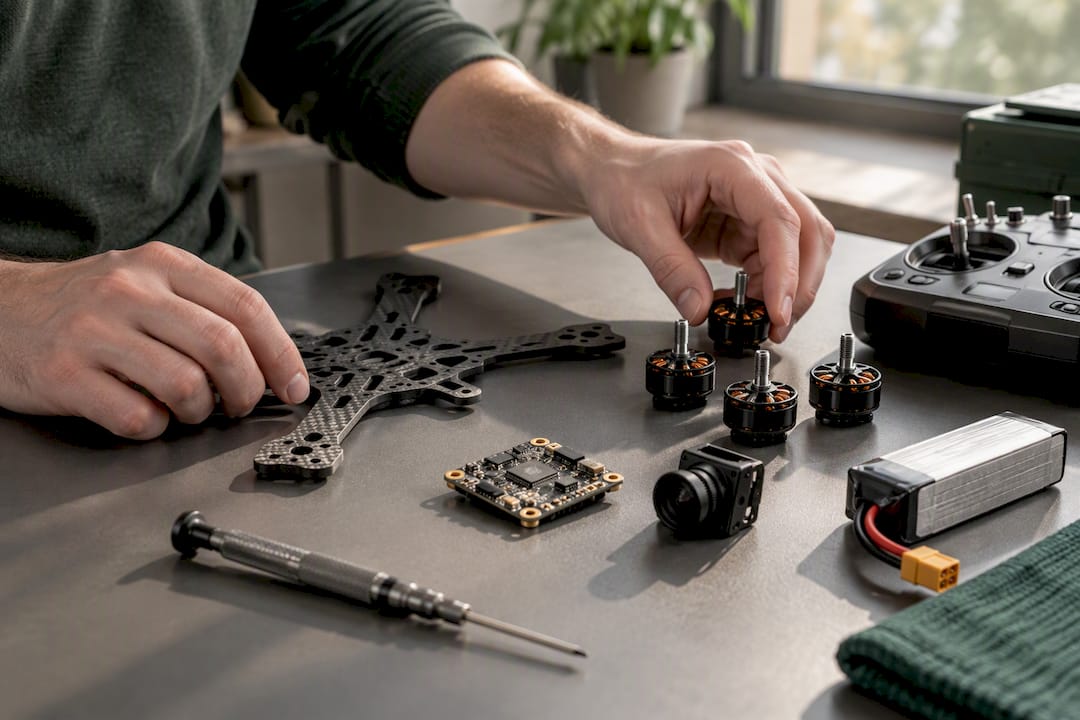
DIY and custom builds: $150 to $1,000+ in parts
Building your own drone from individual components, frame, motors, flight controller, camera, transmitter, makes sense mainly for FPV racing and freestyle flying, where hobbyists want to swap parts after crashes rather than replace an entire retail unit. Parts-driven costs vary wildly depending on component quality, but a competent build rarely beats retail pricing for camera drones. It only makes financial sense when you're optimizing for racing performance or repairability rather than convenience.
What Actually Drives Drone Prices?
Camera sensor size and gimbal quality account for more of a drone's price than almost any other factor. A 1/2-inch sensor produces noticeably better low-light and dynamic range than the smaller sensors in budget drones, and that jump alone can add $300 to $500 to a retail price. Mechanical 3-axis gimbals, which physically stabilize the camera rather than relying on software correction, cost more to manufacture and show up almost exclusively in prosumer models and above.
Autonomy features are the second big lever. Obstacle avoidance sensors, subject tracking, and automated flight modes require additional processing hardware and sensor arrays, not just software. RTK (real-time kinematic) positioning, which improves GPS accuracy from meters down to centimeters, is a feature almost exclusive to enterprise mapping drones and adds real cost because it requires dedicated correction hardware.
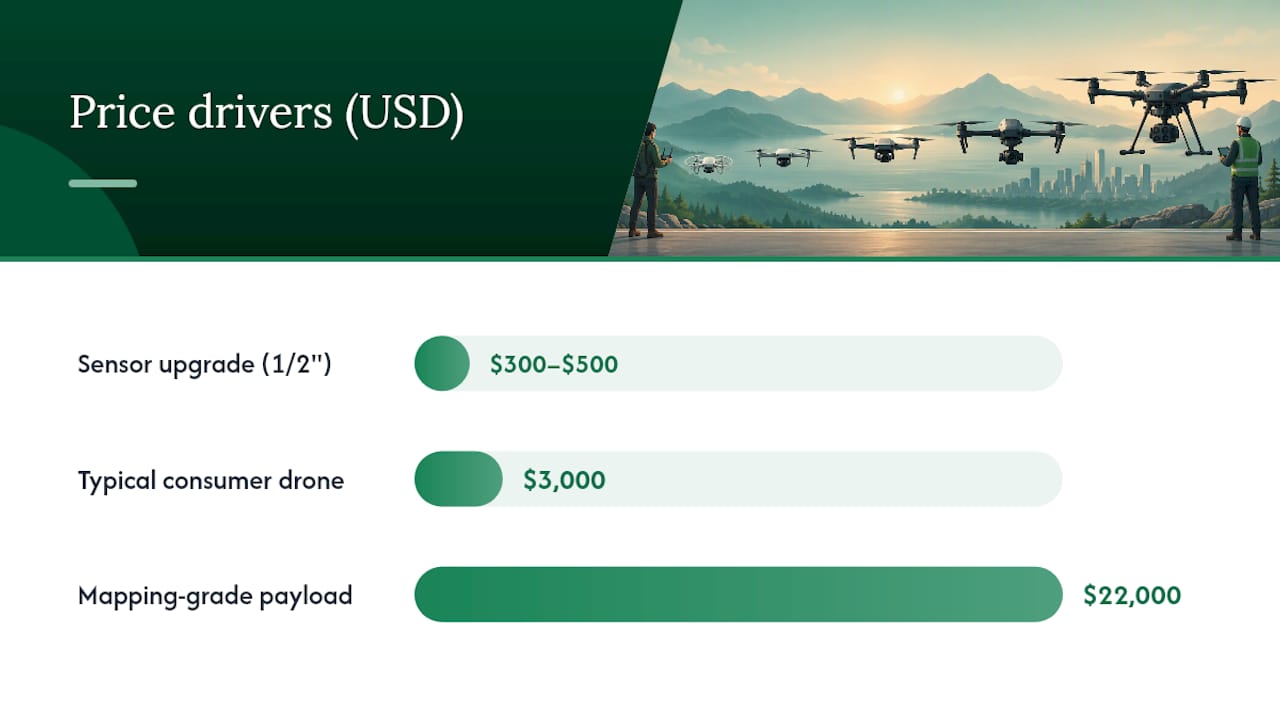
Specialty payloads push prices into an entirely different bracket. Thermal sensors for inspection work, zoom lenses for law enforcement or utility applications, and LiDAR units for surveying can each cost as much as a complete consumer drone. A drone body that retails for $3,000 can become a $25,000 system once a mapping-grade payload gets attached.
A few other factors round out the price equation:
- Build materials and redundancy: enterprise drones often use reinforced frames and redundant flight controllers, adding cost but also reliability for commercial operations.
- Battery capacity and flight time: longer flight times require larger batteries, which add both weight and price, and swapping to a bigger battery sometimes requires a heavier frame to match.
- Brand ecosystem lock-in: buying into a specific brand's battery and controller system saves money on future accessories but limits flexibility if you want to mix hardware later.
- Warranty and required subscriptions: some professional platforms bundle mapping or fleet-management software into an annual fee, which adds to total ownership cost beyond the sticker price.
Pro Tip: Before paying extra for a bigger sensor or added autonomy feature, check whether your actual use case needs it. A real estate photographer benefits enormously from a dual-camera system like the Air 3S offers; a weekend hobbyist flying over a local park usually won't notice the difference.
How to Compare Drone Listings and Spot Real Market Prices
Two listings for the same drone model can differ by $200 or more, and the reason almost always comes down to what's actually included, not the drone itself. Working through a short checklist before comparing prices across sellers saves you from an expensive mistake.
- Confirm exact bundle contents. Does the listing include the controller, or is it aircraft-only? Some sellers list a low headline price for the drone body alone, with the controller sold separately for another $80 to $150.
- Count the batteries. A single-battery listing and a three-battery Fly More combo can carry a price gap of $150 to $300 for the identical airframe.
- Check for a charging hub. Multi-battery kits usually include a charging hub that lets you charge several batteries in sequence; buying one separately adds another $40 to $60.
- Verify the controller type. Some models ship with a basic controller and offer a premium controller with a built-in screen as a paid upgrade, sometimes $100 or more.
- Look for spare props and a case. These are minor individually but add up, and a hard case alone can run $30 to $50 if purchased after the fact.
For used drones, sold-listing evidence matters far more than asking prices. Anyone can list a used DJI Mini 3 at whatever price they want; what it actually sold for tells you the real market rate. A drone listed at $450 might only close at $320 once negotiation and condition get factored in, and pulling several recent sold prices rather than trusting one asking price gives a far more reliable number.
Used-drone specifics worth checking: battery cycle count (batteries degrade noticeably past 200 charge cycles), gimbal alignment (test hover footage for tilt or drift), firmware and app compatibility (older models sometimes lose support), and whether the proprietary controller is even still available if it's missing from the listing, since replacement controllers for discontinued models can be hard to source at any price.
If you're comparing prices across regions or currencies, remember that a "cheap" listing in one country can include import duties or lack local warranty support that a slightly pricier domestic listing includes. And if a drone weighs 250 grams or more, factor registration into your budget from the start rather than discovering it after purchase.
What Owning a Drone Costs Beyond the Purchase Price
The sticker price is just the entry fee. In the United States, recreational drones weighing 250 grams or more require FAA registration, and recreational flyers must complete the free TRUST test before flying. Registration itself carries a small administrative fee, historically around $5 per aircraft submission through the FAA's registry system, though you should verify the current fee directly since these figures can change. Drones requiring registration also generally need to broadcast Remote ID unless flown within a Federally Recognized Identification Area.
Insurance is optional for most recreational flying but worth considering once you own anything above entry-level pricing. Recreational liability coverage through hobbyist organizations often costs relatively little annually, while commercial drone insurance, required for most paid inspection or photography work, runs considerably higher because it covers liability for third-party property damage.
Batteries are the recurring cost most new buyers underestimate. LiPo batteries degrade with use and typically need replacement after 200 to 300 charge cycles, which for an active hobbyist can mean a new battery every year or two. A replacement battery for a mini-class drone runs $50 to $80; prosumer batteries cost more.
Budget for these recurring items:
- Replacement propellers after minor crashes, usually $10 to $20 per set.
- A spare battery or two beyond what came in the bundle, since one battery rarely satisfies a full flying session.
- A protective case if one wasn't included, especially for travel.
- Occasional gimbal or sensor repair if the drone takes a hard fall, which can run anywhere from $50 for minor fixes to a few hundred dollars for gimbal replacement.
What Drone Services Typically Cost
If you're hiring a pilot rather than buying a drone, pricing follows a few common models: hourly rates, per-project flat fees, per-acre pricing for large survey jobs, and value-based pricing for specialized deliverables like real estate marketing packages.
Aerial photography services typically run $150 to $400 per hour, while property or roof inspections fall in the $200 to $500 per hour range. Mapping and surveying work commands more, typically $250 to $600 per hour, reflecting the additional processing time required after the flight itself.
What pushes a quote toward the higher end of any range comes down to three things: the sensor required, flight complexity, and post-processing time. A standard RGB photography job costs far less than a job requiring thermal or LiDAR sensors, since specialized equipment and the expertise to operate it both carry a premium. A simple single-flight photo session also costs less than a multi-flight mapping job that requires stitching hundreds of images into a single orthomosaic map afterward.
For buyers weighing whether to hire a service or buy their own drone, the math usually favors hiring for a one-time need (a single property listing, one inspection) and buying for anything recurring. A DJI Mini 4 Pro purchase pays for itself after just a handful of jobs compared to hiring out repeatedly.
What Most Buyers Actually Need at Their Budget
Most hobbyists overspend on features they'll never use. If you're flying for fun on weekends, a DJI Mini 2 or DJI Neo gets you real 4K footage without the expense of tracking systems and dual cameras you won't fully exploit. Prioritize flight time and portability over spec-sheet extras.
Content creators are the group where mid-range prosumer pricing earns its keep. A DJI Air 3S's dual-camera setup solves a genuine workflow problem, letting you frame wide establishing shots and tighter details without swapping gear mid-shoot. That's the tier where spending more visibly improves the final product.
Professionals and enterprise buyers should resist the instinct to buy the flashiest sensor available. Match the payload to the actual deliverable, a thermal sensor only earns its cost on inspection work, LiDAR only pays off on mapping contracts, and prioritize certified hardware and support contracts over marginal spec improvements once you're operating commercially.
Verify Real Drone Prices Before You Buy or Sell
Asking prices lie. Sold prices tell the truth, and that gap is exactly what trips up buyers comparing a used DJI Mini 3 Pro listing against a used DJI Air 3S listing without knowing which one actually closed near its asking price.
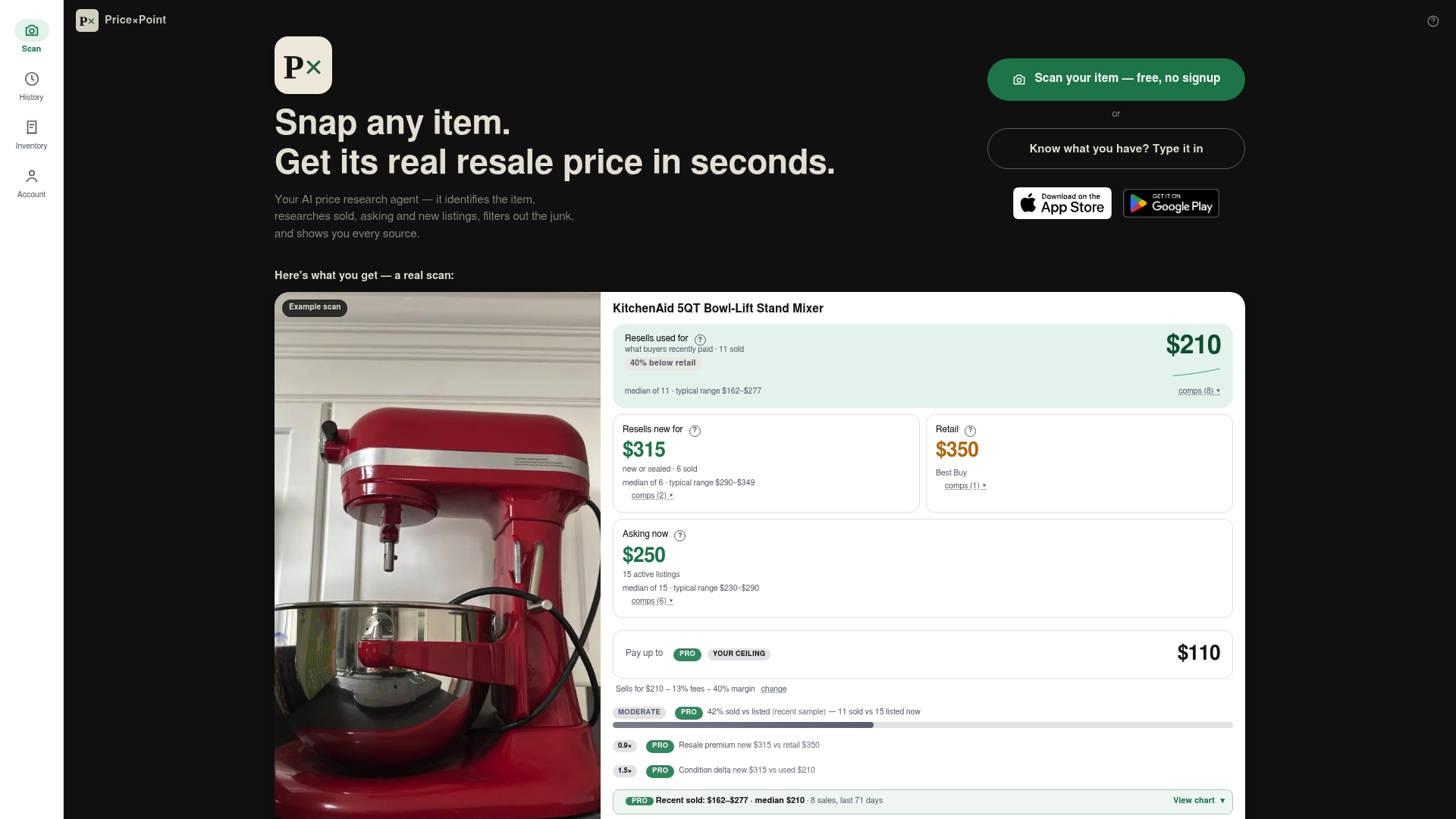
Pricexpoint works as a price-research agent: snap a photo of a drone or type its name, and it pulls real sold, asking, and new listing data across multiple marketplaces, filtering out unreliable or outdated listings in the process. Instead of guessing whether that $280 "like new" Mini 2 listing reflects the real market, you get evidence tied directly to actual sales, with links back to the source. That same approach works for verifying whether a bundle price is fair before you buy, or for pricing your own used drone accurately before you list it.
The Pro plan runs $9.99 per month for ongoing lookups, or you can buy a one-off pack of 100 tokens for $5.99 if you just need to check a handful of listings. Try a sold-price search on your next used-drone comparison before you commit to a price.
Sources
- How Much Does a Drone Cost? An In-Depth Guide New for 2026 — UAV Coach
- FAA – Recreational Flyers & Modeler Community-Based Organizations
- The best drones we've tested for 2026 — PCMag
- DJI Neo 2 review: I guess I’m a drone guy now — The Verge
FAQ
What Is the Average Price of a Good Drone?
A genuinely good camera drone, one with real stabilization and usable 4K footage, typically costs between $400 and $2,000, depending on sensor size and features. Popular Mechanics' testing points to the $400 to $1,500 range as the sweet spot where image quality improves sharply without professional-tier pricing.
What Is the Average Price of a Drone Overall?
Including toys, the average skews much lower, since basic toy drones start around $30 to $60. But if you're asking about drones capable of real photo or video work, expect to spend at least $150 to $400 for an entry-level camera model.
What's the Best Drone to Buy Right Now?
There's no single best drone, only the best fit for your budget and use case. For most buyers wanting a strong balance of portability and image quality, the DJI Air 3S and DJI Mini 4 Pro represent the current sweet spot in the $700 to $1,000 range, while the DJI Neo covers first-time buyers who want real footage under $250.
Is Owning a Drone Worth It?
For hobbyists who fly regularly, yes, a $200 to $800 drone pays for itself in enjoyment and creative output within a season of regular flying. For anyone needing drone footage only once or twice, hiring a pilot at typical service rates often makes more financial sense than buying.
How Much Do Drones Cost to Maintain Each Year?
Beyond the purchase price, budget roughly $100 to $200 a year for a replacement battery, spare propellers, and minor repairs if you fly often. Commercial operators should add insurance costs, which vary significantly based on coverage level and usage.