Expect mass-market Barbie dolls to retail roughly $17 to $30 at big-box stores, signature and collectible lines to run in a higher price range on Mattel's own product pages, and select movie-tied or limited editions to resell for several times their original price. Start by checking Mattel, Target, Walmart, and Amazon for current listings, then confirm real market value against recent sold prices on resale marketplaces. A sold-price research tool speeds up that second step considerably.
TL;DR:
- Most mass-market Barbie dolls sell for $10 to $30 retail, but limited editions or movie tie-ins can resell for several times their original price.
- Limited-release Signature dolls and holiday editions with certificates tend to retain or increase their value, especially if kept in mint condition with original packaging.
- Retailer signals like "sold out" badges, purchase limits, or exclusive labels indicate scarcity and potential resale value; regular sale discounts diminish resale premiums.
- Exact resale prices should be determined by checking recent sold listings, considering doll condition, packaging, and rarity, rather than relying on asking prices alone.
- AI tools like PriceXPoint can quickly pull real-time sold and asking prices from multiple marketplaces, aiding in accurate valuation before buying or selling.
Table of Contents
- Price ranges by Barbie product line
- Where to buy now: retailer pricing patterns
- Secondary-market valuations: why resale prices diverge
- How to check the current price of your Barbie
- How to price for sale and where to list by doll type
- What the Barbie market gets wrong about value
- Verify prices before you buy or sell with PriceXPoint
- Sources
- FAQ
Price ranges by Barbie product line
Prices vary widely across Barbie's product lines, and knowing which category a doll belongs to is the fastest way to judge whether an asking price is fair.
- Barbie Fashionistas: mass-market fashion dolls at accessible price points, best for play and casual collecting, common on shelves and frequently discounted.
- Barbie Signature Dolls: premium collectible releases with certificates and limited runs, best for display collectors, often sold out quickly on Mattel Creations before resale premiums appear.
- Career Barbie Dolls: themed dolls at standard mass-retail prices, best for gifts and themed collections, widely available with occasional seasonal promotions.
- Barbie Mini Dolls: smaller-format dolls and multi-packs at lower unit prices, best for budget shoppers and playset builders, consistently common in stock.
- Barbie Holiday Dolls: seasonal releases sold at premium prices during a narrow window, best for seasonal collectors, limited to the holiday period each year.
- Barbie Dreamhouse (playsets): large-format playsets priced well above single dolls because of scale and included accessories, best for play-focused buyers and major gift purchases.
- Barbie The Movie Dolls: film tie-in releases that launch at standard collectible pricing. They can see resale spikes tied to cultural demand around the movie.
| Product line | Typical retail (MSRP range) | Best for | Secondary-market behavior | Availability |
|---|---|---|---|---|
| Barbie Fashionistas | $10 to $25 | Play and casual collectors | Common, modest resale premium | Common |
| Barbie Signature Dolls | $50 to $60 | Collectors and display | Occasional premium on sold-out drops | Limited |
| Career Barbie Dolls | $10 to $30 | Gifts and themed collections | Common, low markup | Common |
| Barbie Mini Dolls | $5 to $30 | Budget shoppers and playsets | Common, minimal resale interest | Common |
| Barbie Holiday Dolls | $27 to $60 | Seasonal collectors and gift buyers | Occasional premium after season ends | Limited (seasonal) |
| Barbie Dreamhouse (playsets) | $100 to $630 or more | Play-focused buyers | Common, driven by condition of accessories | Common |
| Barbie The Movie Dolls | $17 to $30 | Movie fans and collectors | Can spike sharply around release demand | Collectible |
Barbie Basics and similar lines show up frequently on Target's site with sale pricing well under MSRP, while Mattel Creations reserves its steepest markups for certificate-backed, limited-drop items.
Where to buy now: retailer pricing patterns
Each major retailer signals price and availability differently, and learning to read those signals saves money and prevents overpaying for something that isn't actually rare.
Mattel's own site lists current lines directly, including the Barbie Basics 2026 Neutrals Series at a moderate price, alongside signature pieces that carry higher list prices and limited-drop notices. Target commonly prices Barbie Basics and Made to Move dolls within a range under $30, with sale prices appearing often enough that MSRP rarely holds for long. Amazon behaves differently: because third-party sellers list alongside the retailer, search results for Barbie dolls span roughly $5 to $630 or more, depending on whether you're looking at a basic single doll or a rare bundled lot.
A few cues tell you whether you're looking at a deal or a collectible:
- A "sold out" badge on a Mattel Creations page usually means the run was limited and resale interest will likely follow.
- Purchase limits per customer signal the retailer expects demand to outstrip supply.
- "Barbie Club" exclusive labeling and included certificates of authenticity mark a doll as collector-oriented rather than mass-market.
Amazon marketplace prices for Barbie dolls span roughly $5 to $630 or more, a spread that reflects both bargain-bin basics and rare collector lots rather than a single consistent retail price.
Retail sales and rollbacks can temporarily flood the market with cheap stock, which narrows the window for reselling that particular batch at a premium. A doll bought during a deep discount rarely commands a strong resale price until the retail supply dries up again.
Secondary-market valuations: why resale prices diverge
Barbie pricing effectively runs on two tracks. Primary retail sets a fixed MSRP that Mattel and its retail partners control, while the secondary market lets buyers and sellers set prices based on scarcity, condition, and timing, and the two rarely move in step.
Movie tie-ins show this most clearly. Media reporting documented significant resale value spikes for some Barbie movie dolls following the film's release, as demand outpaced what retailers had in stock. That kind of jump is not typical for most Barbie lines, but it illustrates how quickly a doll's secondary value can decouple from its original sticker price when cultural interest surges.
A handful of factors reliably drive that divergence:
- Limited production runs, especially numbered or club-exclusive editions.
- A certificate of authenticity included with the original packaging.
- An intact original box, since collectors discount heavily for damaged or missing packaging.
- Timing tied to a cultural event, such as a film release or anniversary edition.
- Manufacturing errors or unusual variants, which sometimes command outsized premiums among specialist collectors.
Mattel Creations product listings, including the Wonder Woman Barbie Signature doll, show the collectible mechanics directly: sold-out notices during member sale windows, purchase caps, and certificate details that separate these releases from anything found on a standard toy aisle.
Pro Tip: If you're chasing a limited drop, join the retailer's club or mailing list ahead of release and buy during the initial window; waiting even a few days after a sellout usually means paying a resale premium instead of MSRP.
How to check the current price of your Barbie
Pricing a Barbie accurately takes a few minutes of structured research rather than a single search, following the method complète pour estimer la valeur de vos cartes Pokémon which applies similarly for collectibles like dolls.
- Identify the model. Check the box, the doll's back markings, or included tags for the model name, SKU, and edition year.
- Record current retail listings. Note prices and MSRP from Mattel, Target, Walmart, and Amazon, along with the SKU and the date you checked.
- Sample recent sold listings. Pull several completed sales from secondary marketplaces, recording sale date, condition, and whether shipping was included.
- Adjust for condition and extras. Factor in whether the box is intact, whether a certificate of authenticity is present, and typical marketplace fees before settling on a realistic price.
Quick checklist to copy: model name and SKU noted, MSRP recorded from at least two retailers, five or more comparable sold listings sampled from the last few months, condition and packaging factored into the final number.
How to price for sale and where to list by doll type
Once you have a handful of comparable sold prices, set your asking price from the median of that sample rather than the highest number you found. A sealed, mint-condition doll can reasonably list slightly above the median, while a loose but complete doll in excellent shape should sit closer to the median itself.
Marketplace and payment processing fees, plus shipping costs for a boxed doll, eat into net proceeds meaningfully, so build those into your target price before listing rather than after a sale closes.
- Mass-market dolls (Fashionistas, Career, Mini lines) tend to do best on general marketplaces where buyers are searching for bargains and volume matters more than provenance.
- Collectible lines (Signature, Holiday, Movie tie-ins) generally perform better on auction-style or collector-focused platforms where buyers actively bid up rare or sealed examples.
- Timing matters, since listing a Holiday Barbie right before the next holiday season, or a Movie doll during a fresh wave of film-related attention, tends to attract more competitive offers.
Pro Tip: List collectible dolls with clear, well-lit photos of the box, any certificate of authenticity, and the doll's markings; incomplete documentation is one of the most common reasons a genuinely valuable doll sells below its real worth.
What the Barbie market gets wrong about value

Most people assume rarity alone drives Barbie prices, but timing matters just as much. A limited Signature doll released during a quiet season can sit at MSRP for months, while a mass-market Movie tie-in doll launched during peak cultural buzz can outsell its collectible cousins several times over.
The practical takeaway: buy common lines at retail or wait for the inevitable sale, and save the sold-price research for anything marketed as limited, numbered, or tied to a movie release. Before you buy or sell a doll priced above $50, run a quick sold-price check rather than trusting a single listing's asking price.
— PricexPoint
Verify prices before you buy or sell with PriceXPoint
Checking sold, asking, and new listings by hand across multiple marketplaces takes time most buyers and sellers don't have. PriceXPoint works as an AI price research agent: snap a photo of a doll or type its name, and it pulls real-time sold, asking, and new listing data from multiple markets in seconds.
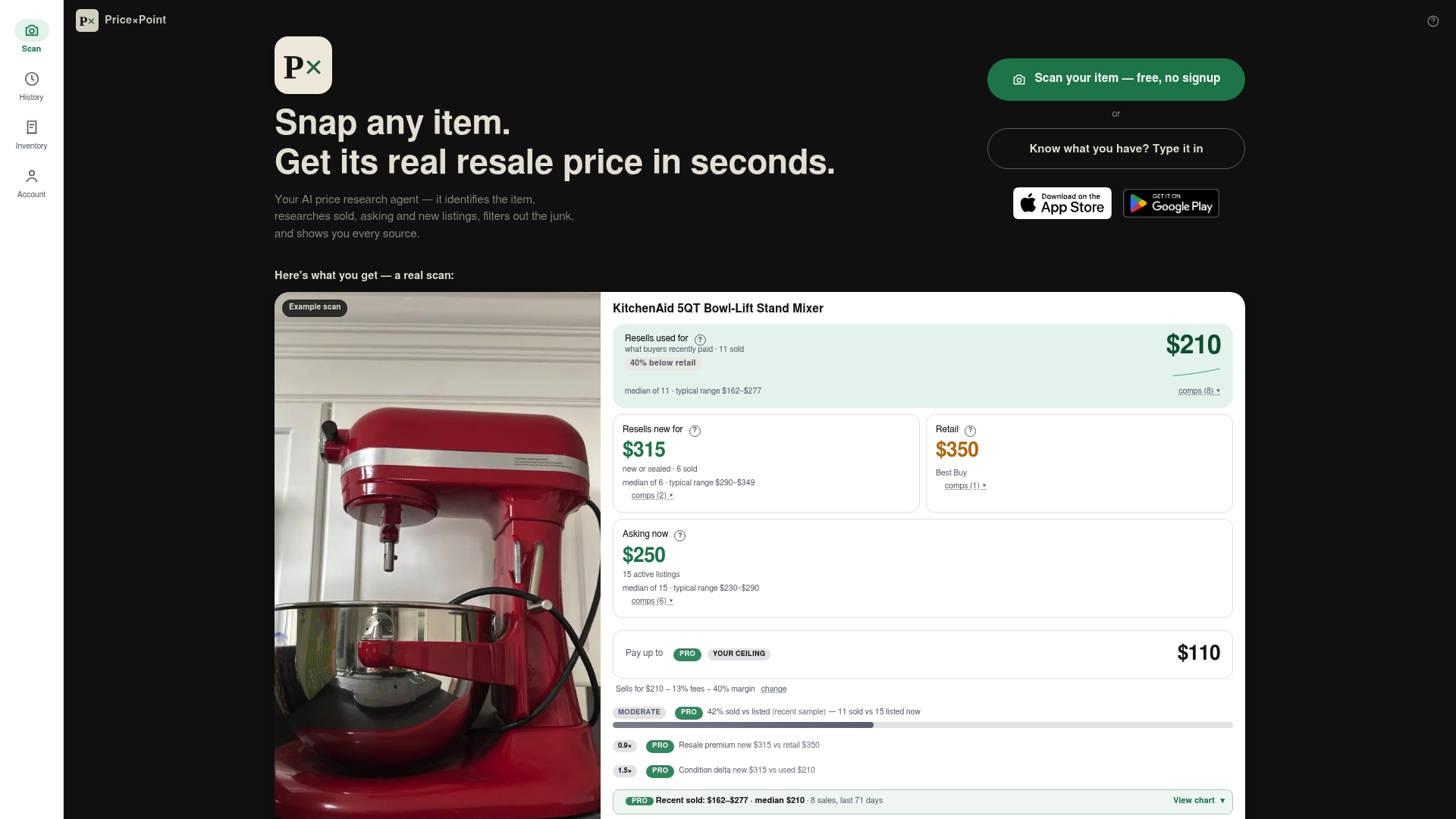
- Verify sold prices instead of guessing from a single asking-price listing, with links back to the actual sales behind each figure.
- Run bulk price checks on a whole collection at once using a CSV upload or multiple photos, rather than researching each doll one at a time.
- Export price history for your records, useful whether you're setting a listing price or documenting value for insurance or resale planning.
For collectors managing more than a few dolls, the Pro plan at $9.99 per month covers regular lookups, while the Power plan at $24.99 per month suits active resellers running frequent checks. Casual sellers can start with a one-off 100-token pack at $5.99 to test the process on a single doll. See how the sold-price lookup works before you commit to a listing price, or try a related example like what a Vitamix 5200 Blender is worth to see the sold-price format in action.
Sources
- Barbie Basics Collectible Doll, Model 01 with Brunette Hair in Black Dress and Pointed Booties : Target
- TMZ report on Barbie movie doll resale boost
- Barbie dolls — Amazon search results
FAQ
Which Barbie dolls are worth money?
Signature Dolls, movie tie-in releases, and holiday editions with intact boxes and certificates of authenticity tend to hold or gain value, especially when production was limited. Mass-market Fashionistas and Career dolls generally stay close to their original retail price unless a specific variant or error makes them scarce.
How can I check the price of my Barbie doll?
Identify the model and SKU from the packaging or doll markings, then compare current retail listings from Mattel, Target, Walmart, and Amazon against recent sold prices on resale marketplaces. A sold-price research tool can pull that comparison automatically from a photo or model name.
What is the average price for a Barbie doll?
Most current mass-market Barbie dolls list between $10 and $30 at retail, while Mattel's own signature and collectible releases run roughly $27 to $60. Prices climb well beyond that range for limited or movie-tied collectibles once resale demand kicks in.
How much should I sell my old Barbies for?
Price based on the median of several recent sold listings for the same model and condition, not on a single asking price you happened to find. Sealed, boxed dolls with certificates can list above that median, while loose but complete dolls typically sell closer to it.