
Shill bidding is fake bidding meant to push an auction price up. On eBay, the seller or someone connected to the seller places bids with no intention of owning the item. eBay prohibits it and says its own systems watch bidding patterns. Your best protection as a buyer is not catching every shill. It is deciding what an item is worth before the auction heats up, using what similar items actually sold for, and refusing to bid past that number.
This guide covers who is barred from bidding on a seller's listing, what eBay and U.S. consumer agencies say about it, the patterns worth a second look, and a simple way to set a ceiling that holds up even when an auction looks rigged.
TL;DR
- Shill bidding means bids placed to inflate a price or an item's apparent popularity, by the seller or someone who knows the seller. eBay prohibits it.
- eBay says its systems monitor bidding patterns and that buyers do not need to report suspected shilling directly.
- A firm maximum bid, set before you start, is the standard consumer-agency advice for staying in control.
- Completed (sold) listings show what items really sold for. Asking prices only show what sellers hope to get.
- Anchor your ceiling to several recent sales, so one inflated auction cannot set your price.
Table of Contents
- What shill bidding is and how it works
- Who is not allowed to bid on a seller's item
- What eBay does about it, and whether you should report
- Patterns worth a second look
- The defense that works every time: a ceiling set in advance
- Sold prices versus asking prices
- Why checking several markets helps
- How PriceXPoint fits this routine
- Our perspective
- If you sell on eBay
- FAQ
- Sources
What shill bidding is and how it works
eBay defines shill bidding as bidding intended to artificially increase an item's price, its desirability, or its standing in search. The key word is intent. A shill bidder is not trying to win. The goal is to make real bidders think others want the item, or to push a real bidder to pay more than they otherwise would.
The Federal Trade Commission's internet auction guide describes the same thing: sellers or their partners bidding on the seller's own items to drive up the price. The guide dates from 2006, but the mechanics have not changed.
The usual playbook looks like this:
- A seller lists an item with a low starting price, which draws watchers and early bids.
- A second account, controlled by the seller or a friend, bids to create momentum.
- A real buyer sees activity, assumes the item is hot, and bids higher.
- The shill stops, and the real buyer wins at a price pumped above the market.
Shill bids can also be used to nudge an auction toward a seller's hoped-for number. The risk for the shill is winning by accident, which is why shills tend to bid and then retreat.
Who is not allowed to bid on a seller's item
The rule is broader than "the seller can't bid on their own listing." eBay's policy says shilling can involve the seller or anyone who knows them, including family, friends, roommates, employees and online connections. eBay's rules for buyers say the same: a person who knows the seller may not bid with the intent to artificially increase price or desirability. The same page calls bidding on your own item shill bidding, a policy violation, and against the law in many places.
Two details matter:
- Using another account is still bidding on your own item. Switching accounts does not change who benefits.
- Knowing the seller is not the offense; intent is. A friend who genuinely wants the item and bids to win is a different case from a friend bidding to lift the price. The policy targets bidding done to inflate price or desirability.
The law differs by place. eBay states that shill bidding is against the law in many jurisdictions, and what the consequences are depends on where you live. Whether it is a crime or a civil matter in your state is a question for your state attorney general's consumer protection office, not for a forum thread.
What eBay does about it, and whether you should report
eBay's policy allows enforcement that includes removing listings, issuing warnings, restricting accounts and suspending them. It also says its systems monitor bidding patterns, and that buyers do not need to report suspected shilling directly to eBay.
That is worth knowing, because forum threads on this topic are full of frustration that nothing visible happens. Enforcement is usually invisible to the buyer. You will not get a report back on an account that was restricted.
Researchers explain why detection is hard. A 2023 account from the Universitat Oberta de Catalunya, writing about shill bidding on eBay-style platforms, calls the practice difficult to detect and says the bidding behavior of buyers and sellers can help platforms spot suspicious patterns. It adds that automated pattern detection, including machine learning, is seen as a promising way to improve fraud detection. In plain terms: a single odd bid proves nothing, and platforms look for patterns across many auctions.
The Arizona Attorney General's internet auction tips advise buyers to check whether the auction allows seller or auctioneer bids at all, and to report suspected shill bidding to the platform when it is not allowed. If you believe you were defrauded and not just outbid, your state attorney general's consumer office is the authority to contact.
Patterns worth a second look
No single sign proves shilling. These are patterns that should make you slow down, based on how the scheme works:
- Bidders with little history who bid repeatedly on one seller's items. Real buyers tend to bid across many sellers.
- Early bids that appear and then stop. The bidder jumps in, then never returns to defend the bid, even when outbid.
- A very low starting price paired with fast price growth. Low starts invite activity, and activity can be manufactured.
- A final price far above what comparable items sold for. This is the clearest signal you can check yourself, and it is the one the rest of this article is built around.
- Private bidder listings. When bidder identities are hidden, you cannot see who is bidding, so the price pattern is all you have.
If a seller's listings keep showing the same pattern, treat the seller with caution. You can also check a marketplace site's overall reputation signals with marketplace trust scores, which rate the site, though not individual sellers or auctions.
The defense that works every time: a ceiling set in advance
Shill bidding only works on people who bid emotionally. The Arizona Attorney General's guidance stresses keeping a firm maximum bid, because the excitement of an auction can lead buyers to bid more than they planned. The FTC's guide also advises setting a maximum bid.
A ceiling is only as good as the number behind it. Pick it from the auction's current price and you are letting the possible shill set your budget. Pick it from evidence outside the auction and the shill has nothing to push against.
The routine:
- Identify the exact item. Model, edition, condition, included accessories. Small differences move prices a lot.
- Collect recent sold prices for the same item. Not one sale. Several.
- Throw out the outliers on both ends. One suspiciously high sale could itself be a shilled auction.
- Set your maximum at the top of the realistic range, minus anything you need to spend (shipping, repairs, fees if you plan to resell).
- Place that maximum once and walk away. If you are outbid, someone paid more than you decided the item was worth.
The FTC also recommends keeping transaction records: the seller's identity, the item description, and the bid time, date and price. If a dispute comes up, those details are what you will want in hand. Screenshots of the listing and your bid history are enough.
Sold prices versus asking prices
This is the other half of the keyword, and the source of the most common pricing mistake. eBay's pricing help draws the line clearly: similar listings show what sellers are charging, while completed listings show how much similar items sold for.
An asking price is a wish. Anyone can list a used lens at $400. A sold price is a fact: a real buyer agreed to pay it. For judging a fair price, only sold data counts. We go deeper on this in our guide to sold price vs. asking price.
There is a wrinkle that matters for this topic. A sold price is only as honest as the auction behind it. If one auction was inflated by shill bids, its sold price overstates the market. That is why you want several comparable sales, not one. A single sale well above the rest is the one to distrust.
A worked example
This is an illustration, not real market data. Say you want a used camera lens. You find eight recent sold listings in the same condition: six between $140 and $165, one at $120 with a cracked hood, and one at $215.

The $120 sale has a visible flaw, so it explains itself. The $215 sale is far from the cluster and deserves suspicion. It might be a rare bundle, or it might be an auction where bidding was pushed up. Your realistic range is $140 to $165. You set a ceiling of $165, and if a live auction races past $180 with a few minutes left, you let it go. Another one will come along.
The same logic works in reverse for sellers. A strong sold-price history for your item tells you where to start an auction and when a Buy It Now price is realistic. If you are deciding between formats, our comparison of auction vs. Buy It Now covers how each tends to price.
Why checking several markets helps
An auction on one site is one set of bidders. A price that holds across several marketplaces is harder for any single seller to distort. That is the reasoning behind pulling sold data from more than one place, and from many sales, before you commit to a ceiling.
Doing this by hand means searching completed listings on each marketplace, matching items, and discarding unreliable entries. It works for one item. It is slow when you are sourcing inventory, valuing a collection, or checking items at an estate sale or thrift store.
How PriceXPoint fits this routine
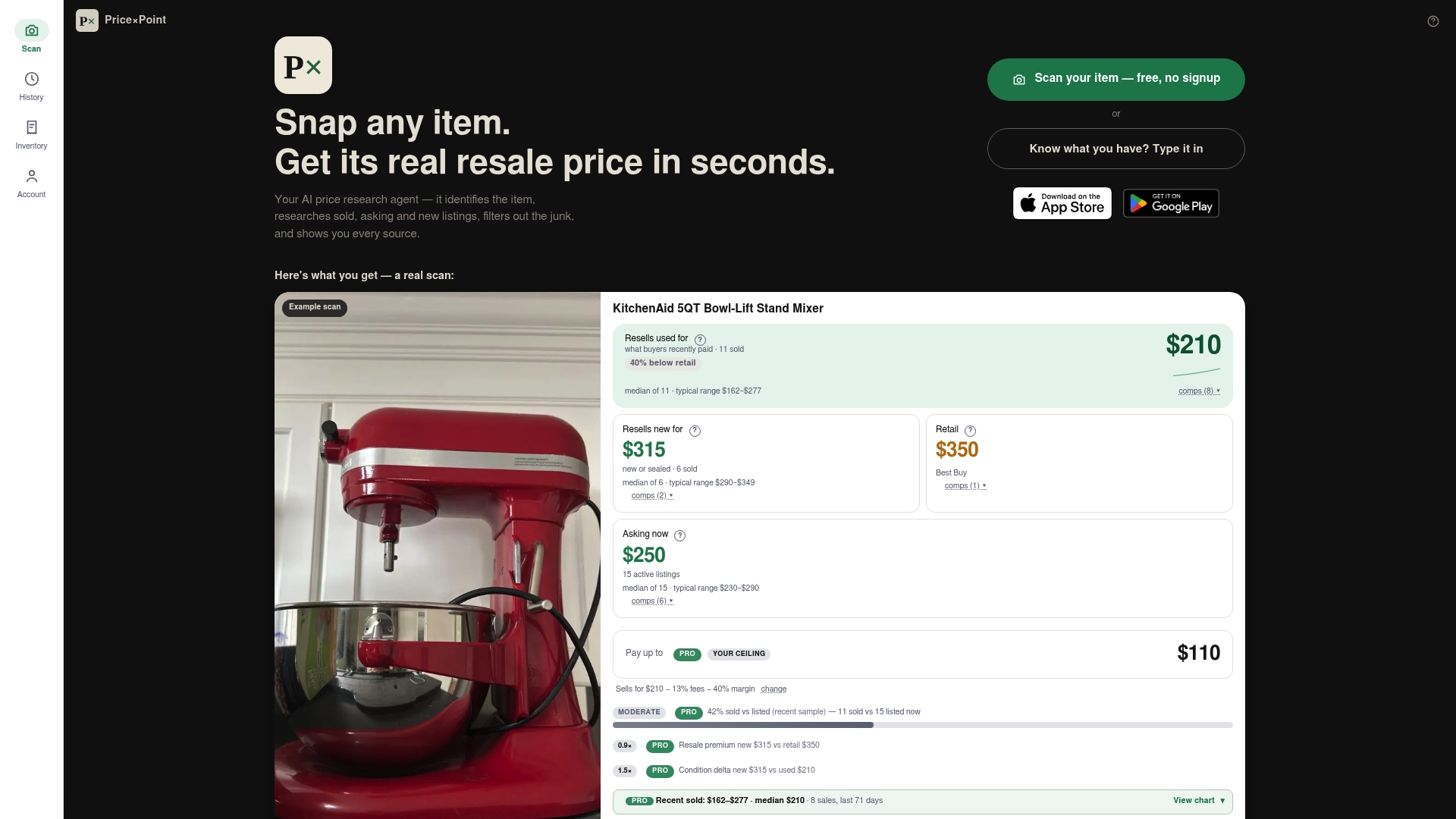
PriceXPoint is an AI price research app. You snap a photo of an item or type its name, and it returns sold, asking and new listing data from multiple marketplaces. It filters out misleading information, and its price estimates are linked to actual sold listings, with every data source named, so you can open the sales behind a number and judge them yourself. If it misidentifies an item, you can verify and correct the identification so the pricing matches what you are holding. It does not provide figures without supporting evidence.

For buyers, that gives you the outside number your ceiling needs before the bidding starts. For resellers, it does the same across a whole haul: bulk pricing works from a CSV or a photo with multiple items, and scan history is saved with export options.
There is a free tier. Paid monthly plans are Basic at $4.99 per month, Pro at $9.99 per month and Power at $24.99 per month. If you prefer not to subscribe, token packs are a one-time purchase: 100 tokens for $5.99, 300 tokens for $12.99 and 1000 tokens for $34.99. See the current options on the pricing page, or browse real sold prices for items people commonly look up.
Our perspective
Shill bidding survives because buyers treat an auction's current price as information about value. It is not. It is information about who is bidding, and some of those bidders may not be real.
We built PriceXPoint around a different source of truth: what items actually sold for. Our price estimates link to real sold listings from several marketplaces, and we name every data source, so you can see the evidence behind a number instead of taking it on faith. We will not give you a figure without evidence behind it.
That matters most at the moment a shilled auction does its damage: when you are watching a price climb and wondering whether to follow it. If you already know what comparable items sold for, the question answers itself. You bid to your number, and if the auction goes past it, you move on.
The same discipline helps every kind of reader we serve. Collectors get a defensible valuation. Resellers get a buy limit that protects their margin. Small businesses tracking the value of inventory over time get data tied to real sales.
PricexPoint
If you sell on eBay
Everything above applies to you in the other direction. Do not bid on your own listings, from any account, and do not ask friends, family, roommates, employees or online contacts to bid on your behalf. eBay's policy covers all of them, and enforcement can include listing removal, warnings, account restrictions and suspension.
The legitimate way to get a better price is to price accurately and list well. Start from sold data, pick a format that suits the item, and write a listing that explains condition honestly. Our guide on how to sell used items for more covers the listing side, and our marketplace fee comparison helps you work out what you will keep after fees.
FAQ
Is it illegal to bid on your own eBay auction?
It is against eBay's rules, which call it shill bidding, and eBay says it is against the law in many places. The legal consequences depend on your jurisdiction. On eBay, the practical risks include removed listings, warnings, restrictions and account suspension.
Do I need to report suspected shill bidding to eBay?
eBay says its systems monitor bidding patterns and that buyers do not need to report suspected shilling directly. Arizona's attorney general advises reporting suspected shill bidding to the platform where it is not allowed. If you lost money to what you believe is fraud, contact your state attorney general's consumer protection office.
What is the difference between sold price and asking price?
An asking price is what a seller is charging right now. A sold price is what a buyer actually paid. eBay's help pages describe similar listings as showing what sellers charge and completed listings as showing what similar items sold for. Use sold prices to judge value.
How can I avoid overpaying if I suspect shill bidding?
Set a maximum bid before the auction heats up, based on several recent sales of the same item, and do not go past it. Save the listing and your bid details in case you need them later. If the price passes your number, walk away.
Can a seller refuse to sell if I win?
A seller who lists an item in an auction is expected to complete the sale. Rules and remedies depend on eBay's current policies and your local law, so check eBay's seller and buyer rules for the specifics of your case before you act.
Sources
- Shill bidding policy | eBay
- Rules and requirements for buyers | eBay
- Pricing your items | eBay
- Internet Auctions | Arizona Attorney General's Office
- Internet Auction: A Guide for Buyers and Sellers | Federal Trade Commission
- Shill bidding in online platforms | Universitat Oberta de Catalunya